
Natural Resources and Environment associate professor Wei Ren leads a project seeking to reveal underground movement of water and chemicals
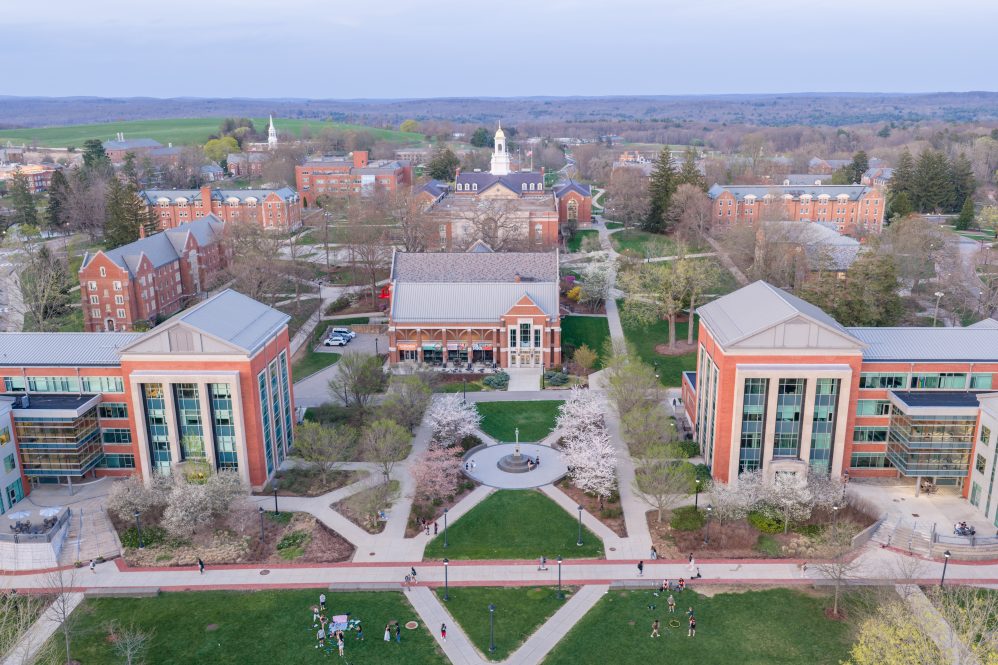
An aerial view spring blossoms across campus at sunset on Thursday, April 16, 2026. (Sydney Herdle/UConn Photo)
A team of UConn researchers is a recipient of a federal Department of Energy (DOE) inaugural Genesis Mission award. The program is designed to double the country's scientific productivity by funding AI-related research projects to accelerate breakthroughs in energy, discovery, and national security.
The DOE announced the first cohort of awardees during Genesis Mission summit on Wednesday, July 22. Wei Ren, who leads the UConn team that awarded one of the initial grants, was on hand in Washington for the announcement of 278 awardees, selected from several thousand applicants nationwide.
"Our project aims to make the invisible visible," says Ren, an associate professor of natural resources and the environment in the College of Agriculture, Health and Natural Resources (CAHNR). "We are building an AI-powered 'digital twin' of the Northeast U.S.-a virtual replica that combines satellite observations, field measurements, and state-of-the-art numerical models to reveal how water and chemicals move above and below the ground."
Three UConn researchers join Ren on the project, which will award $525,000 to the University and $225,000 to the Pacific Northwest National Laboratory (PNNL). Co-PIs include UConn Tech Park and Institute of Environment and Energy Executive Director Emmanouil Anagnostou, civil and environmental engineering assistant Professor Zhi Li, and natural resources and the environment assistant research Professor Bo Tao, and PNNL senior research scientist Glenn Hammond.
"We are excited to leverage the DOE Genesis Mission to advance AI-driven energy and environmental sustainability," says Anagnostou. "Through strategic cross-sector initiatives, we will empower communities, governments, and corporate partners."
The project is entitled an "AI-Enabled Digital Twin Framework for Coupled Surface-Subsurface Hydrologic and Biogeochemical Simulation in the Northeast U.S. Coastal Region." It will create a publicly accessible dataset with numerous applications and strengthen predictive earth system science consistent with the DOE's mission.
"Just as weather forecasts help us prepare for storms, this digital twin will help us better predict groundwater supplies, understand how carbon is transported, protect coastal water quality, and support the safe deployment of emerging clean energy technologies such as geothermal energy and underground carbon storage," Ren says.
Lindsay DiStefano, UConn's interim vice president for research, innovation, and technology, congratulated the research team on the award.
"Our UConn researchers took the Genesis Mission challenge to heart in utilizing AI to accelerate science with impact," DiStefano says. "The team's work shows us parts of our world that were previously unseen, giving us new understanding into how groundwater moves. Such research could lead to breakthroughs in areas like underground carbon storage, sources of clean, renewable geothermal energy, and improve environmental resilience."
In March, the DOE announced that the Genesis Mission would award $293 million in funding for projects to interdisciplinary teams nationwide. The program sought to bring together public, private, and academic researchers to leverage novel AI models and frameworks to address more than 20 national challenges, spanning fields such as advanced manufacturing, biotechnology, nuclear energy, and quantum science.
The projects announced on Wednesday include 142 universities, 157 companies, 13 nonprofit organizations, 16 national laboratories, and 14 other institutions.
"America has no shortage of bold ideas or talented scientists, and the response to the Genesis Mission proves that," said U.S. Secretary of Energy Chris Wright in a statement. "The 278 projects selected today represent the very best of our nation's scientific enterprise. The remarkable number of high-quality proposals we received demonstrates that America's innovation pipeline is strong, and it points to even greater opportunities for future investment and continued expansion of the Genesis Mission portfolio."
DOE leaders said that following the announcement, the awarded research teams can move forward developing and demonstrating AI-enabled scientific workflows.
"The extraordinary response to this Genesis Mission application process demonstrates that America's scientific community is ready to reimagine how discovery happens," said Under Secretary for Science Darío Gil. "Through the Genesis Mission, we are bringing together the nation's leading researchers, institutions, and technology partners to build the next generation of scientific capability. We look forward to seeing these teams demonstrate new research workflows that accelerate discovery and reveal what is possible when AI and science advance together."


