
Seagrass meadows are the unsung heroes of the Great Barrier Reef, quietly storing carbon, sheltering marine life and feeding sea turtles and dugongs. But in recent years, these critical ecosystems have suffered severe losses. Now, a new technology is offering fresh hope for their recovery.
It comes in the form of an underwater robot, custom-built to plant seagrass seeds and help restore meadows. It has now been trialled for the first time on the Great Barrier Reef.
Led by the Great Barrier Reef Foundation in partnership with marine robotics company Ulysses and Central Queensland University (CQU), the trial tested a new approach to one of the Reef's biggest restoration challenges: how to bring seagrass meadows back faster, and across much larger areas.
#Why seagrass matters
Seagrass meadows cover an estimated 35,000 square kilometres of the Great Barrier Reef. These underwater forests play a powerful role in keeping the Reef healthy - absorbing and storing vast amounts of carbon, improving water quality, stabilising sediments and providing food, resting and breeding grounds for marine life.
But climate change, extreme weather, declining water quality and coastal development are taking a growing toll. While seagrass can recover naturally, the pace of damage now often outstrips its ability to bounce back.
Traditional restoration methods, where people collect and spread seeds by hand, remain important, but they are slow, labour-intensive and costly.
CQU's Emma Jackson, the Director of the Coastal Marine Ecosystem Research Centre at Gladstone, said: "The logistical issues with getting seed out onto large intertidal meadows are a real impediment to seagrass restoration at scale. We have to use lots of people to place individual seedballs out on the meadows, which takes a great deal of time and cost."
To meet the scale and urgency of the challenge, new tools are needed. That's where robotics comes in.
"If we can use robots to plant the seeds at high tide, with precision in terms of depth in the sediment and where in the seagrass meadow they're planted, we can significantly reduce the number of people involved in restoration efforts and therefore the cost," Emma said.
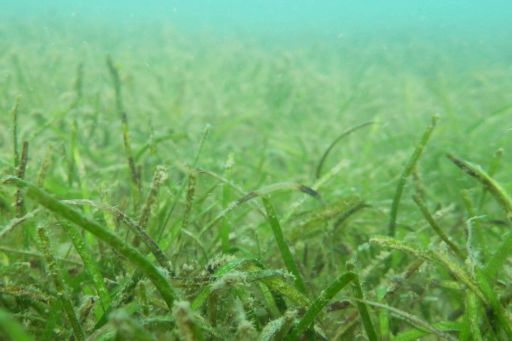
A meadow of N. muelleri, a target species for seagrass restoration. Credit: Ulysses Ecosystems Engineering.
#A new kind of helper
In early 2025, Ulysses began developing an uncrewed underwater vehicle (UUV) with a purpose-built planting attachment designed specifically for seagrass restoration.
Named Mako, the robot can map the seafloor and plant seeds with precision, using small robotic drills to place seeds directly into the sediment.
"The Mako is a modular system which has attachments for all seagrass restoration techniques — harvesting, planting or monitoring — to truly enable seagrass restoration at scale," said Callum O'Brien, Co-founder at Ulysses Ecosystems Engineering.
"For planting, current restoration methods - if they go well - restore five hectares of seagrass per year. We're looking to build a robot that can do five hectares of seagrass restoration per day."
#The seagrass restoration trial
In July, the team gathered in Gladstone for a five-day field trial - the first time this type of robotic seagrass planting had been tested in real Great Barrier Reef conditions.
Will Hamill, Director of Islands and Coasts at the Great Barrier Reef Foundation, said: "Conditions along the Reef can be challenging with murky water, silty seabeds and strong currents. We needed to test that its performance in the field is as strong as its results in the lab."
#Planting the first seeds
During the trial, the Mako successfully navigated low-visibility waters and planted Nanozostera muelleri seagrass seeds into the seabed, proving that autonomous seagrass restoration is mechanically possible under Great Barrier Reef conditions.
The trial delivered several positive results that showed this technology should be explored further:
- Robotic drills could place seeds at the correct depth, quickly and accurately
- Operation was reliable in fast-moving, murky, high-energy waters
- The modular design allowed parts to be easily repaired or replaced Together, these results show how technology could help overcome some of the biggest barriers to restoring seagrass at scale.
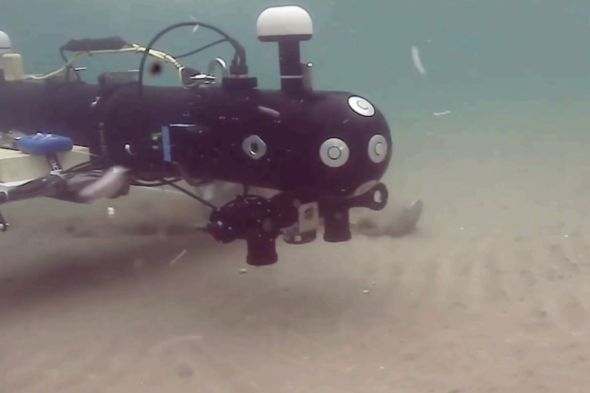
Ulysses Mako UUV driving over the seabed to deliver N. muelleri seeds into the sediment. Credit: Ulysses Ecosystems Engineering.
#Key learnings
Like any first trial, the project also revealed areas for improvement. The team identified challenges around maintaining consistent seed flow as supplies ran low, and ensuring seeds were planted at the ideal depth when sediment conditions changed.
Rather than setbacks, these insights are critical steps forward.
"Identifying and solving these early challenges is how we make restoration faster, more efficient and more affordable, allowing us to move from restoring small patches, to restoring entire meadows at a scale, matching the urgency of the Reef's decline," said Will.
"The future goal is an underwater vehicle that not only plant seagrass, but also collect seeds and monitor restoration sites, that further drastically reduces the time and cost required and finally makes large-scale seagrass restoration financially viable."
"After the success of this trial, we want to keep scaling seagrass restoration in Gladstone and the Great Barrier Reef, and keep forward momentum, by planting larger and larger sites and restore more and more seagrass, and bring life back to this ecosystem," Callum said.


