
With accelerator operations for 2025 having ended on 8 December and the Linac4 source restarting already on 5 January, this year's transition felt particularly short. While there was formally a year-end technical stop (YETS), accelerator activity resumed almost immediately, leaving little sense of a real pause. Nevertheless, many teams made effective use of the short stop, carrying out essential maintenance and selected improvement activities, as outlined in the previous report.
As every year, the CERN accelerator complex is restarting in a carefully sequenced manner, from the Linac4 source through the accelerator complex all the way up to the LHC, together with the attached experimental facilities. Once responsibility is handed over from shutdown coordination to the operations teams, each accelerator follows its established restart sequence: DSO (Departmental Safety Officer) tests to verify the integrity of the safety systems, equipment and control checks, machine checkout, and finally beam commissioning to prepare the beams required for the downstream machines and users.
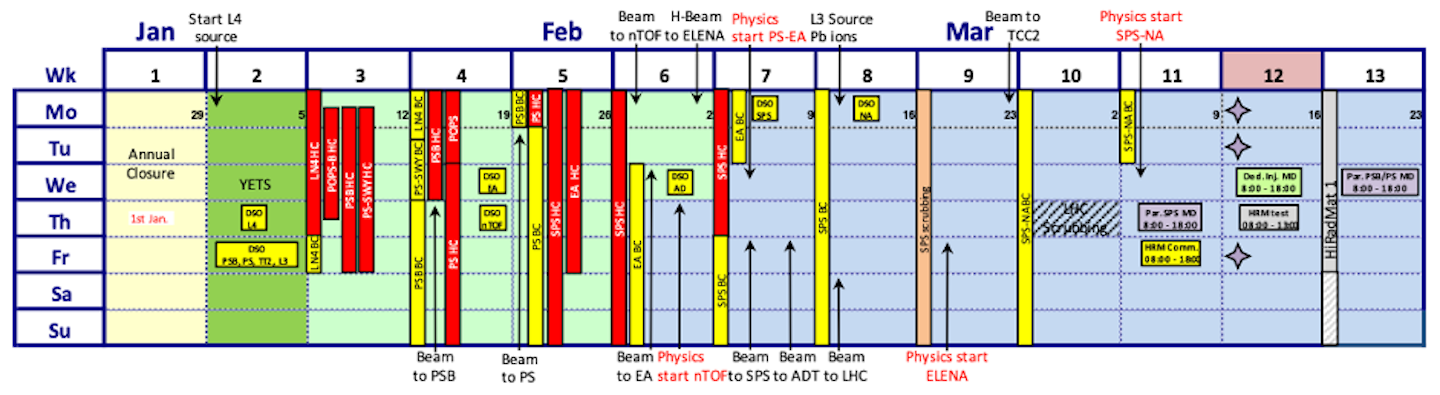
As can be seen in figure 1, Linac4 and the PS Booster have already completed their standalone beam commissioning successfully and have handed over the baton to the PS. The East Area and the SPS are following closely behind. According to the current schedule, the 2026 physics programme will begin on 5 February with n_TOF, followed by the East Area on 11 February.
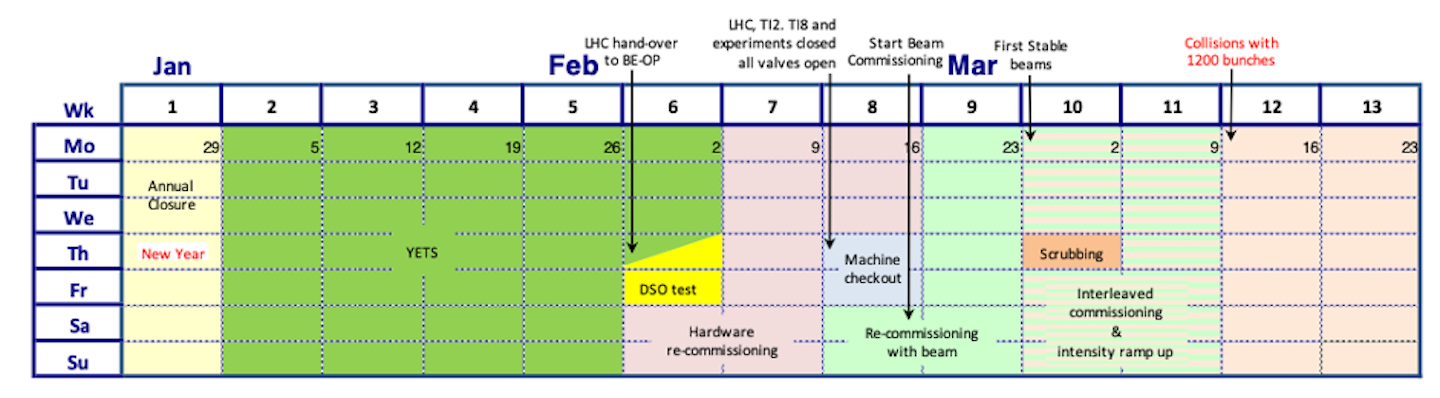
For the LHC (see figure 2), DSO tests are scheduled for the end of next week, followed by around two weeks of hardware recommissioning and machine checkout. This year, the restart falls during the February holiday period, rather than the "notorious" Easter timeframe of previous years, illustrating the squeezed schedule.
Operations in 2026 will bring the Run 3 period to its conclusion, ahead of the upcoming Long Shutdown 3 (LS3). While LS2 focused primarily on the LHC Injector Upgrade (LIU) programme, LS3 will be dedicated to the High-Luminosity LHC (HL-LHC) upgrade, alongside several major projects such as the North Area consolidation, ISOLDE improvements and preparations for AWAKE Run 2c.
Although the official Run 3 target for the LHC of 500 fb⁻¹ of integrated luminosity was already reached by the end of last year, the LHC physics programme continues until 29 June 2026, with ongoing efforts to maximise physics output until the very end of the run. The injector chain will continue delivering proton and ion beams until the injectors' own shutdowns for LS3, which will start on 31 August 2026.
Next week, the annual Chamonix workshop will take place from Monday to Thursday. Discussions will focus on the end of Run 3, preparations for LS3, the staged restart of Run 4 and a broader outlook on CERN's future projects.
Challenging months lie ahead as Run 3 draws to a close and preparations for the next phase intensify - stay tuned!


