
Angus Gillespie has been featuring winery owners and Rutgers experts who support the industry on his local cable TV show
American Studies Professor Angus Gillespie, an expert in folklore who taught at Rutgers for more than 50 years, has a new passion: Promoting New Jersey's growing wine industry and the university's efforts to bolster its success.
Several years ago, Gillespie and his wife, Rowena, were strolling Lambertville's Bridge Street when he found a tourism brochure extolling New Jersey's 60 wineries.
"Who knew?'' recalled a surprised Gillespie, who saw one, Angelico Winery, was nearby, prompting the couple to take a serendipitous detour to the "charming…small scale, friendly'' place.
Gillespie was quickly hooked on a burgeoning hobby he wanted to share with others.
"I think it's safe to say that many New Jerseyans have no idea there's 60 wineries in New Jersey,'' said Gillespie.
According to Garden State Wine Growers Association, the New Jersey Farm Winery Act of 1981 repealed restrictive limits on the number of wineries from less than 10 then to 60 licensed today that have produced approximately 2 million gallons of wine. New Jersey vineyards grow more than 80 varieties of grapes - including leading varietals Chardonnay, Riesling, Cabernet Franc, Cabernet Sauvignon and hybrids Chambourcin and Vidal Blanc - on more than 1,500 acres, totaling $92.5 million in annual tourism expenditures, according to association data.
After obtaining a New Jersey Wine Passport from the association, Gillespie and his wife began visiting other wineries to have the booklet stamped and learn more about the cultivation of grapes (viticulture) and winemaking (enology). He also has been featuring winery owners and other industry experts on his local cable show, "Old Ways in New Jersey,'' which is produced by East Brunswick Television (EBTV) and shared on YouTube for broader viewership.
Gillespie says the link between Rutgers and the winery industry is predicated on the university's "obligation to promote agriculture,'' given the school's roots as a land grant university and the cooperative extension program.

"The heroes of this story are Rutgers Professors Gary Pavlis and Daniel Ward,'' said Gillespie, referring to two of the university's agricultural agents who assist the state's small wine producers. "They're the real people that have a connection to the New Jersey wineries because they are in touch with the winemakers whenever the winemakers have a problem with deer, or birds, or insects, or diseases, or drainage.''
Since 2017, as growing traditional produce has contracted, New Jersey has lost 22,000 acres of farmland, while the increased grape cultivation and winemaking are bright spots, said Pavlis, an agricultural agent at Rutgers Cooperative Extension of Atlantic County.
"The wine industry is keeping the garden in the Garden State,'' said Pavlis, a wine enthusiast, tasting judge, and avid collector himself, who in 1984 started Grape Expectations, an annual educational seminar focused on issues related to viticulture, enology, and marketing.
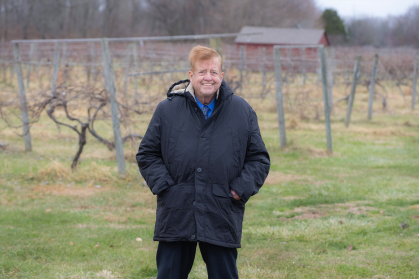
He has played a key role in the development of the state's wineries. Many started after Pavlis spoke to the prospective owners, answering an array of questions like:
"How do you do it? What is it going to cost? What grapes can I grow? What kinds of sites do we need?'' said Pavlis. "All of that, the license process…is something I do…And then I still help wineries with blending.''
Blending grapes helps increase year-to-year consistency in wine quality and taste.
"The art is figuring out how can you make the best wine with the grapes you have,'' explained Pavlis.
How do New Jersey wines compete against better-known counterparts in California, France, Italy, Argentina, and New Zealand?
"People like local,'' said Pavlis. "There is a very good local market here. The Jersey wineries are doing fine.''
For Ward, director of the New Jersey Center for Wine Research and Education at Rutgers who works closely with Pavlis, developing a business plan is key to starting a winery in the state.
"The first thing to know is your market,'' said Ward. "You have to be able to sell it at the time you need, at the price you need. Learn the industry in the state.''

Rutgers Department of Food Science Professor Beverly Tepper, who began a Grape and Wine Science Certificate program and also has a winery, said the state's winemakers "have come very far'' in raising vintage quality.
"Rutgers has so much strength, particularly in the ag area,'' said Tepper. "It just seems like a no-brainer that we should be heavily involved.''
Gillespie, meanwhile, already has visited a dozen wineries, setting up professional tastings to meet and interview winemakers, while his wife Rowena takes photos. His latest cable show features Rebel Sheep Wine Company in Chester, with co-owner and winemaker Dana Ronyack-Davis.
So, after all those tastings, does Gillespie have a favorite type of wine?
"Actually, I'm not too fussy,'' responded Gillespie, who first liked sweeter wines before his palette evolved. "Now, I'm favoring the dry wines."
For Gillespie, whose legacy at Rutgers includes founding the New Jersey Folk Festival in 1975, there also is a folklore aspect to winemaking.
"It's family tradition, it's something handed down father to son, mother to daughter, generation after generation,'' said Gillespie. "That feeds right into my interest in folklife and traditions."


