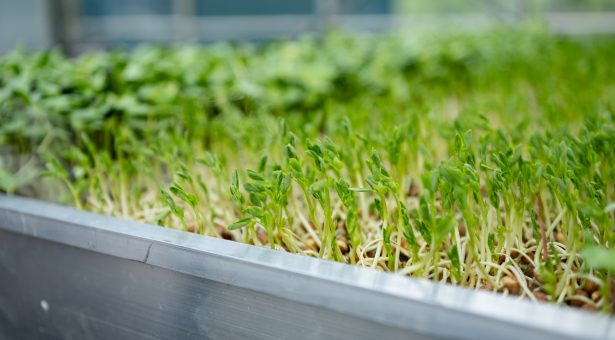
A pioneering research-industry partnership has used advances in indoor farming technology to grow pea shoots fortified with Vitamin B12, opening an exciting route to market for farmers and addressing a major public health need.
The partnership between the John Innes Centre and the Quadram Institute, based at the Norwich Research Park, the University of Bristol, and indoor farm specialists LettUs Grow, harnessed the latest aeroponic techniques to successfully deliver the recommended daily allowance (RDA) of Vitamin B12 within a 15-gram portion of pea shoots.
The fortified salad crop not only exceeded expectations by delivering in excess of the RDA of Vitamin B12 in a single serving of salad: the team also found that the pea shoots maintained their shelf-life and the B12 content persisted through an extended period of cold storage – elements essential for the crop to succeed commercially.
Simulated human digestion experiments carried out at Quadram Institute confirmed that the fortified pea shoots are accessible to digestion, meaning that not only has the crop been successfully fortified with B12, but that this vital nutrient will likely be passed into the bloodstream of those eating it.
The research, which appears in Communications Biology, offers a new commercially viable approach for dietary supplementation of vitamin and nutrient intake that is predicted to work not only in pea shoots, but in other rapid-cycling salad crops grown in indoor farming environments.
More broadly, the project offers a rapid, cost-effective and sustainable solution to the issue of hidden hunger. This is when people receive enough calories but not with the right mix of nutrients necessary to maintain good health. The term hidden hunger is also applied to nutritional deficiencies that may occur in some people taking appetite suppressing drugs.
Professor Antony Dodd, a group leader at the John Innes Centre and corresponding author of the study, said: "This novel fortification method can be done at extremely low cost to growers as a way of providing consumers with a cost-effective way of supplementing their diet with Vitamin B12 in a form that their body can use."
Vitamin B12, also known as cobalamin, is an essential nutrient that plants do not make and which presents a nutritional insufficiency risk for people adopting more vegetarian and vegan diets without supplementation. Symptoms of deficiency can include anaemia, muscle weakness, psychological, cognitive, and neurological problems.
The most structurally complex nutrient, Vitamin B12 is made exclusively by bacteria. Humans acquire Vitamin B12 from animal-based foods in their diet, including fish, meat, poultry, eggs, milk, and other dairy products.
It is estimated that around 6% of the UK population is B12 deficient and a further 44% may have insufficient levels, although many people do not realise they are in nutritional deficit. Globally, B12 insufficiency is common, particularly in populations consuming low amounts of animal-derived foods and in older adults.
Tablet based supplements are widely available, however there are drawbacks: they are easily forgotten and are less effective when taken without food because the process of eating releases enzymes required for nutrient absorption). Furthermore, many people prefer not to take supplements but to receive nutrients as whole foods.
Given these constraints – and with a rise in sustainable plant-based diets – there is an urgent need for alternative, plant-based sources of Vitamin B12.
One problem has been the prohibitive cost of making Vitamin B12 commercially due to its molecular complexity, which makes traditional chemical synthesis impossible. Production requires a vast number of bacteria, making the vitamin the most expensive on the market costing up to £20,000 per kilogramme – which is one third of the price of gold. Currently, around 90 percent of the world's B12 is produced in China.
In this project, the team used aeroponic technology developed by LettUs Grow to supply the roots of pea shoots with a Vitamin B12-fortified nutrient solution delivered within an aerosol.
Using this technology, a thin film of nutrients forms on the roots, and the vitamin is absorbed and taken up by the plant's nutrient transport system. During the eight-day cultivation period, plants were supplied with the most widely available and bioavailable form of B12, cyanocobalamin. Experiments on harvested plants showed that the leaves accumulated more than the quantity of B12 that is necessary to deliver the RDA within 15g of plant material.
The aeroponic method enables control over the application of expensive source vitamins, making production more efficient and cost-effective for commercial partners and consumers.
The team estimated that the additional cost associated with adding B12 into bags of pea shoots (or in bags of salad containing pea shoots) could be less than one penny (1p).
They are now investigating commercial ways of delivering the product and adapting the technique so that it works both in vertical farms and horticultural glasshouses.
First author of the study Dr Bethany Eldridge, who was awarded a BBSRC Flexible Talent Mobility Account (FTMA) and a BBSRC Follow-on Fund grant to facilitate her central role in this research-industry partnership, said: "The beauty of this work is how it marries high tech and low tech in such a cost-effective way. Pea shoots are literal sponges for B12, while vertical farms provide a controllable environment in which we can tailor its uptake by the plants.
"This method diversifies ways of getting B12 naturally into your diet, especially if you are not consuming meat and dairy as vegans or vegetarians, or if you are consuming meat and dairy in smaller quantities as part of a flexitarian diet. Globally B12 levels are in decline and if we can find a variety of ways that we can get it into food in a bio-accessible way, then that is exciting."
Dr Jonathan Clarke, Head of Business Development at the John Innes Centre, and one of the authors of the study said: "The challenge we faced is to find a way to provide a bioavailable source of Vitamin B12 in a vegetarian meal. The solution came not through engineering the plant but by simply exploiting the ability of the plant to take up B12 when applied. It is an innovative, multidisciplinary approach that highlights the strength of the partnership across the Norwich Research Park and its industrial and academic collaborators."
Professor Martin Warren, chief scientific officer at the Quadram Institute and one of the authors of the study, said: "Vitamin B12 deficiency is often framed solely as a concern for people following vegetarian or vegan diets, but the reality is far broader. Across many populations, inadequate B12 intake contributes to what nutritionists call 'hidden hunger' – micronutrient deficiencies that occur even when people consume sufficient calories. Developing practical ways to incorporate B12 into everyday foods, such as these fortified pea shoots, offers an exciting route to improve nutritional resilience. It demonstrates how advances in agriculture and food technology can help address a quiet but significant global health challenge."
Jack Farmer, Head of Research and Development at LettUs Grow, said: "The exciting thing about this project is that it is the first time the enhanced yield potential of aeroponics has been combined with the nutrition enhancement of B12 fortification in a way that can be scaled up to commercial volumes."
Addressing Vitamin B12 deficiency through aeroponic fortification of a salad crop is in Communications Biology
Image – LettUs Grow