A region of Antarctica with one of the greatest potential contributions to reshape the natural world and human society is also the least scientifically understood and explored.
A major new global review paper published today in Nature Reviews Earth & Environment is calling for a coordinated global campaign to study East Antarctica's Wilkes Subglacial Basin, one of the most important regions on Earth for predicting future sea-level rise, containing enough ice to raise global mean sea levels by an estimated three to four metres.
Led by Australian Centre for Excellence in Antarctic Science Chief Investigator, Professor Matt King from the University of Tasmania, the review synthesises findings from geology, oceanography, climate science, satellite observations and ice-sheet modelling to assess what scientists know, and don't know, about the vast ice-filled basin.
The review concludes that major gaps in observations mean scientists still cannot confidently predict how rapidly change could occur or what climate thresholds might trigger large-scale retreat.
"The Wilkes Subglacial Basin is arguably the last unexplored place in Antarctica," Professor King said.
"No ship has ever been within 150 kilometres of the front of one of the key glaciers, the Cook Glacier. There's no in situ mapping data of the sea floor, and we have very limited information about the ocean conditions that could drive future melting."
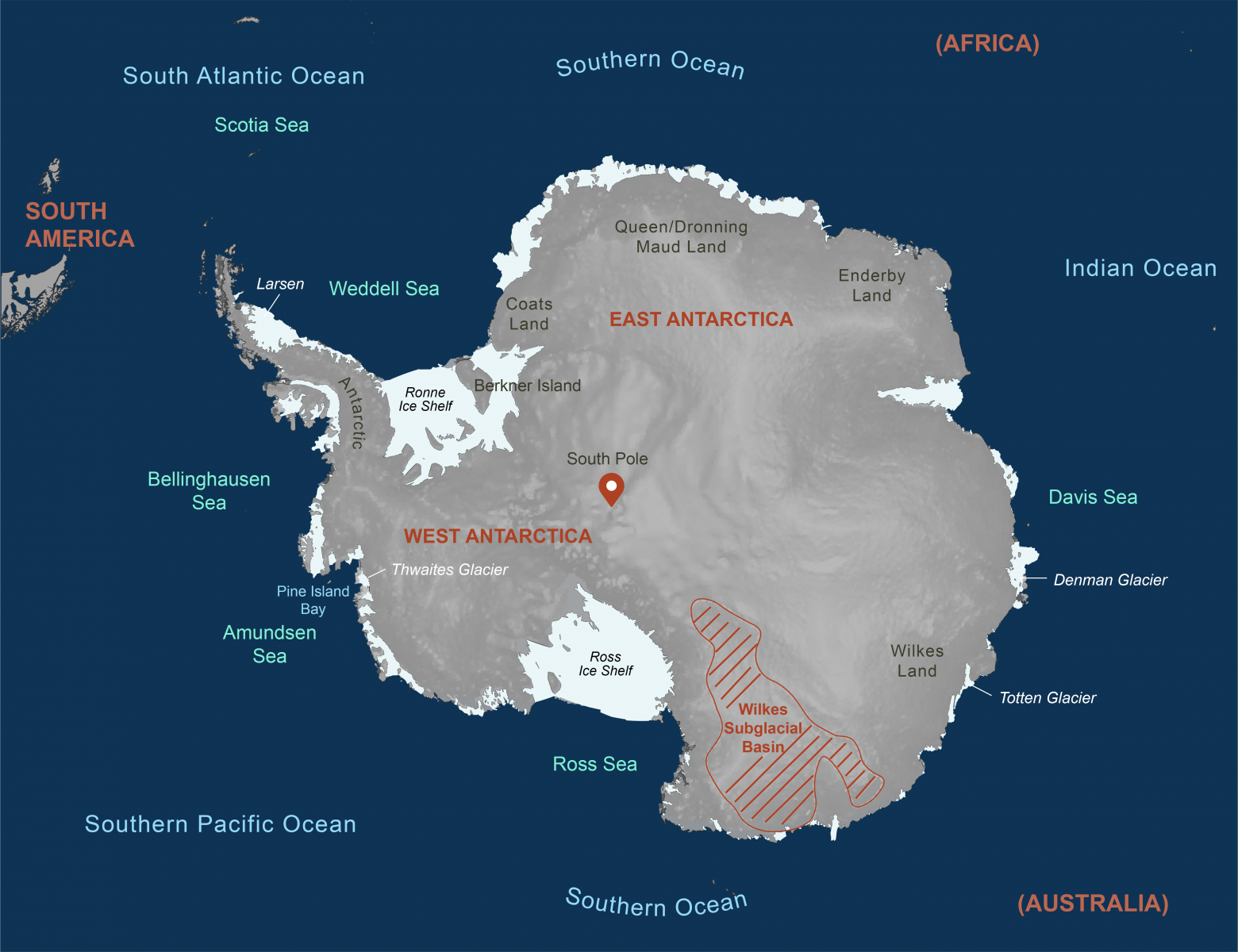
Despite these major knowledge gaps, evidence from geological records suggests the basin, located largely within Australian Antarctic Territory, has undergone substantial retreat during past warm periods, raising questions about how it may respond to future climate change.
"The evidence from past warm periods is enough to ring an alarm bell that this is a region we need to understand much better, but it's hard to find a living scientist who's been there," Professor King said.
The review was co-authored by researchers from 14 countries and calls for an urgent international response to map the region, improve ocean and ice-sheet observations, and reduce uncertainty about future climate and sea-level impacts.
"If we can better understand this region and its trajectory more accurately, we'll be better prepared for future sea-level rise, climate impacts and the consequences for coastal communities and vulnerable infrastructure in Australia, the Pacific and around the world," Professor King said.
Learn more about the Wilkes Subglacial Basin and the review conclusions in this ACEAS article
This work was led by the Australian Centre for Excellence in Antarctic Science (ACEAS) in collaboration with the Australian Antarctic Program Partnership (AAPP) and Securing Antarctica's Environmental Future (SAEF). The research contributes to delivering the Australian Antarctic Science Decadal Strategy 2025-2035.
Cover image: Ice cliffs at Mertz Glacier
Credit: Esmee van Wijk AAD