New report identifies six lessons to improve leadership opportunities for women with disability
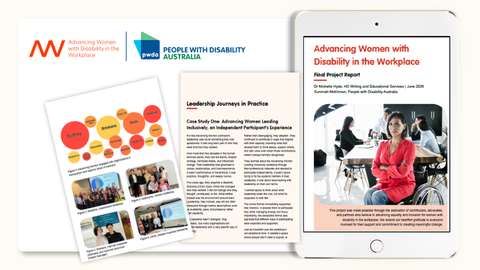
Employers must do more to remove the barriers preventing women with disability from progressing into leadership, with a new report from People with Disability Australia (PWDA), the national disability rights and advocacy organisation, identifying six lessons to help drive change.
The findings come from PWDA's Advancing Women with Disability in the Workplace project, which worked with women with disability and employers over three years to strengthen leadership opportunities and build more accessible and inclusive workplaces.
The national project, which ran from January 2023 to July 2026, reached 107 women with disability, including 46 mentors and 46 mentees, and engaged organisations across nine industries and sectors.
Before participating, 82% of surveyed participants reported experiencing barriers to leadership opportunities, while more than 60% reported low confidence in progressing into leadership roles.
These barriers included inaccessible workplace practices, discrimination, limited opportunities for career development and workplace cultures that fail to recognise the skills and leadership potential of women with disability.
Through mentoring, disability-led education and professional networking, participants reported greater confidence in their leadership abilities, stronger professional connections and clearer career goals.
Mentoring proved particularly valuable, with 71% of post-program survey respondents identifying it as the most valuable part of their experience.
However, the report found that individual leadership development alone cannot overcome the structural and organisational barriers women with disability across Australia continue to face.
Drawing on three years of learning, the report identifies six recommendations to strengthen future programs and support lasting change:
- Strengthen organisational commitment and accountability to create more accessible and inclusive workplaces.
- Expand mentoring and shared learning opportunities to support leadership development and career progression.
- Build stronger professional networks to connect women with disability and create opportunities for collaboration.
- Make leadership development more relevant and accessible to participants' experiences, career stages and goals.
- Adopt flexible, participant-centred evaluation methods to better understand what works and improve future programs.
- Support longer-term pathways to employment and leadership through sustained investment and organisational support.
PWDA's Advancing Women with Disability in the Workplace Project Manager, Summah McKinnon, stated the findings reinforced the need for employers to recognise the leadership potential of women with disability and address the barriers preventing them from progressing.
"Women with disability have the skills, experience and ambition to lead, but too often we're expected to navigate workplaces and systems that weren't designed with us in mind.
"This project has shown what happens when women with disability are given the opportunity to build connections, develop their leadership and be recognised for what they bring. But employers also need to do their part to make those opportunities possible," Ms McKinnon said.
Ms McKinnon, who is herself a woman with disability, said the project had reinforced the importance of creating workplaces where women with disability could progress without having to compromise their wellbeing or hide their support needs.
"We need workplaces where women with disability are trusted, supported and given the same opportunities to lead as anyone else.
"Through this project, we've built a powerful network of women who are supporting one another, sharing knowledge and creating opportunities for the next generation of leaders," she said.
Dr Michelle Hyde, co-author of the final report, said the findings showed that improving leadership opportunities for women with disability required more than individual professional development.
"The women involved in this project demonstrated considerable capability, motivation and leadership potential. What became clear was that the barriers to progression were often embedded in workplace cultures, practices and expectations.
"Mentoring and leadership development can help women with disability build confidence and professional networks, but employers must also examine how their organisations recruit, support and promote women with disability," she said.
The impact of the project was also reflected in participant feedback, with one mentee saying it had opened up new career pathways and left her feeling excited about the next chapter of her career.
While the project has concluded, PWDA says its findings offer valuable lessons for employers, policymakers and organisations seeking to improve workplace inclusion and leadership opportunities for women with disability.
PWDA is calling for continued investment in disability-led leadership development, alongside stronger organisational accountability and practical action to remove the barriers preventing women with disability from progressing in their careers.
Read the full report: Advancing Women with Disability in the Workplace - Final Project Report