
New research using smartwatches shows that older adults can accurately assess how well they are thinking in the moment. The study finds their self-ratings closely match actual cognitive performance.
The research, published in Neuropsychology, assessed real-time mood and cognition in normal, everyday settings.
"Our goal is to understand how people perceive their cognition, or ability to think, and how that compares with how they actually perform using objective test measures," said UC Davis Health neuropsychologist Sarah Tomaszewski Farias, senior author on the paper. Tomaszewski Farias is a professor in the Department of Neurology, director of the UC Davis California Alzheimer's Center of Excellence and the clinical core leader of the National Institutes of Health-funded UC Davis Alzheimer's Disease Research Center.
"We found that people's moment-to-moment impressions of their cognitive abilities were closely aligned with their actual performance. This could help lead to possible earlier detection of cognitive decline and Alzheimer's risk than standard cognitive testing," she said.
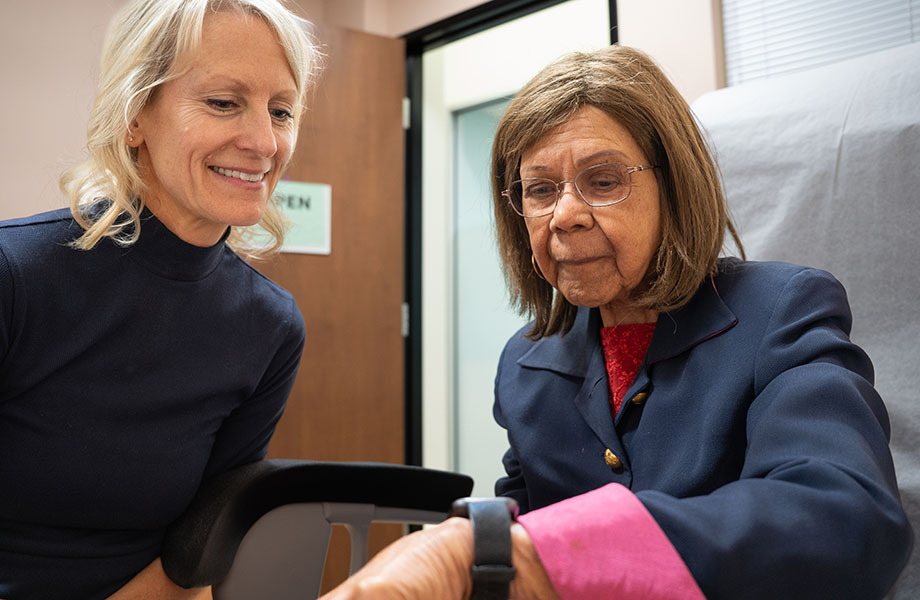
Using smartwatches to prompt real-time cognitive assessments
The study followed 162 older adults, with an average age of around 72. They all had concerns about memory or cognitive changes but scored within normal limits on standard cognitive tests prior to the study.
For one week, the participants received prompts on an Apple Watch four times a day. Each time, they rated their mental sharpness and their mood — such as how stressed, fatigued or depressed they felt. They also completed brief cognitive tasks to measure processing speed and attention directly through the Apple Watch.
Unlike standard testing, which often relies on people recalling how they have felt over weeks or months, this approach captured cognition in real time. It's a method known as ecological momentary assessment.
"Usually, in a clinic or a research setting, we have people do tests and ask them to retrospectively say how much they have problems with their memory. A lot of times, their test results and how they perceive their memory problem aren't correlated," Tomaszewski Farias explained.
In this study, researchers measured both subjective mental sharpness and objective cognitive performance during regular, daily life.
"When the participants were performing cognitive tests and rating their mental sharpness, it was happening throughout their day — whether they were doing chores at home or out shopping. We were capturing their cognition in real time, rather than having them come into a clinic where it's very quiet and in a very artificial contrived environment," Tomaszewski Farias said.
The researchers looked at how closely the participants' ratings of mental sharpness corresponded to their objective performance. They also checked whether the mood ratings interfered with their ability to accurately perceive their level of sharpness.
We were capturing their cognition in real time, rather than having them come into a clinic where it's very quiet and in a very artificial contrived environment."-Sarah Tomaszewski Farias, neuropsychologist and professor, Department of Neurology

Subjective cognitive decline, mood and cognitive performance
The study showed that the people's perception of their mental sharpness in the moment correlated with the actual performance. When participants rated their mental sharpness as lower than their personal average, their cognitive performance on the tests was lower as well — independent of mood, age or contextual factors.
Subjective cognitive decline can also be highly correlated with depression. But the study found that mood did not impact the association between their ratings of mental sharpness and their actual cognitive performance.
"It was exciting to find that the mood didn't play a big role in the relationship between how they felt, how sharp they felt, and how they performed on the cognitive test," Tomaszewski Farias said. "This suggests that measuring subjective cognition in the moment may be more sensitive to objective cognitive performance — and less impacted by depression than measured in the clinic or laboratory."
The study also found that the time of day affected thinking. It showed more sharp thinking earlier in the day. "We often tell patients in clinic to do things that are more cognitively demanding earlier in the day," Tomaszewski Farias added. "This study potentially supports such recommendations."
The real-time subjective assessment could help clinicians better understand patients' everyday cognition. It could also help them better support patients who notice cognitive changes.
The coauthors on this study are Brandon Gavett, Alyssa Weakley and Jaclyn Fox of UC Davis Health; Maureen Schmitter-Edgecombe, Catherine Luna and Shenghai Dai of Washington State University; Matthew Zawadzki of University of California, Merced; and Diane Cook of Washington State University.
This study was funded by the National Institutes of Health (AG066748).


