
A jacuzzi for washing your tomatoes might seem odd, but new research finds that a bubble bath with a constant acoustic sound in the water may be the best chemical-free, gentle method for cleaning agricultural produce and possibly medical instruments and semiconductors.
The results were published March 25 in the journal Droplet.
Agricultural produce is currently cleaned by washing with bubblers for greens or soft brushes for root crops to clean off sediments. Chorine, ozone and peroxyacetic acid are often added to the water as sanitizers.
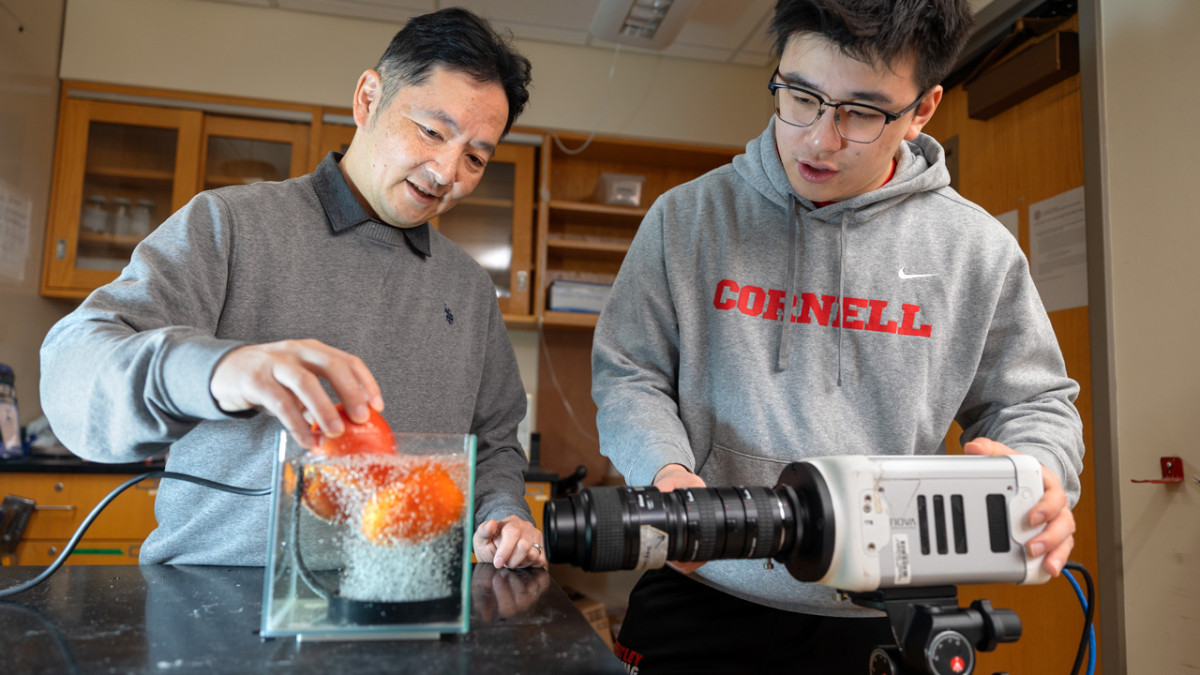
Sunny Jung (left) places a tomato in a prototype bubbler for cleaning produce while Yanny Lin films the experiment with a camera.
The new technique places vegetables in a bath with a bubbler, and then adds a constant acoustic drone at a low frequency with an underwater speaker. The sound creates resonance in bubbles that causes them to vibrate. Vegetables were 90% cleaner when washed with the resonating bubbles, as compared with bubbles without any sound waves or at frequencies that didn't lead to resonance, according to the study.
"There are few options for cleaning soft surfaces," said Sunny Jung, professor of biological and environmental engineering in the College of Agriculture and Life Sciences and the study's senior author. Yany Lin '26, a biological sciences and philosophy double-major in the College of Arts and Sciences and a member of Jung's lab, is the paper's first author.
"It might be one of the best ways to clean a soft surface without using metal, plastic or solid brushes," Jung said. This alternative cleaning method could be refined to help farmers and households avoid harsh chemicals and eliminate surface damage to vegetables and fruits, while saving on the high amounts of energy often needed for traditional cleaning.
"Since this is a newly identified mechanism, it opens the door to additional applications that we have not yet explored, and its sustainable, non-abrasive nature makes it especially promising for cleaning delicate and contamination-sensitive surfaces like semiconductors and medical instruments," Lin said.
The method works because the vibration of the bubbles as they resonate creates a scrubbing action. In the study, the researchers investigated how bubbles of various sizes resonate at different frequencies, with small bubbles resonating at higher frequencies than large bubbles. Optimal frequencies for bubbles of certain sizes, such as 50 hertz for 1.3-millimeter diameter bubbles, amplify a stop-and-go action that improves cleaning.
The researchers tested cleaning efficacy using protein-based artificial soil on glass slides. They generated bubbles with needles to eject air or porous stones pumped with air. Sound was generated with an underwater speaker.
"One takeaway message is that when you are sitting in the jacuzzi, play the music at a low frequency," Jung joked.


