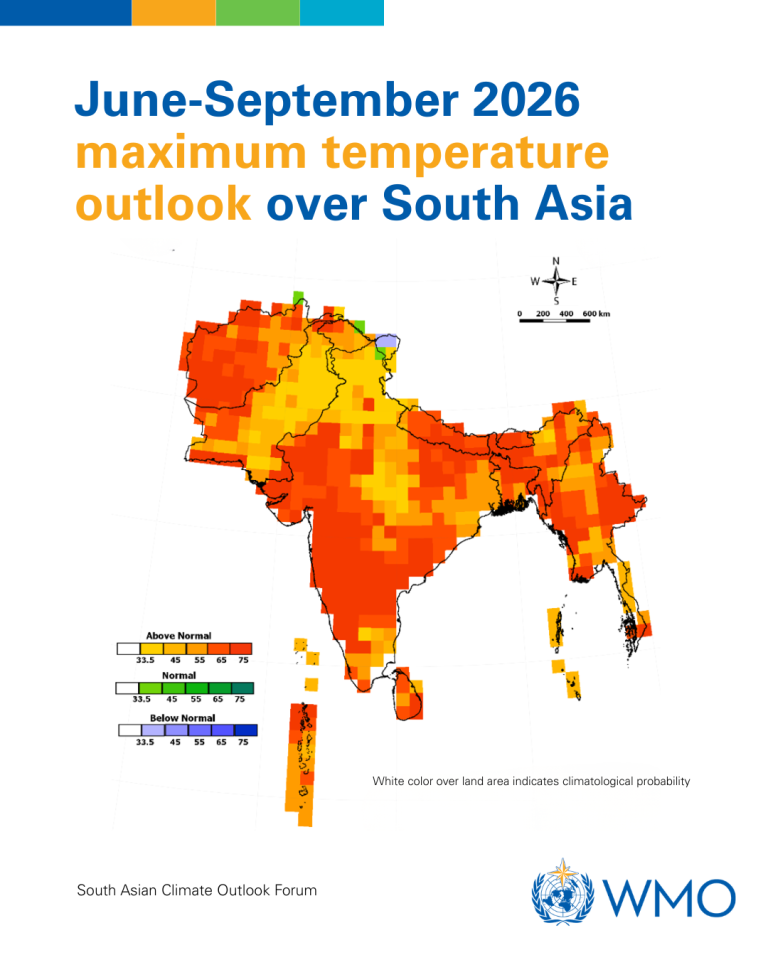
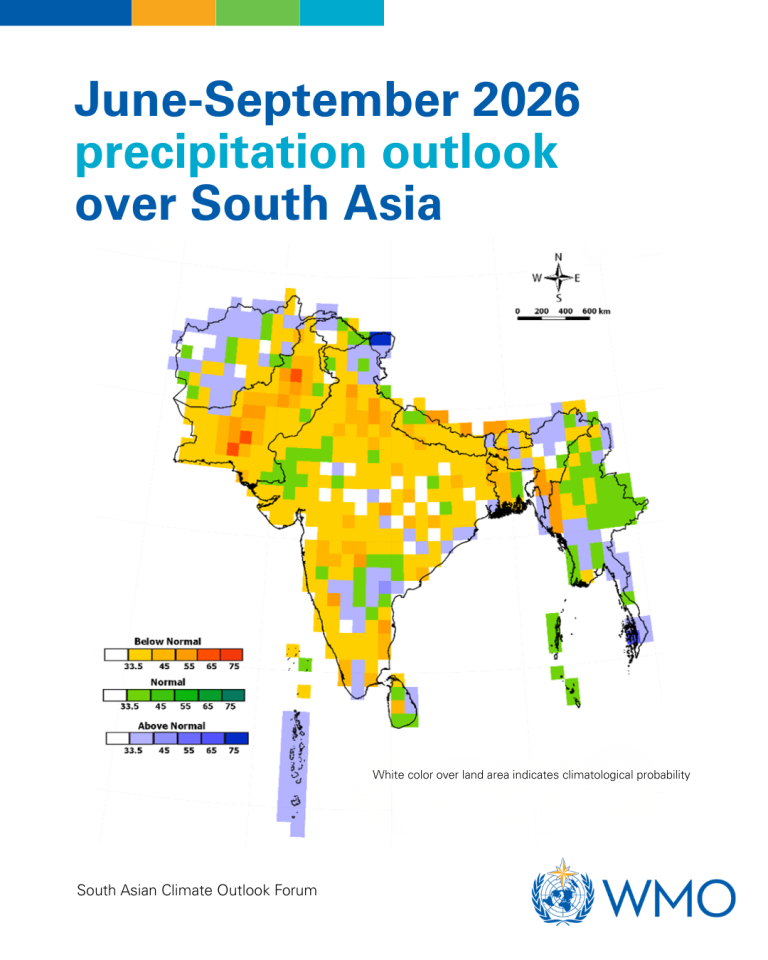
Rainfall is likely to be below normal during the June-September 2026 southwest monsoon season across much of South Asia, with the strongest signal over central regions, according to a new seasonal forecast which will help millions of people prepare.
A few parts of the north-western, north-eastern and southern region are likely to receive normal to above normal rainfall between the May-September monsoon period, according to the South Asian Climate Outlook Forum.
Temperatures - both maximum daytime and minimum overnight ones - are expected to be above normal.
Advance information about the likely performance of the monsoon underpins planning in climate-sensitive sectors such as agriculture and renewable energy (hydropower). It also informs risk management and public health strategies - including heat-health action plans - in the world's most populous region.
Seasonal climate outlooks are one of a suite of products from the World Meteorological Organization community which protect lives and livelihoods, and are worth billions to the international economy. They exemplify the cooperation and data-sharing fostered by WMO to support community and global well-being.
Developing El Niño
The forum, held in Malé, Maldives, brought together nine National Meteorological and Hydrological Services in South Asia, namely Afghanistan, Bangladesh, Bhutan, India, Maldives, Myanmar, Nepal, Pakistan and Sri Lanka.
The forecast is based on an analysis of global climate conditions. There is strong consensus among experts that El conditions are likely to develop during the 2026 monsoon season. In parallel, the Indian Ocean Dipole - which is another key climate driver in the region - is expected to move from a neutral to positive phase.
Although the current spring predictability barrier means that forecasts at this time of year have less certainty, National Meteorological and Hydrological Services will provide nationally-tailored updates to inform decision-making.
From June through September, the Southwest Monsoon dominates life in much of South Asia. Accounting for 75-90 per cent of the annual rainfall in most parts of the region (excepting Sri Lanka and south-eastern India), replenishing water resources like rivers, lakes, and groundwater, which are vital for irrigation and drinking water supplies.
It is the lifeblood of national economies, agricultural production and food security. Below-average monsoon rainfall can trigger food insecurity among vulnerable populations, whilst heavy monsoon-related rainfall and flooding also causes many casualties each year.
WMO Action
WMO is supporting the expansion of multi-hazard early warnings, including flash flood forecasts and drought and water management tools.
The WMO is also working with the World Health Organization and partners to strengthen collaboration between meteorological and health authorities. The new South Asia Heat and Health Hub will serve as the region's central platform for collaboration, knowledge exchange, and policy innovation on heat-related health risks.
In addition, there is a new South Asia Climate-Health Desk, established as part of the WHO-WMO Climate and Health Joint Programme and implemented with the Indian Institute of Tropical Meteorology (IITM), India Meteorological Department (IMD), and other partners.
The WMO Coordination Mechanism (WCM) delivers a Global HydroMet Weekly Scan and the Global Seasonal Climate Outlook Briefing , to support UN and humanitarian agencies in preparedness and early action. These products are even more relevant given the likely development of El Niño.
The monthly briefing on 29 April included a presentation by an expert from the India Meteorological Department / Pune Regional Climate Centre on the southwest monsoon outlook. The session brought together staff from more than 20 UN and humanitarian organizations, and its content is distributed to over 300 recipients.