
How did a large crab end up trapped inside a plastic bottle with an opening smaller than its body? Hiroshima University researchers investigated this unusual marine mystery, revealing a lesser-known impact of marine plastic pollution on crustaceans.
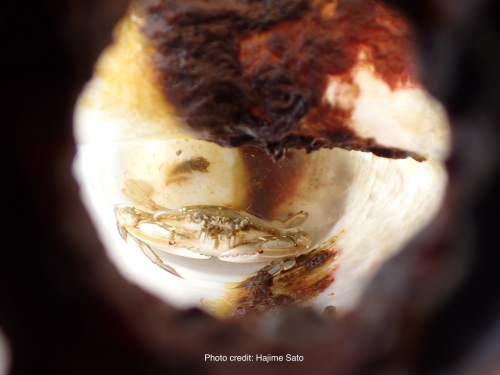
A large, live swimming crab, Portunus sanguinolentus entrapped inside the bottle. (Hajime Sato / Hiroshima University)
Marine plastic pollution is a major and well-known component of pollution in the oceans. Examples of the impacts of plastic pollution on ocean life serve as some of the most evocative demonstrations of the severe negative impacts of plastic pollution on marine animals. Images of seals and seabirds entangled in fishing nets, and sea turtles eating plastic bags are often used for this purpose.
Researchers at Hiroshima University discovered a crab trapped in a high-density polyethylene (HDPE) Shaoxing wine bottle floating on the surface of sea off Okinawa, Japan. Investigations into how the crab came to be trapped and how it managed to survive highlight that the dangers of plastic pollution extend even to smaller marine animals.
Their findings were published in the journal Ecosphere on April 3, 2026.
"During juvenile fish surveys in offshore waters, we happened to encounter a floating plastic bottle approximately 500 m off Sesoko Island, Okinawa, Japan, with many juvenile fish associated with it," say study authors Hajime Sato and Yoichi Sakai. Sato, first and corresponding author of the study, was a doctoral student under Sakai at the time of the study (now a postdoctoral research fellow at the Okinawa Institute of Science and Technology (OIST) in Okinawa). Sakai is professor at Hiroshima University's Graduate School of Integrated Sciences for Life. "[To our surprise], a large live swimming crab, Portunus sanguinolentus, was trapped inside the bottle. The crab was clearly larger than the opening of the bottle!"
The bottle was collected on July 15, 2022. It carried marks identifying it as having been manufactured on November 17, 2021. The bottle was open, allowing seawater to freely enter and leave. The mouth of the bottle was 24 mm in diameter, while the crab inside was 40.31 mm long, 88.23 mm wide, and weighed 42.06 g. Clearly, the crab could not have entered the bottle at its current size, so the researchers investigated how it came to be inside the bottle, and how long it had been trapped there.
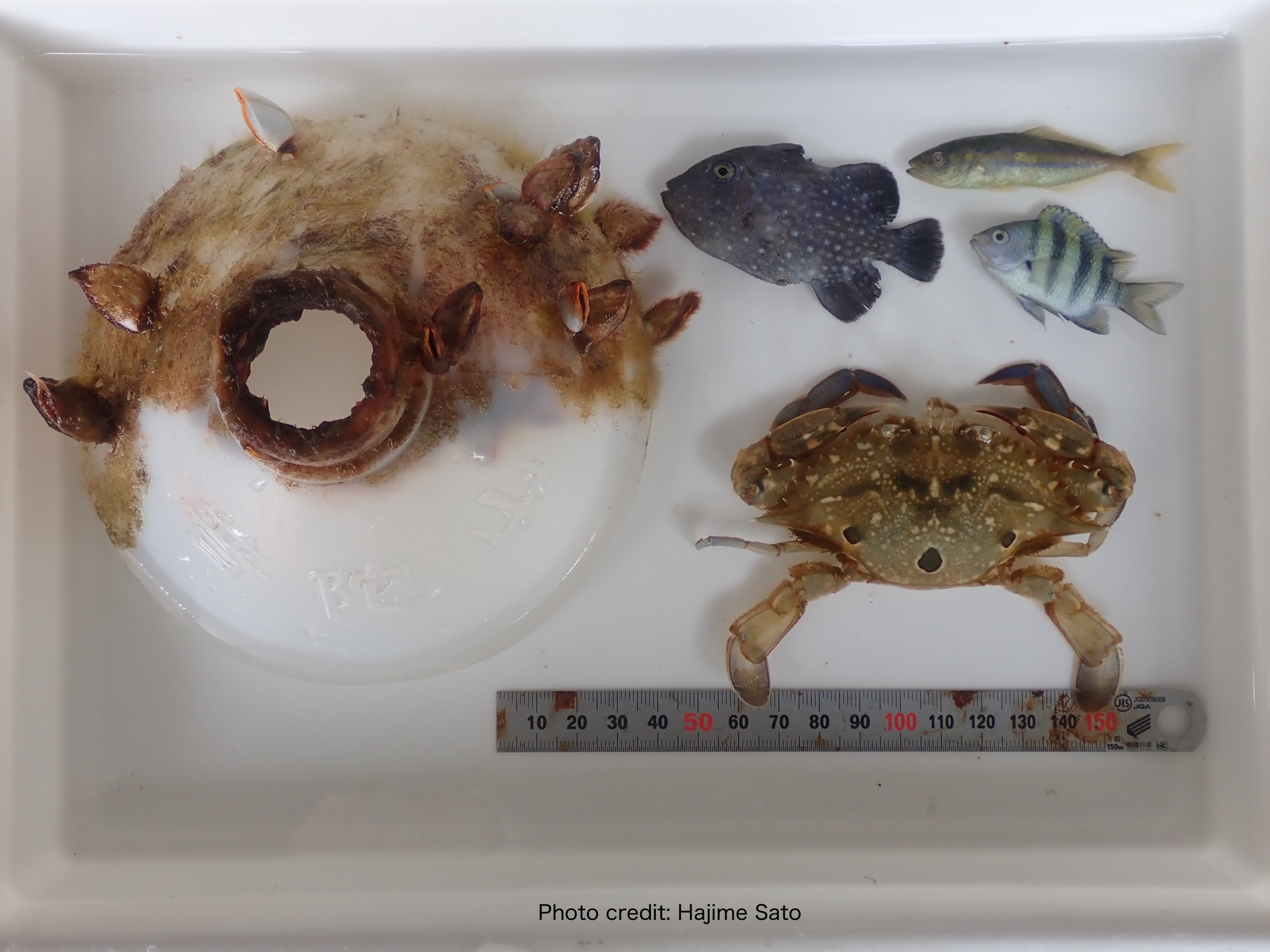
The bottle with attached algae and goose barnacles, juvenile fish collected along with it, and the swimming crab extracted from the bottle. (Hajime Sato / Hiroshima University)
The researchers explained that the study attempted to unravel the mysteries surrounding the survival and growth processes of the crab through various biological analyses. DNA analysis of the stomach contents revealed that the crab had consumed juvenile fishes associated with the bottle, including the rough triggerfish Canthidermis maculata, and the sergeant major Abudefduf vaigiensis, as well as algae that had probably grown inside the bottle. The study also estimated the drifting duration of the bottle from the growth rate of the goose barnacle Lepas anserifera attached to its surface. By combining these lines of evidence, the researchers concluded that the crab had entered the bottle as a juvenile, continued to feed on juvenile fishes and algae inside the bottle for about two months, and finally grew too large to escape.
"This crab reminds us of Salamander, a famous short story by Japanese novelist Masuji Ibuse," the authors said. Salamander depicts the despair of a salamander who, after spending more than two years continuously eating in its burrow, becomes unable to leave because of its growth.
"Plastic bottles discarded by humans can trap crabs and prevent their escape. Similar cases have already been reported from waters around Japan, suggesting that this was not an isolated accident. Through this striking example, we would like readers to recognize that objects that make our lives more convenient can sometimes have unexpected effects on small marine animals, while also appreciating the remarkable vitality of the swimming crab," the authors conclude.
The late Tetsuo Kuwamura at Chukyo University, Nagoya, co-authored the study.
This study was supported by the Sasakawa Scientific Research Grant from the Japan Science Society; and by the Japan Science and Technology Agency (JST) under the University Fellowships for the Creation of Science and Technology Innovation (JPMJFS2129).
About the study
- Journal: Ecosphere
- Title: Swimming crab in a bottle: A two-month drift on the ocean surface while entrapped
- Authors: Hajime Sato, Yoichi Sakai, Tetsuo Kuwamura
- DOI: https://doi.org/10.1002/ecs2.70609
- Date: April 3, 2026


