The scales of a pine cone open in low humidity to scatter seeds, but close in damp conditions to protect seeds from moisture. An artificial material with the same behavior could be useful in applications like moisture-responsive shingles for passive cooling.
MIT researchers have now developed a system that simplifies the process of designing this type of bioinspired material.
Their framework captures how mechanisms across length scales in a natural system, like the cells, fibers, and tissues inside a pine cone, work together to achieve unique properties. It then formally translates that behavior in an engineered system.
The framework organizes biological behavior into building blocks that can be used to design synthetic structures that can be mathematically validated to perform the same way, and fabricated using a 3D printer.
"What really excites me about this work is going beyond bio-inspiration to what we could call 'bio-derivation,' where we move past observing a unique behavior to capturing the relationships and mechanisms that are actually producing that behavior, and then finding a systematic way to translate them into an engineered system," says Lee Marom.
Video: Courtesy of the researchers
By taking much of the guesswork out of this design process, the framework could help engineers more readily create new adaptive materials while cutting development time and eliminating costs from failed prototypes. This framework could one day be used to design soft robotic grippers that respond automatically to their environment without any complex electronics, or morphing structures for airplane wings that predictably change their shape in response to temperature shifts.
"I've always been fascinated with natural materials and how complex behavior emerges from very simple building blocks," says Lee Marom, an MIT graduate student in the departments of Mechanical Engineering and Architecture and lead author of a paper on this framework . "What really excites me about this work is going beyond bio-inspiration to what we could call 'bio-derivation,' where we move past observing a unique behavior to capturing the relationships and mechanisms that are actually producing that behavior, and then finding a systematic way to translate them into an engineered system."
Marom is joined on the paper by corresponding author Markus Buehler, the Jerry McAfee Professor of Engineering in the departments of Civil and Environmental Engineering and Mechanical Engineering; Gioele Zardini, the Rudge and Nancy Allen Assistant Professor of Civil and Environmental Engineering, a principal investigator in the Laboratory for Information and Decision Systems, and an affiliate faculty with the Institute for Data, Systems, and Society; and Skylar Tibbits, an associate professor in the Department of Architecture. The research appears in the Journal of the Mechanics and Physics of Solids .
Biological building blocks
Pine cones can open and close their scales in response to humidity because of complex interactions within the organism's structure.
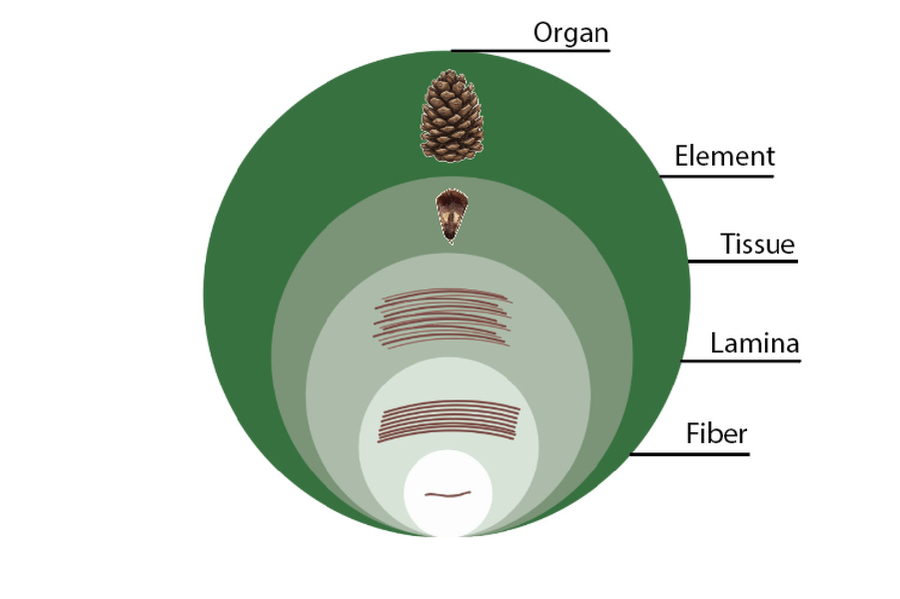
Shifts in humidity cause changes in microscopic cellulose fibers, which then cause transformations in larger groupings of fibers called laminas, which impact tissue layers, and so on, all the way up to the pinecone we see hanging from a tree branch.
"We instantiated the framework on the pine cone because it gives us a relatively simple, well-understood mechanism to demonstrate how the framework works. But its value becomes even greater as we apply it to more complex systems," Marom says.
For engineers, the challenge is not necessarily reproducing an individual behavior, but translating the mechanisms and relationships that produce it across length scales. Without an explicit framework, these relationships need to be reformulated for each new system.
To streamline the material design process, MIT researchers created a mathematical framework that captures how the components at each scale in a natural object work together to exhibit a certain behavior. The framework carries the design all the way to fabrication, translating the engineered behavior into verified manufacturing specifications and executable code that is used to 3D-print the object.
Previous item Next item
"What we were missing was a way to connect the mathematical description of a natural system all the way to its physical realization. The goal of this framework is to make that entire chain explicit so we can reason about what has to be preserved at each step," Marom says.
The framework utilizes tools from category theory, which is a systematic method to compose larger systems from smaller ones in a way that is guaranteed to succeed.
Using category theory, the system maps out how a stimulus, such as humidity, causes a response at each level of the biological hierarchy within an organism like a pine cone. It models each level of the biological hierarchy as a separate building block that is independently validated.
Then the framework constructs a larger system from these building blocks by employing mathematical rules to ensure there is a valid transition between each step in the hierarchy.
It assigns each building block in the natural system to a synthetic counterpart. In this way, the engineered material preserves the stimulus-response interactions that cause the natural organism's unique behavior.
The work extends a research program in Buehler's laboratory spanning more than a decade.
Earlier studies used category theory to describe hierarchical materials and determine when building blocks could be replaced while preserving higher-level function. In subsequent work, Buehler and colleagues introduced "categorical prototyping," using the same mathematics to preserve selected molecular-scale mechanics when translating computational models into large-scale 3D-printed prototypes.
The new framework takes the next step by closing the entire chain, from multiscale biological mechanics, through an engineered realization and fabrication specification, to an experimentally validated, machine-executable design.
"Biological materials derive their extraordinary functionality from relationships that span scales, from molecular and fiber-level mechanisms to whole structures. Category theory gives us a way to make those relationships explicit and transferable. Once that design logic is captured mathematically, nature becomes a library of composable mechanisms that can be translated, recombined, and realized in new material systems," Buehler says.
Compositional structure
"Once we know that the relationships we mapped are valid, we can start recombining them in new ways. That means the framework isn't only describing existing systems, it can also help us reason about ones we haven't built before," Marom explains.
For instance, the engineers mapped the humidity-driven bending behavior in a pine cone and the humidity-driven twisting behavior of a wheat awn as separate sets of building blocks.
Then they combined some building blocks from each to design and fabricate a new type of actuator that exhibits thermal twisting behavior, without the need to do any new design work. When tested, the twisting actuator performed as the researchers expected.
In the future, engineers could use this framework to reliably combine verified components into new, bio-inspired designs for adaptive materials in applications like robotics, biomedical devices, or wearable technology.
"The systematization of our framework allows you to reuse pieces without needing to start from scratch each time, saving a huge amount of computation. That's the real-world payoff," Zardini says.
Now that the researchers have laid the groundwork with this mathematical framework, they can apply it to objects with more complex mechanics. They also plan to incorporate artificial intelligence models into their pipeline to expedite the discovery of new adaptive materials.
"We have shown that the boundaries between disciplines do not matter as much as we think they do. Some of the principles from category theory can be used to guide and empower materials design. These mathematical structures seem to really have no boundaries," Zardini says.
"The larger vision is physical AI: intelligence that can reason in terms of physical mechanisms and then turn those ideas into matter. Here we are beginning to build the infrastructure for that - composable physical knowledge, mathematical rules for determining what can be combined, and a path from a new design concept all the way to machine instructions and fabrication. Ultimately, this could allow AI not only to discover new materials and mechanisms, but to physically realize and test what it discovers," Buehler says.
This research was supported, in part, by the MIT Lemelson Engineering Fellowship, Singapore DSO National Laboratories, and the MIT Generative AI Impact Consortium.