
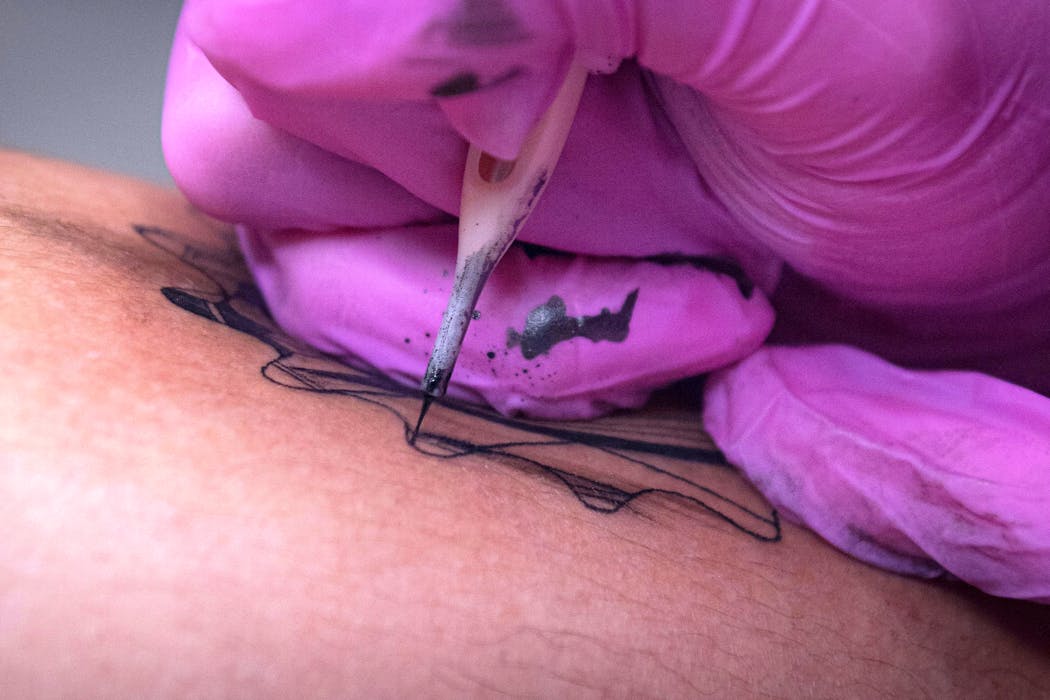
In recent decades, millions of Australians have embraced body art - an estimated 30% of adults have a tattoo. Over a third of those with tattoos have five or more pieces.
Authors
- William Alexander Donald
Professor of Chemistry, UNSW Sydney
- Jake P. Violi
Postdoctoral Fellow, School of Chemistry, UNSW Sydney
Trend reporting from industry and lifestyle sources suggests designs are becoming increasingly large, colourful and complex . Although tattoos have become more common, less attention has been paid to what's in the inks being injected into people's skin.
In a study published today in the Journal of Hazardous Materials , our team analysed tattoo inks available in Australia. We found they contain carcinogenic organic chemicals and toxic metals at levels that wouldn't meet existing European safety standards.
Tattoo ink regulations
Injected into living tissue, tattoo inks are designed to last essentially permanently. Once in the body, pigments can persist, migrate through the lymphatic system or slowly break down over time.
Concerns about tattoo ink composition are not new. In Europe, early guidance on such inks emerged more than a decade ago , and was initially non-binding. As tattooing became more widespread, regulators moved towards stricter controls.
Since 2022, the European Union has enforced binding chemical limits on tattoo inks , restricting metals including arsenic, cadmium and lead as well as specific organic compounds that are known or suspected to be carcinogenic. Tattoo inks that don't comply cannot be legally sold in EU member countries.
Australia doesn't have an equivalent national framework for regulating tattoo ink. There's minimal routine oversight of what tattoo inks contain in Australia, and consumers have limited information available. There's no requirement to perform routine batch testing of inks sold in Australia.
Oversight relies on voluntary compliance, with one government survey released in 2016, and updated in 2018 . That survey found many inks wouldn't meet European guidelines, which at the time were less restrictive than the current EU framework.
Similar issues with tattoo inks have been found in the United States , Sweden and Turkey . Problems included inaccurate labelling, elevated metal concentrations, and in some cases evidence of cellular toxicity in lab tests . While people sometimes have acute reactions to tattoo ink, detecting potential long-term or chronic exposures is much harder.
What we did and what we found
The project began with an interesting question from a high school student. As part of her senior year research project, Bianca Tasevski, then at St Mary Star of the Sea College in Wollongong, contacted the School of Chemistry at UNSW Sydney to ask what was actually in tattoo inks.
To answer the question, we analysed 15 tattoo inks including black and coloured inks sold in Australia. The inks were all from major, established international brands widely used by tattoo artists.
This analysis provides a snapshot of inks currently sold in Australia, and was not intended to monitor batches across locations as a surveillance exercise, which is a role arguably more suited to regulators. Thus, specific brands are not disclosed.
With two standard, widely used laboratory approaches, we measured the concentrations of metals in the inks and screened for a broad range of organic chemicals.
Every ink we tested would have failed at least one EU safety requirement. We detected multiple toxic metals at concentrations exceeding EU law. These include arsenic, cadmium, chromium and lead. Although detected at trace levels, these concentrations are considered unacceptable for tattoo inks by EU regulators.
We also identified organic compounds in some inks, including aromatic amines restricted in EU countries because of their carcinogenic potential .
Some patterns emerged across ink types. Black inks contained a broader range of regulated metals, while brightly coloured inks often contained high levels of specific pigment-associated metals.

Why pigments often contain metals
Ideally, tattoo pigments should be bright, stable and resistant to fading. Metals are particularly important in obtaining such properties.
Metals are not always intentionally included in inks. They can be residues or impurities from pigment manufacturing, or byproducts from incomplete purification.
In our study, we found extremely high concentrations of some pigment-associated metals including titanium, aluminium and zirconium in specific coloured inks.
These metals aren't currently restricted in tattoo ink under EU legislation, but their presence at such high levels is notable because of long exposure times, unknown chemical forms, and unknown effects of chronic exposure.
Ink chemistry is not the same as health risk
We're not toxicologists, and our study doesn't assess health effects. Our work was limited to analysing the chemical composition of tattoo inks. We didn't measure how much of these substances are absorbed into the body, how they behave over time, or whether they cause any harm.
Health effects will depend strongly on many factors including chemical form, dose, exposure time and individual biology. Cancer Council Australia advises tattoos have not been shown to cause cancer , but notes concerns about ink composition.
A number of epidemiological studies have examined potential links between tattoos and health outcomes. However, such studies are challenging to interpret without directly measuring ink chemistry or exposure.
We need better regulation
The findings point to a clear regulatory gap in consumer protection. Many tattoo inks available in Australia wouldn't meet current EU standards and there's no routine system in place to identify or address this blind spot.
A sensible, practical step would be increasing the monitoring of tattoo inks and reviewing Australian standards to align with international best practice. This would improve transparency, provide clearer information to consumers, and reduce unnecessary exposure to hazardous substances.
Tattoos are a form of self-expression that many Australians value. As with other products that are injected into the body, knowing what they contain is a reasonable starting point for oversight and informed decision-making.

William Alexander Donald receives funding from the Australian Research Council, National Health and Medical Research Council, Department of Education, icare Dust Diseases Board, Coal Services NSW Health & Safety Trust, and several industry research contracts, however none are related to tattoo inks or the tattoo industry. He is an advisor to Preview Health and Mass Affinity. He is president of the Australian & New Zealand Society for Mass Spectrometry.
Jake P. Violi does not work for, consult, own shares in or receive funding from any company or organisation that would benefit from this article, and has disclosed no relevant affiliations beyond their academic appointment.


