
The research study "Transformative Narratives for Global Justice: Hate Discourse, Responses and Horizons of Change" was presented in Barcelona on 14 October. The event also served to discuss and understand how social narratives shape the way we imagine and construct our reality.
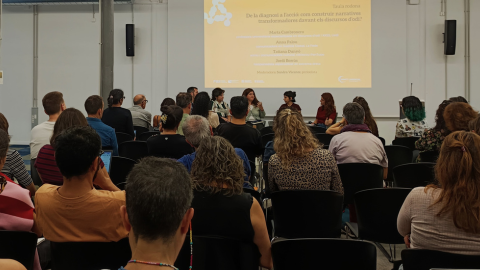
The UOC's headquarters in Barcelona hosted the first debate day of the Laboratory for Transformative Narratives for Global Justice last Wednesday, an initiative by the Open University of Catalonia (UOC) and the Solidarity Foundation of the UAB (FAS-UAB), with the support of the Catalan Agency for Cooperation for Development (ACCD), as part of the UNIACT! project.
The gathering brought together institutional representatives, researchers, communication professionals, social organisations, and individuals interested in the challenges posed by hate speech and anti-rights narratives; it marked the beginning of a shared process to understand how social narratives shape the way we imagine and construct our reality.
The event opened with an institutional welcome from Manel Jiménez, vice-rector for Alliances, Community, and Culture at the UOC; Virginia Luzón, vice-rector for Communication at the UAB; and Gerard Graells, director of the ACCD, who highlighted the need for spaces for research, dialogue, and experimentation that strengthen democratic coexistence and the defense of fundamental rights.
Next, Ronald Sáenz-Leandro (UOC) and Àsia Selma (UAB), researchers at the Lab, presented the study on "Transformative narratives for global justice: hate speech, responses and horizons of change", which highlights a key imbalance: while the tools for detecting and monitoring hate speech have advanced significantly, there is still little evidence on which transformative responses actually work. The study also shows how these narratives are increasingly circulating in audiovisual, humorous or aspirational formats, beyond the platforms traditionally studied. Júlia Pírez, cooperation coordinator at FAS-UAB, and Sonia Herrera, the project's principal investigator, presented the Laboratory as a space that connects research, experimentation and co-creation to build narratives that reinforce human rights and global justice. The Laboratory's branding and website, which contains all the information, resources and activities, were also presented.
After a short break, the round table "De la diagnosi a l'acció: com construir narratives transformadores davant els discursos d'odi?" [From Diagnosis to Action: How to Build Transformative Narratives in the Face of Hate Speech?]—moderated by journalist Sandra Vicente—brought together Marta Cambronero, UAB lecturer and expert on hate speech and social media; Anna Palou, communicator specialising in Global Justice at La Fede; Tatiana Dunyó, actress and cultural communicator from the collective PanTube; and photojournalist Jordi Borràs, leading figure in the analysis of the far-right. The participants discussed the limitations of strategies based solely on data and counter-narratives, as well as the importance of crafting stories capable of connecting with emotions, everyday experiences, and hope—resulting in an engaging dialogue shaped by diverse perspectives.
The event concluded by announcing the Laboratory's next activity: the Co-creation Conference, scheduled for 26 November at the UAB, a multi-stakeholder gathering to begin collectively experimenting with transformative narratives.


