
The Technical University of Munich (TUM) and Tsinghua University in China have renewed their flagship partnership and are expanding their long-standing strategic collaboration. The agreement provides the institutional framework for deepening cooperation in research, education, and innovation, and underscores the role of both universities as global actors in science and technology.
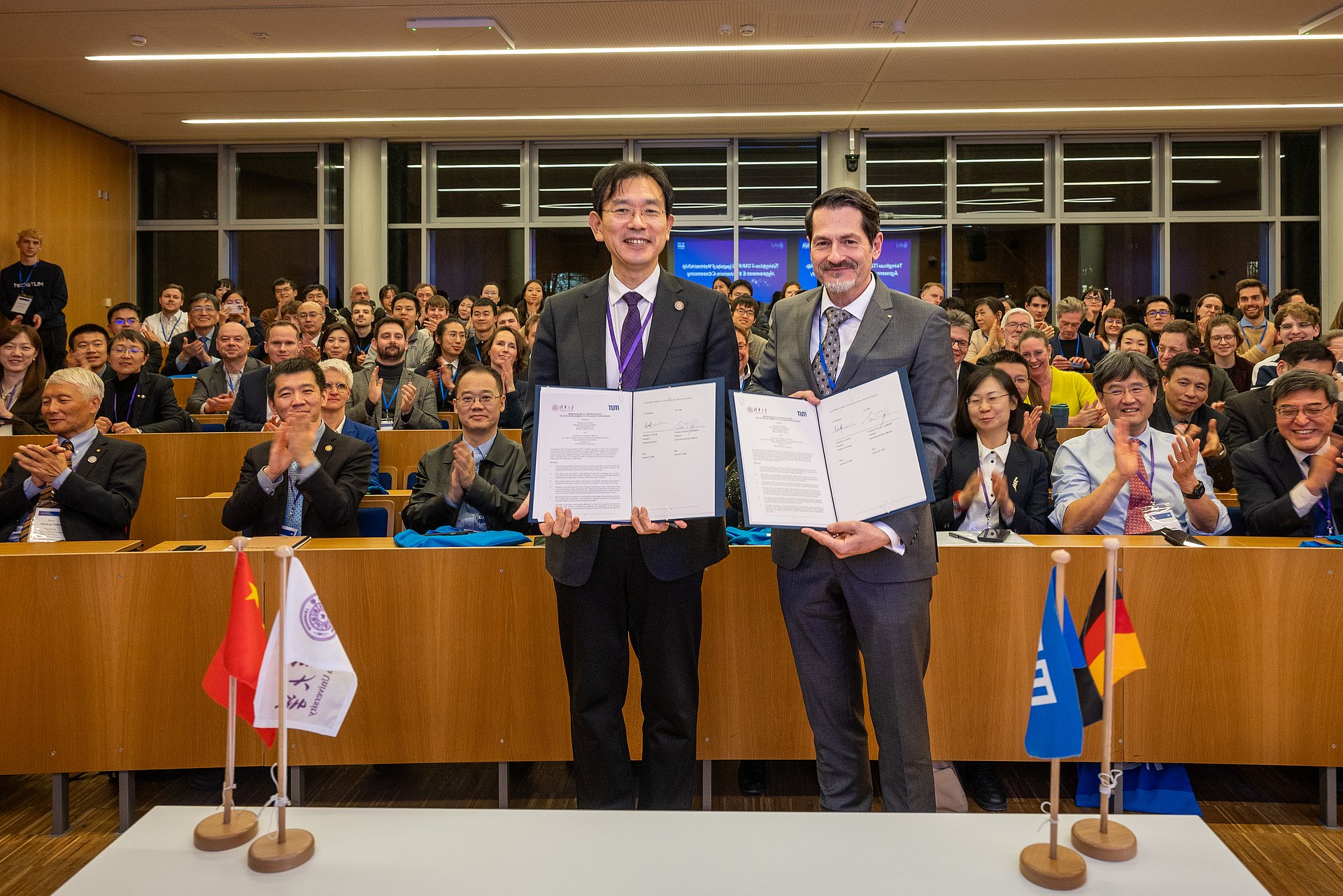 Andreas Heddergott / TUM
 The two leading universities from Germany and China aim to further develop their collaboration into a global ecosystem for transformation and knowledge exchange. The expansion of the partnership was formally sealed during a high-level delegation visit to Munich and Garching, led by Tsinghua President Prof. Luming Li. In addition to the ceremonial signing, discussions focused on future strategic direction and the further development of joint initiatives.
Educating Global Leaders
TUM President Prof. Thomas F. Hofmann expressed his great pleasure at the expansion of the flagship partnership concluded in 2020:
"At TUM, together with our partners at Tsinghua University, we share the goal of educating the next generation of leading scientists, societal and political leaders, and entrepreneurial talent - individuals who think unconventionally and bring new technologies into the world to effectively address global challenges. As leading universities, we bear the responsibility of linking innovation and sustainability."
Prof. Luming Li emphasized: "Tsinghua University has always pursued an open educational philosophy and actively engages with partners around the world. We hope that, together with the Technical University of Munich, we will further deepen research and innovation cooperation on international topics such as sustainable development and climate change, while continuing to expand collaboration in student exchange and academic visits."
New Priorities for the Next Phase of Cooperation
In the upcoming term of the partnership, TUM and Tsinghua are setting new thematic priorities. A central focus is the expansion of the Tsinghua-TUM Joint Center for Global Transitions, which addresses climate change, health, and CO₂ neutrality. The center is intended to serve as an interdisciplinary platform for research and societal dialogue - both digitally and at potential locations in Beijing, Shenzhen, or Munich.
In addition, both universities are planning targeted seed-funding programs and the establishment of a joint visiting professorship to initiate new interdisciplinary research initiatives. Innovative formats for the joint education and supervision of doctoral candidates are to be tested and further developed. Researchers from both universities are also strengthening their collaboration in multilateral networks such as the Carbon Neutrality and Energy System Transformation (CNEST) network. Cooperation in innovation and entrepreneurship is likewise being expanded, for example through the established TIE² - Asian Venture Program .
Successful Measures and Established Structures
In recent years, TUM and Tsinghua have built key structures that lend stability and visibility to the partnership - even in an increasingly complex geopolitical environment. With locations in Beijing and Shenzhen, as well as a strong Chinese student body of around 4,000 at TUM, the collaboration has become a resilient, institutionally anchored platform. It stands as a model for values-based, open academic cooperation that contributes to addressing global challenges.
A key role is played by TUM's offices in China: The TUM Beijing Liaison Office is located at Tsinghua University and serves as a central point of contact for academic networking and project development. The TUM office in Shenzhen, based at the Tsinghua Shenzhen International Graduate School (SIGS), particularly supports cooperation in research, innovation, and technology transfer in the Greater Bay Area - one of the world's largest economic regions on China's southern coast - and strengthens TUM's long-term presence in China.


