
On 20 and 21 April 2026, the Facultat of Education was the headquarters of the first meeting of the FRIDA project, an initiative to foster the to foster the agency of girls and women with disabilities who belong to culturally minoritised groups, funded by the European Union's Horizon Europe Marie Skłodowska-Curie Actions programme. The meeting included members from eleven countries.
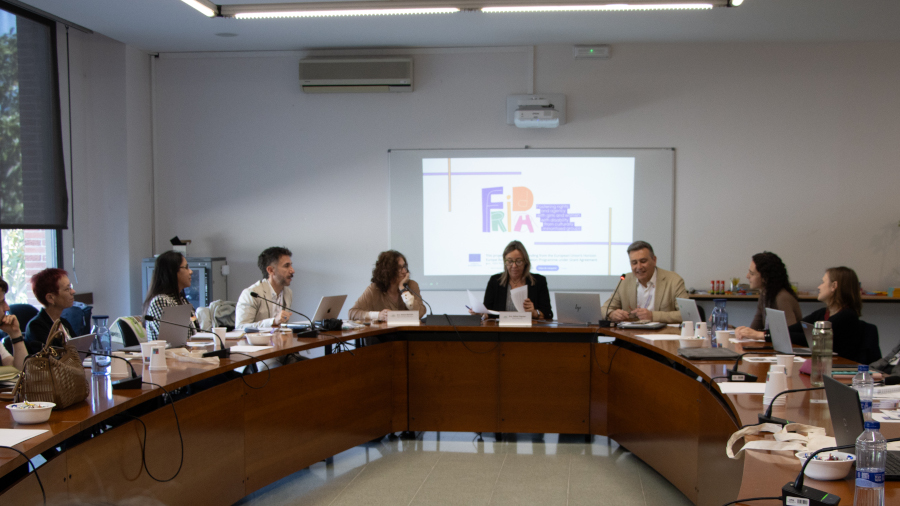
On 20 and 21 April the Universitat Autònoma de Barcelona (UAB) hosted the first meeting of the European project FRIDA (Fostering Rights and Agency with Girls and Women with Disability from Culturally Minoritised Groups), funded by the EU's Horizon Europe Marie Skłodowska-Curie Actions programme. The meeting was held at the Board Room of the UAB Faculty of Education.
The welcoming event included Esther Zapater, secretary general of the UAB; Marta Bertrán, dean of the Faculty of Education; and the coordinators of the FRIDA project, Josep Maria Sanahuja and Mario Montero, from the Centre for Research and Studies for an Inclusive Society (CERSIN).
For two days, participants worked on different areas of the project, such as the fundamental rights and agency (the real capacity to make decisions about one's own life) of girls and women with disabilities who belong to culturally minority groups. They also focused on their priorities, community services, good practices in inclusive research, training, communication, and the dissemination, and management and networking in this sphere.
The FRIDA project has a consortium formed by 15 entities, 10 academic and 5 non-academic, from 11 countries in Europe, South America and Africa. For the project coordinators, "the international, interdisciplinary and intersectoral nature of FRIDA will have a significant impact on the participants and their local contexts, which will favour the acquisition of new skills and knowledge that will contribute to their professional and personal development".
Among the main expected results of the project are the development of an international comparative report on the rights of girls and women with disabilities from an intersectional perspective, as well as the design of a set of tools aimed at professionals to promote their agency in the educational, work and family spheres. The project also foresees the creation of an interactive digital platform to make visible and denounce situations of oppression and to share and respond to the priorities expressed by these girls and women. In addition, FRIDA will include recommendations aimed at policymakers and the research community to optimise community resources and promote inclusive research projects through innovative actions that strengthen the agency of girls and women with disabilities from culturally minoritised groups.


