
Students are learning to evaluate AI, faculty are redesigning courses, and a digital makerspace and AI studio are planned for fall 2027.
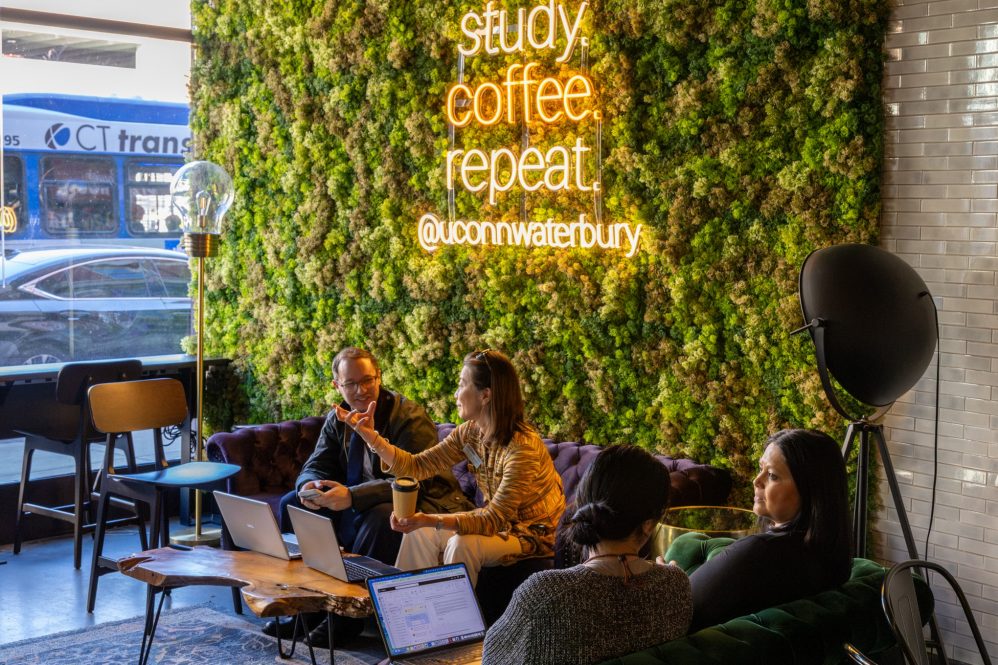
UConn Waterbury's Spirit Café is where the AI Café began in fall 2025, bringing faculty and staff together to explore and experiment with AI. (Photo: Steve Bustamante)
This fall, students in UConn Waterbury's AI literacy course are learning to check what an AI tool produces before relying on it. In the Ideas + Impact Learning Community, students are using AI to develop and pitch solutions to community problems. The work is part of UConn's university-wide AI for ImpaCT initiative. Both efforts reflect the campus's guiding idea, "AI+. Human Potential. Amplified."
Starting with Human Potential
Waterbury's Neurovariability Initiative, launched in 2025, brings together educational neuroscience, learning science, Universal Design for Learning (UDL), and responsible AI. Its premise is that courses and technology should adapt to the natural variability of human minds.
"Students differ in how they pay attention, how they read and how they learn. Those differences are a natural part of being human and often come with strengths that students do not always get to use in a traditional classroom. Our goal is to design courses and technology with that variability in mind, so that the student is not the only one who has to adapt," says Arash Zaghi, a professor in UConn's College of Engineering.
With support from the College of Liberal Arts and Sciences (CLAS), Waterbury adapted Zaghi's AI4ALL model for a three-credit AI literacy course for students outside engineering. Both sections enrolled beyond capacity this fall. Students learn when AI is useful, how to validate what it produces, where it can fail, and when to rely on their own judgment.
For a campus serving many first-generation and Pell-eligible students, offering the course outside engineering gives students across disciplines a chance to build those skills.
Faculty and Staff Investment that Reaches Students
Waterbury's AI Café, launched in fall 2025, is now AI Café Plus. Ten faculty and staff members, including adjunct faculty and graduate assistants, were selected as AI Fellows to participate in this fall's program.
Participants have been testing AI tools and recently took part in a hands-on Collage AI workshop. They will also work with UConn's Center for Excellence in Teaching and Learning (CETL) and CAST on responsible use, accessibility, and inclusive teaching, as well as help design the Waterbury AI institute to take place next spring break.
The CREATE Faculty Innovation Awards support course redesign around undergraduate research and AI. CREATE stands for Creatively Reimagining Education to Advance Teaching and Engagement.
"We want to foster a culture in which faculty can think expansively about what AI makes possible for teaching and learning. CREATE gives them the support to rethink courses and assignments around how students learn best, and to turn their pedagogical ideas into experiences they can actually bring into the classroom," says Silvia Clement-Lam, associate director of research and assistant research professor at UConn Waterbury.
The first three AI-focused awardees have redesigned courses in Allied Health Sciences (AHS) and English. Aviana Rosen, an assistant professor-in-residence of AHS, is building AI-supported scientific inquiry into her research methods and writing courses. Ellen Carillo, a professor of English, has built a writing studies unit on AI and authorship. Pablo Kokay Valente, an assistant professor in AHS, has redesigned his Introduction to Infectious Diseases course so students first reason through clinical cases, then ask AI for a critique and verify its feedback for themselves.
"I've found it a necessity to not just teach students about AI; but teaching them how to decipher when AI belongs in the research process and in the classroom by comparing tools critically, verifying output, and recognizing when their own expertise and judgement should take the lead," says Rosen.
Building Ideas with the Waterbury Community
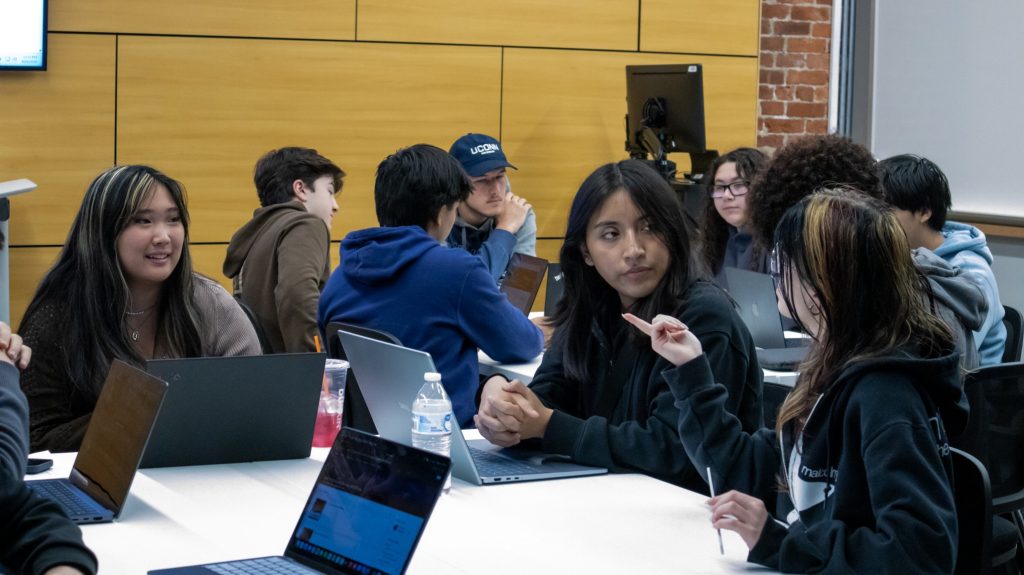
The Ideas + Impact (I+I) Learning Community, which launched in fall 2024 with support from UConn Waterbury alumnus Mike Peluso '99 (BUS), brings students from different disciplines together around entrepreneurship and community problem-solving. Peluso continues to mentor students in the learning community.
This fall, students are incorporating responsible AI into their research, idea development, and final pitches. Each student team receives a $4,000 budget and, if its idea is deemed feasible, can choose to put it into action. Campus leaders are also exploring whether business advising could operate alongside the planned digital makerspace and AI studio. The space would give students and local entrepreneurs a place to develop and test ideas together.
"What makes Waterbury powerful is that students can learn entrepreneurship by working on real problems in a real city. If you put AI, making, business expertise, and community partners in the same ecosystem, students are not just studying innovation; they are participating in it. That is exactly the kind of experience employers and communities need," says Mike Peluso, a UConn Waterbury alumnus, advisor to the campus dean, and I+I mentor.
"AI Café Plus and I+I give us an opportunity to approach AI from both sides of the campus experience. With faculty and staff, we're building confidence and capacity to apply AI to real challenges across our work, teaching, research, and campus operations. With students in I+I that I lead, we're introducing AI as a tool for problem-solving, creativity, and developing ideas that could make a meaningful impact both on campus and throughout the greater Waterbury community. In both spaces, the goal is the same: to move beyond simply talking about AI and create opportunities to learn by using it," says Alexander Ali, assistant director of Student Services at UConn Waterbury and co-founder of the AI Café.
From Learning About AI to Building with It
The Neil O'Leary Building already houses health simulation labs and the Waterbury Robotics Institute. UConn's COR²E Brain Imaging Research Core (BIRC) is helping develop the Waterbury Education, Science and Translation hub (BIRC-WEST) there. Researchers from UConn Waterbury, UConn Storrs, and Yale have begun using the space ahead of the hub's planned full launch in fall 2027. Its newly arrived Hyperfine scanner is Connecticut's first portable MRI intended for undergraduate education. Plans also include a CAVE, a room-sized virtual reality environment, along with additional facilities and equipment.
Innovate Labs, a digital makerspace and AI studio being developed with the School of Business, is scheduled to open in fall 2027. David Bergman, the school's associate dean for faculty and research and special advisor to the provost on AI, is helping plan the space and explore business advising to help students and local entrepreneurs develop and test ideas.
"Waterbury students should not have to leave their campus to engage with advanced research and immersive technologies. BIRC-WEST gives us an opportunity to bring sophisticated, state-of-the-art tools directly to Waterbury and, in doing so, create opportunities for UConn researchers across Storrs and the regional campuses to connect with AI, experiential learning, health, and real-world research questions," says Nabin Koirala, director of BIRC and associate research professor of Psychological Sciences.
"We want students to take an idea from the classroom to a working prototype and understand what it would take to put it into practice," says Bergman. "Bringing business expertise into Innovate Labs could help students and local entrepreneurs test their assumptions and develop solutions that meet real community needs."
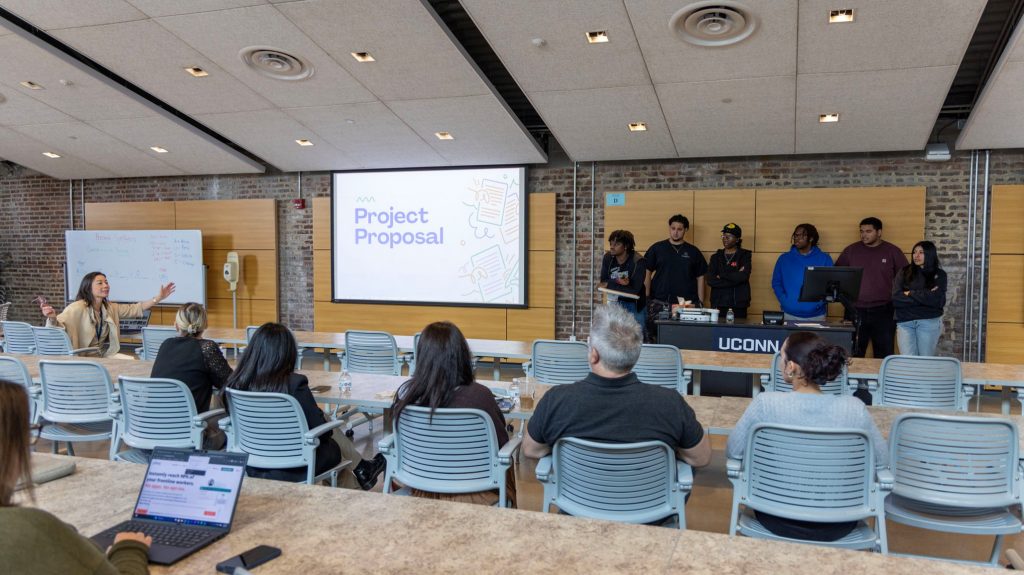
WISHfest began in 2023 as an annual citywide event focused on innovation, sustainability, and health. This year, it drew nearly 1,500 students, educators, and community members from central and northwestern Connecticut. Organizers hope students and faculty will showcase their prototypes and AI-generated immersive experiences at a future WISHfest as those projects develop.
"Our faculty and students approach AI with healthy skepticism and legitimate concerns about its impact. They also have fabulous ideas about how they could use AI in the classroom, in the lab, and here in Waterbury," says Fumiko Hoeft, campus dean and chief administrative officer of UConn Waterbury. "I want them to dream big, even if they don't yet know how to make an idea work. Our job is to make sure they have the tools, the support, and the room to try. A few years from now, I'd love to run into our students or graduates and have them show me something they've built that none of us can quite imagine today."
Building Learning Infrastructure and Faculty Capacity
In addition to the work already underway at UConn Waterbury, CETL is also advancing two interrelated components of a UConn 2000-funded initiative to improve digital learning infrastructure at UConn Waterbury: connected classrooms that expand access to courses across campuses and faculty support for contemporary, responsive course design.
The first component, in collaboration with UConn' Information and Technology Services (ITS), will provide Waterbury, Avery Point, Hartford, and Stamford with updated technology for video-enhanced, in-person remote instruction, enabling students at sending and receiving locations to take part in discussions and collaborative activities. The rooms will also support technology-rich in-person classes.
The second component will support up to 50 faculty members developing or redesigning courses that serve Waterbury students and may originate at Waterbury, another regional campus, or Storrs. Some courses will be taught in person at Waterbury. Others may be offered more broadly through connected classrooms or online delivery, expanding access for students across the University. Through cohorts, training, peer exchange, and individual consultations, faculty will design courses around AI-responsive teaching and assessment, AI literacy, accessibility and inclusive design, career competencies they select for their courses using the National Association of Colleges and Employers (NACE) framework, and clear learning outcomes. A community of practice will sustain and share the work across UConn. The project also brings together faculty and staff from across the University, UConn Library, and the Center for Career Readiness and Life Skills.
"Strengthening Waterbury's digital learning infrastructure will immediately benefit the other regional campuses and establish practices CETL and its partners can extend across UConn," says Desmond McCaffrey, interim director of CETL. "We are building a foundation that helps faculty in every discipline design courses that respond intentionally to AI and the changing needs of modern classrooms and learning environments."


