
A new study from The University of New Mexico offers a nationwide look at how Americans discuss one of the most enduring forms of housing discrimination — redlining — using more than a decade of social media data.
Yujian Lu, a Ph.D. candidate in geography, studies GIScience, U.S. housing segregation and urban inequality. His latest research examines how public perceptions of historical redlining vary across the country using geotagged posts from X, formerly known as Twitter, under the guidance of his advisor, Xi Gong, formerly a faculty member in The University of New Mexico Department of Geography & Environmental Studies and now at Penn State University.

"I wanted to examine spatial variation in how redlining practices are discussed across the United States and explore how these patterns are associated with different socioeconomic and demographic factors," Lu said.
Redlining began in the 1930s as a discriminatory housing practice that labeled certain neighborhoods — often communities of color — as high-risk for mortgage lending.
"This policy was abolished in 1968, however, those designations influenced private lending practices for decades," Lu said.
Today, researchers say those effects are still visible in housing access, neighborhood investment and environmental risk.
To better understand how people perceive redlining now, Lu analyzed nearly 19,000 geotagged tweets posted between 2011 and 2023.
"We used geotagged tweets because they allow us to examine public perceptions across a much larger geographic area and over a longer time period than traditional data collection methods," he said.
Unlike surveys or interviews that focus on specific communities, social media data allows researchers to compare conversations across both historically redlined and non-redlined areas.
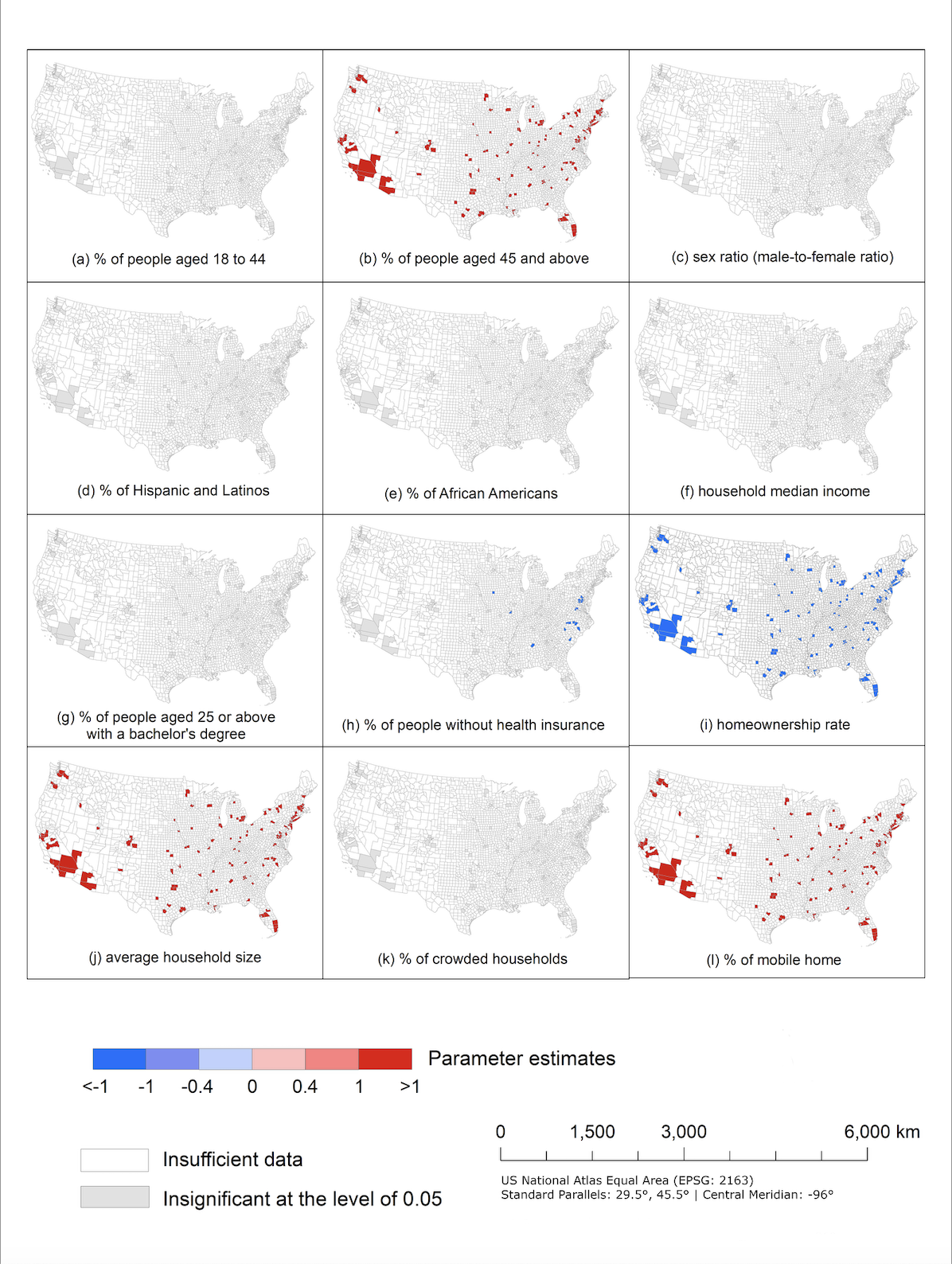
The study combined sentiment analysis with a spatial modeling approach known as Multiscale Geographically Weighted Regression, or MGWR. The method allows researchers to examine how relationships between factors like income, age or housing conditions and public perception differ across locations, rather than assuming the same pattern exists nationwide.
"In simple terms, instead of assuming that the same relationship exists everywhere, MGWR allows us to see how those relationships vary from one location to another," Lu said.
The findings show that public perceptions of redlining are closely tied to local demographic and housing conditions.
For example, areas with larger households or lower homeownership rates were more likely to have tweets with negative sentiment — suggesting that housing pressure and historical barriers to ownership may shape how people discuss redlining today.
"Areas with lower homeownership levels may reflect communities that historically faced barriers to mortgage access or wealth accumulation," Lu said.
Age also played a role, with different generations engaging with the issue in different ways.
"Older residents may have more direct or indirect experiences with discriminatory housing practices, while younger residents may engage with the topic through contemporary discussions about housing inequity and affordability," he said.
In the study, "negative sentiment" does not necessarily mean anger or opposition, but rather the tone of the language used. Instead, it reflects how people frame or describe redlining in public discourse.
The research also highlights some limitations of using social media data. Only a small percentage of posts include location data, which reduces the sample size for geographic analysis.
"One of the main challenges was the limited number of geotagged tweets," Lu said. "Only about 2% of all tweets include coordinates or other geographic information."
Even with those limitations, the study provides insight into how public understanding of redlining connects to present-day housing conditions.
"Understanding public perceptions of historical redlining practices is important because these perceptions influence how people understand and interpret historical reasons for current housing inequity and urban development policies," Lu said.
That awareness can shape how communities respond to issues like housing affordability, redevelopment and environmental justice.
Although New Mexico was not formally mapped under federal redlining programs, similar forms of housing discrimination still occurred.
"New Mexico did not have official HOLC redlining maps, but housing discrimination and segregation practices similar to redlining still occurred," Lu explained.
He added that the research can still inform local conversations and planning decisions.
"It can encourage New Mexico residents to participate more actively in local planning discussions, community meetings, and housing policy debates," he said.
Lu hopes to expand the research to explore additional housing policies and their long-term impacts.
"Exploring these policies could help us better understand how different housing and lending practices have shaped urban development and neighborhood inequity over time," he concluded.


