
Washington University in St. Louis is formally partnering with St. Louis to expand environmental monitoring and public health research in city neighborhoods affected by the devastating May 16, 2025, tornado.
"This partnership demonstrates WashU's 'In St. Louis, For St. Louis' commitment to our region in concrete and tangible terms," Chancellor Andrew D. Martin said. "Under the leadership of Dean Dorian Traube and her team in the Brown School, the Public Exchange and the researchers leading CLEAN STL are creating a model for connecting academic expertise with local leaders to effect real change."
The agreement formalizes and expands CLEAN STL - Contaminant Level Evaluation and Analysis for Neighborhoods - a multidisciplinary initiative launched in fall 2025 to provide residents and city leaders with accurate air and soil data to support long-term recovery efforts. The project began as a pilot developed in partnership with community organizations Better Family Life, Love the Lou and 4theVille and is now growing into a multiyear collaboration with the city.
The expanded initiative represents a significant investment of university resources, with WashU committing more than $500,000 over the next two years to support the project's first phase of growth.
The signees on the partnership were St. Louis Mayor Cara Spencer; Julian Nicks, chief recovery officer for the city; Victoria Anwuri, St. Louis health commissioner; and Dorian Traube, the Neidorff Family and Centene Corporation Dean of the WashU Brown School.
It brings together the resources of the WashU Public Exchange with the city's Recovery Office and Department of Health to safeguard community health during demolition and rebuilding and to give residents direct visibility into the conditions in their neighborhoods.
Led through the WashU Public Exchange initiative, CLEAN STL brings together expertise from WashU's Brown School, Arts & Sciences, McKelvey Engineering, Sam Fox School and School of Law.
"St. Louis is moving into the next chapter of recovery, and that work has to be grounded in trust, transparency and good science," Spencer said. "This partnership puts real-time information in the city's and residents' hands, brings world-class expertise to the neighborhoods that have waited too long for it, and shows that the rebuilding of north St. Louis is going to be done in a community-centric way."
A shared commitment
"This reflects the kind of university WashU aspires to be - one that brings its research, expertise and institutional capacity into direct partnership with the community to help address urgent regional challenges," said Lisa Weingarth, senior advisor to the chancellor and executive director of the university's "In St. Louis, For St. Louis" initiative. "The work is rooted in listening, long-term partnership and a shared commitment to supporting the health and recovery of St. Louis neighborhoods."
The WashU Public Exchange works across the university to connect researchers with community and industry partners to address complex social challenges through collaborative research and action.
"Public Exchange is designed to move ideas beyond the university setting by creating pathways for research, lived experience and cross-sector expertise to inform one another," Traube said. "By connecting WashU researchers with community and industry partners, we can translate research into practical solutions faster, strengthen recovery efforts and create lasting impact for the St. Louis region and beyond."
Following the tornado, many residents raised concerns about potential environmental health risks tied to debris, demolition and contaminated soil. Lead and other heavy metals can become airborne during destructive events and subsequent demolition activities before settling into surrounding soil, creating long-term public health concerns.
Public data, practical strategies
CLEAN STL was designed to help address those concerns through community-centered environmental testing and public-facing data sharing.
The project draws on a breadth of WashU expertise, including environmental geochemist Jeff Catalano, a professor of earth, environmental and planetary sciences in Arts & Sciences; air quality expert Jay Turner, the James McKelvey Professor in Engineering Education at McKelvey Engineering; and Matt Bernstine, director of the Office for Socially Engaged Practice at the Sam Fox School. The WashU Environmental Law Clinic also is supporting the effort.
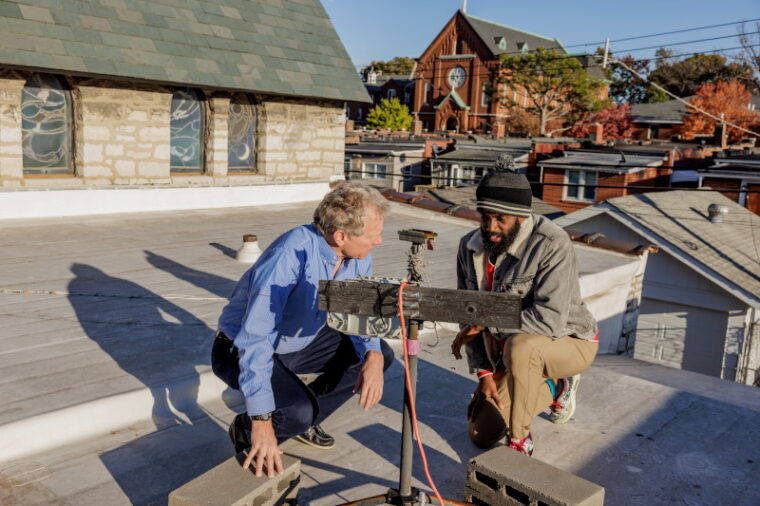
Under the expanded partnership, WashU researchers will broaden soil testing efforts with additional community partners and establish a network of air-quality monitors in neighborhoods experiencing concentrated demolition activity. The monitors will provide neighborhood-level air-quality data to help track dust and contaminants during rebuilding efforts. WashU researchers will place 10 air-monitoring units around the city in the areas of highest demolition concentration.
Researchers also will explore practical and cost-effective remediation strategies for residents with contaminated soil concerns. In addition, the Health Communication Design Studio at the Sam Fox School will help translate complex scientific findings into accessible public information for residents and community organizations.
Additional information about CLEAN STL and opportunities for community engagement will be shared as the expanded project moves forward.


