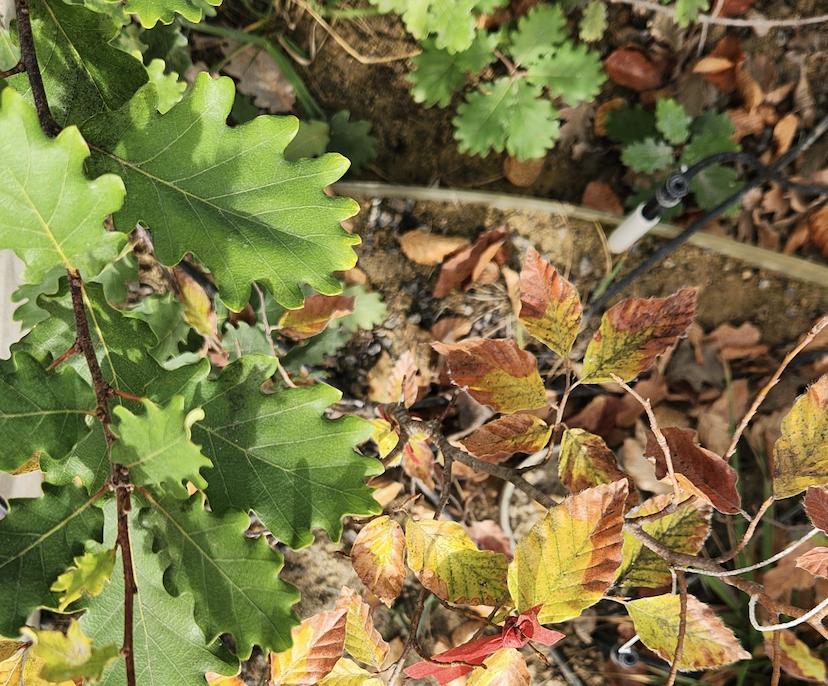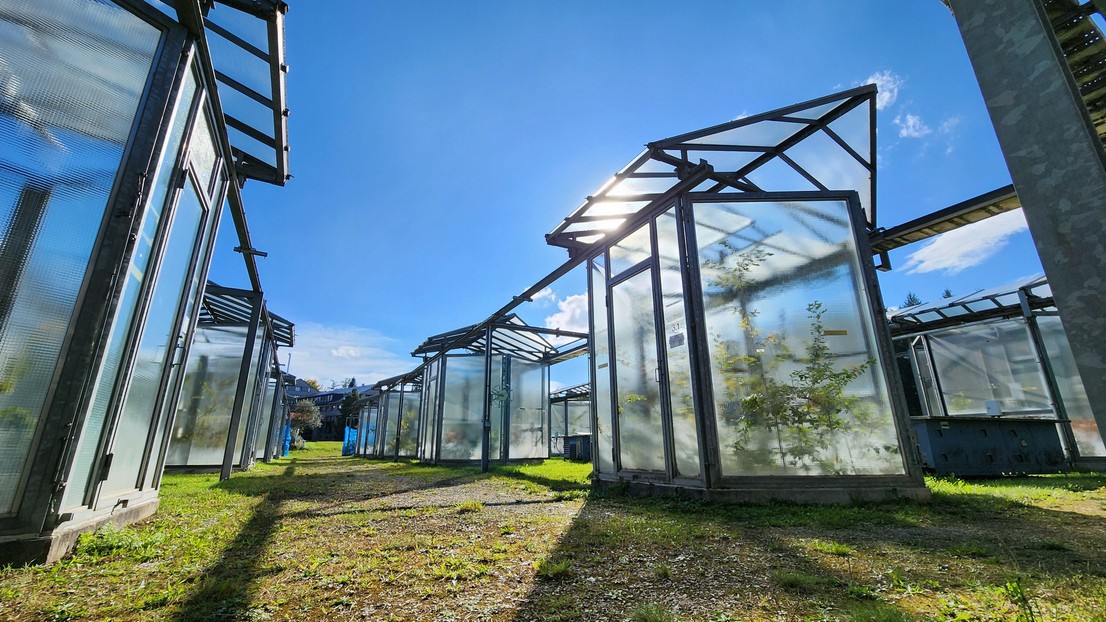
Greenhouses at WSL, at the Modoek facility © 2025 Alyssa Therese Kullberg / EPFL / WSL.
For five years, biologists subjected trees to prolonged drought conditions by reducing soil moisture, while also exposing them to experimental warming. Their findings show that trees can tolerate heat as long as sufficient water is available. However, under water stress, they lose their ability to cool themselves, which significantly increases their vulnerability.
When temperatures start to climb, trees must keep their leaves cool. Water is channeled up from the roots into the leaves where it evaporates through tiny pores called stomata. This lowers the surface temperature of the leaves through a cooling mechanism similar to sweating in humans. But when the ground is very dry, less water is available for the tree to absorb and circulate up to the leaves. The stomata respond by closing so as to conserve water within the tree - but that means the transpiration process no longer works as it should. The leaves cannot cool off and their temperature can rise quickly, especially during heatwaves and when the tree is under direct sunlight. This triggers what is known as a hydraulic and thermal cascade.