
Key points
- Telescopes collect light that was emitted a long time ago and is only now reaching us on Earth. This means telescopes see the Universe as it used to be.
- The further away a telescope can see, the further back in time it sees - and the better it is as a time machine!
- Some of the world's best telescopes use CSIRO's leading technology to see even further back in time, helping answer fundamental questions about the Universe.
We've all heard of a fictional time machine, but the idea isn't as far-fetched as it sounds. Whenever the world's telescopes observe the sky, they're effectively looking back through time.
Telescopes are made to collect light in all its different wavelengths, from the visible spectrum to X-rays to radio waves.
Even light, the fastest thing out there, takes time to move anywhere. It's this delay that makes a telescope the closest thing to a time machine possible.

How do telescopes see back in time?
Space is so vast that astronomers measure distances in units much, much larger than the humble kilometre. One unit is a light year - the distance light can travel in one year, almost 9.5 trillion kilometres.
Our Sun is just over 8 light minutes from Earth, which means the sunlight we see took about 8 minutes to reach us.
Our closest star system, Alpha Centauri - visible in the Pointers to the Southern Cross - is just over four light years away. The light reaching us from those stars today began its journey more than four years ago.
So when you look into the night sky you've got a direct view into the past - no telescope required.
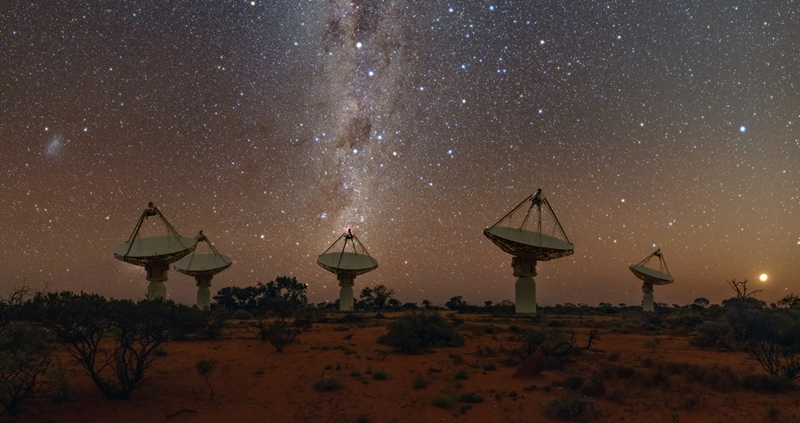
Dr Keith Bannister is no stranger to time travel as the Chief Technologist for CSIRO's Australia Telescope National Facility (ATNF) . He said the world's best telescopes are so sensitive they can collect light that has been travelling through space for billions of years.
"They can see billions of years into the past, almost back to the beginning of the Universe. If you want to see back that far, you need the best time machine possible: a radio telescope."
Why radio telescopes see further
One reason radio telescopes can see further than optical telescopes is because the radio light being emitted by distant objects is brighter.
"It's very easy to see a galaxy 10 billion light years away with a radio telescope, but very difficult with an optical telescope," said Keith.
"The supermassive black holes at the centre of galaxies are messy eaters. They leave behind signals that are very bright in radio waves and can travel further through the Universe than the visible light from the galaxy surrounding them."
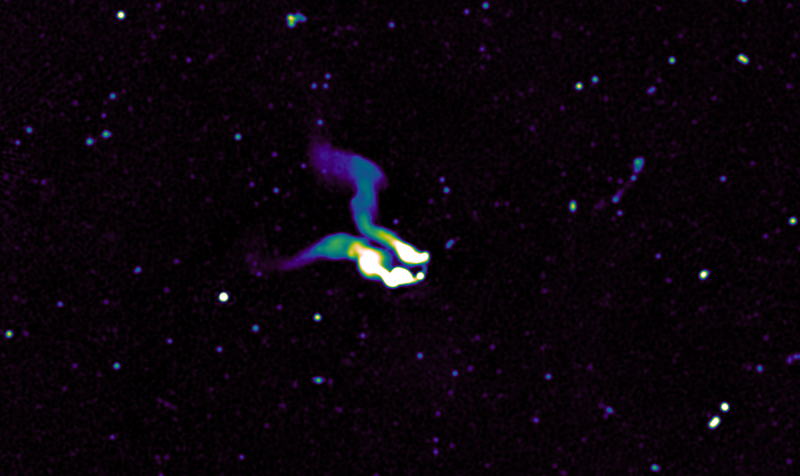
He also said the oldest light in the Universe is all at radio wavelengths.
"After the Big Bang the Universe was too hot and dense for light to travel. As it expanded and cooled, light could finally move freely. That early light was essentially red coloured, but the Universe's expansion has stretched it into radio wavelengths. So, the earliest light in the Universe must be detected by a radio telescope."
The secret to seeing the distant Universe
The more sensitive a telescope, the further it can see into the Universe. Sensitivity can be increased in two main ways: collecting more light or reducing 'noise'.
Collecting more light requires a larger area to collect it - a bigger mirror for optical telescopes, or a larger dish for radio telescopes, or more antennas connected in an array.
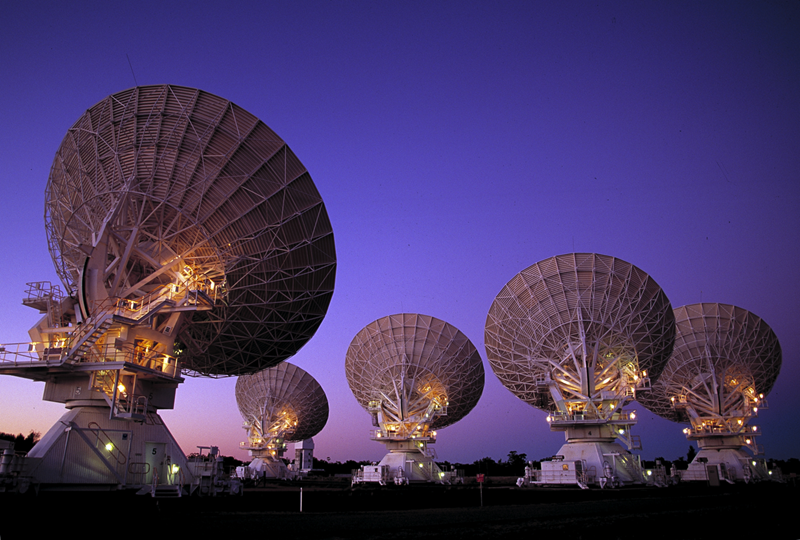
Another approach is decreasing 'noise' so telescopes only capture signals from the Universe. As CSIRO's ATNF Chief Engineer, Mark Bowen is developing technologies that enable telescopes to collect more of the light astronomers rely on.
"The hard part is making sure telescopes are only collecting light from space, not from Earth-based sources, which we class as noise," said Mark.
He said this can be done by moving instruments into space or by engineering more advanced equipment to use on the ground.
"Advances in semiconductors, cryogenic cooling and amplifiers have led to better radio telescope receivers, allowing us to see fainter signals," explained Mark.
"Advances in digital signal processing, hardware and software have allowed us to collect and process more data quickly and with less errors. All this combines and we end up with telescopes seeing much further."
Wider views reveal deeper clues
There's more to sensitivity than just seeing as far as possible.
"It's alright to look far back in time, but if a telescope can only see one single point in space, it can't build a complete picture of what's happening and it's not delivering on its full time-travel potential," said Mark.
Traditional radio telescope receivers only see a small, single point in the sky, called a beam.
"The advent of high-sensitivity multi-beam receivers has allowed telescopes to capture a much larger area of sky simultaneously, while still searching deeper into the Universe's past."
CSIRO has been building cutting-edge multi-beam receivers for global radio telescopes since the 1990s, starting with one for Murriyang, CSIRO's Parkes radio telescope .
"The latest in that series of CSIRO-developed receivers is on China's FAST radio telescope , the largest single-dish telescope on Earth."

But the receiver is just one part of the system, the data processing 'brain' of a telescope is just as important for seeing further.
Dr Keith Bannister is responsible for CRACO , one of the brains that process data from CSIRO's ASKAP radio telescope's 36 antennas.
"There are two approaches to process ASKAP data. You can just add it all together, which is easy but less sensitive, and limits how far the telescope can see," said Keith.
"The other way is much more sensitive - you can combine signals from all the antennas, effectively creating a single, giant telescope."
But with ASKAP, Keith has drawn on the experience across CSIRO to go a step further.
"ASKAP's brain CRACO uses specialised hardware and software to survey thousands of regions of sky at a thousand different distances, simultaneously."
"CRACO checks ASKAP data for things that go bang , a thousand times a second. It takes a much bigger computer to make it work, but it ensures the telescope doesn't miss things."
Assembly required: watching the Universe build itself
CSIRO's ATNF Chief Scientist Professor Cathryn Trott is an expert in looking back in time. She focuses on finding the furthest signals and exploring the early Universe.
"By looking further than we ever have before, we're hoping to detect the Cosmic Dawn signal," said Cathryn.
"We'll be able to see the birth of the first stars that ever existed. We can watch that happen by looking far into space, back in time to the infant Universe. A time before galaxies formed when the Universe looked very different."

But what does this mean for us here on Earth?
"Early on, the Universe was filled with only hydrogen and helium gas and a small amount of lithium. Through the births and deaths of generations of stars we have seen other elements from the periodic table appear," said Cathryn.
"This helps us explain the current Universe, as well as the elements we find here on Earth."
From the outback to out-there: Aussie tech, deeper space
CSIRO has been developing technologies for radio astronomy for more than 80 years , building world-leading experience across analogue and digital systems, timing and signal distribution as well as software and data processing.
"We're in the unique position to combine all this experience into one telescope, ensuring astronomers get as much information as possible out of the light radio telescopes capture from the Universe," said Cathryn.
Now, global projects like the international SKA Observatory's telescopes are benefitting from that experience. CSIRO is helping build hardware and software that will ensure these two radio telescopes see further into the Universe than ever before - helping make the world's best time machines possible.
CSIRO acknowledges the Wajarri Yamaji as Traditional Owners and Native Title Holders of Inyarrimanha Ilgari Bundara, the CSIRO Murchison Radio-astronomy Observatory site.


