How UOW's strengths in materials science are paving the way for groundbreaking medical products
The cornea is the eye's first line of defence. Think of it as the eye's windshield: a thin, dome-shaped layer over the iris and pupil that protects against debris, germs and dust.
We rarely give it a thought. Until something goes wrong.
When the cornea is damaged by injury, infection or disease, the world fades to a blur. For more than 23 million people globally, that is daily life.
The average cornea measures 11mm to 13mm, about as wide as a small marble, yet it produces more than half of the eye's focusing power. Its precise shape bends the light, while three layers do the rest: the epithelium, a clear outer layer that lets light in and protects the eye; the stroma, the middle layer that provides strength and durability; and the endothelium, which pumps excess water out of the stroma to keep the cornea transparent.
Distinguished Professor Gordon Wallace, Director of the University of Wollongong's (UOW) Intelligent Polymer Research Institute (IPRI), has spent much of his career using materials science to address global health issues. So, when Sydney ophthalmic surgeon Professor Gerard Sutton called more than a decade ago asking for his help, he was all in.
"Gerard had been performing corneal transplants from donated corneas and had worked in many developing countries where this wasn't even an option," Professor Wallace said.
"There was huge demand for corneal transplants, but it could never be met by donated corneas. He knew of our background in bioengineering and wanted to know if there's any way we could solve this problem together."
For many forms of corneal blindness, transplantation is the only effective treatment. However, donor corneas can only be recovered from deceased individuals, with consent provided by the donor before death or by their family. In 2025, Australia recorded just 1,677 deceased eye donors, while approximately 2,000 corneal transplants are performed nationally each year.
Securing consent remains a significant challenge, with only 53 per cent of families approached in Australian hospitals consenting to deceased organ donation in 2025. While this figure relates to organ rather than corneal donation, it highlights the broader challenges of relying on donated human tissue. With demand for corneal transplantation far exceeding supply globally, innovative solutions such as bioengineered corneas offer the potential to transform access to sight-restoring treatment.
It's a thorny challenge that no one person can solve.
"The cornea is an exquisite biological structure," Professor Wallace said. "It has three types of cells arranged in a precise three-dimensional structure, and the aim is to bioengineer all of it. That takes more expertise than any single discipline can offer."
That's why BIENCO brings together UOW materials scientists with eye surgeons, chemical, cell and mechatronic engineers, researchers and governance experts from around the country with links to international expertise. Formed in 2021, it was awarded $35 million from the Australian Government's Medical Research Future Fund three years later. UOW is a key partner alongside the University of Sydney, the University of Melbourne, Queensland University of Technology, the Centre for Eye Research Australia and the NSW Organ and Tissue Donation Service. Professor Wallace is one of the consortium's leads and helps govern the group.
"People talk about collaboration in a very light way, but in a project like this, we have a fully integrated, interdisciplinary team who have been part of the journey from the start," he said. "Think of how many elements are involved in BIENCO: materials science, engineering, software development, organ donation experts, manufacturing, clinical practice, policy and governance."
The project has grown steadily more complex, and the team is now considering manufacturing, storage, transportation, regulatory and clinical pathways.
"It is the most intricate research I've ever worked on. There have been many unexpected turns, but it's incredible to see how it has developed," Professor Wallace said.
"We have built the collaboration over time. These tight-knit collaborations don't happen with the click of one's fingers. You need to build that trust and build that knowledge."
The team has made significant inroads, Professor Wallace said. Exploring alternative sources of collagen and of the cells used is on the radar for future generation products. They have overcome challenges in stability, transparency and toughness, and replicated the cornea's intricate structure.
The project isn't complete, but there is light at the end of the tunnel. HYGELIX, developed by colleagues at the University of Melbourne as part of the BIENCO program, is a biodegradable hydrogel that will aid corneal endothelial grafting. It will go to human clinical trials next year. It's designed to support endothelial keratoplasty, surgery that replaces only the cornea's innermost layer instead of the entire cornea.
BIENCO-EK, a two-layer bioengineered tissue designed to replace the endothelium, will begin preclinical studies next year, followed in 2028 by BIENCO-PK, a three-layer tissue designed to repair the whole cornea.
The team is now exploring manufacturing opportunities to move from prototype development to a process that can be scaled up.
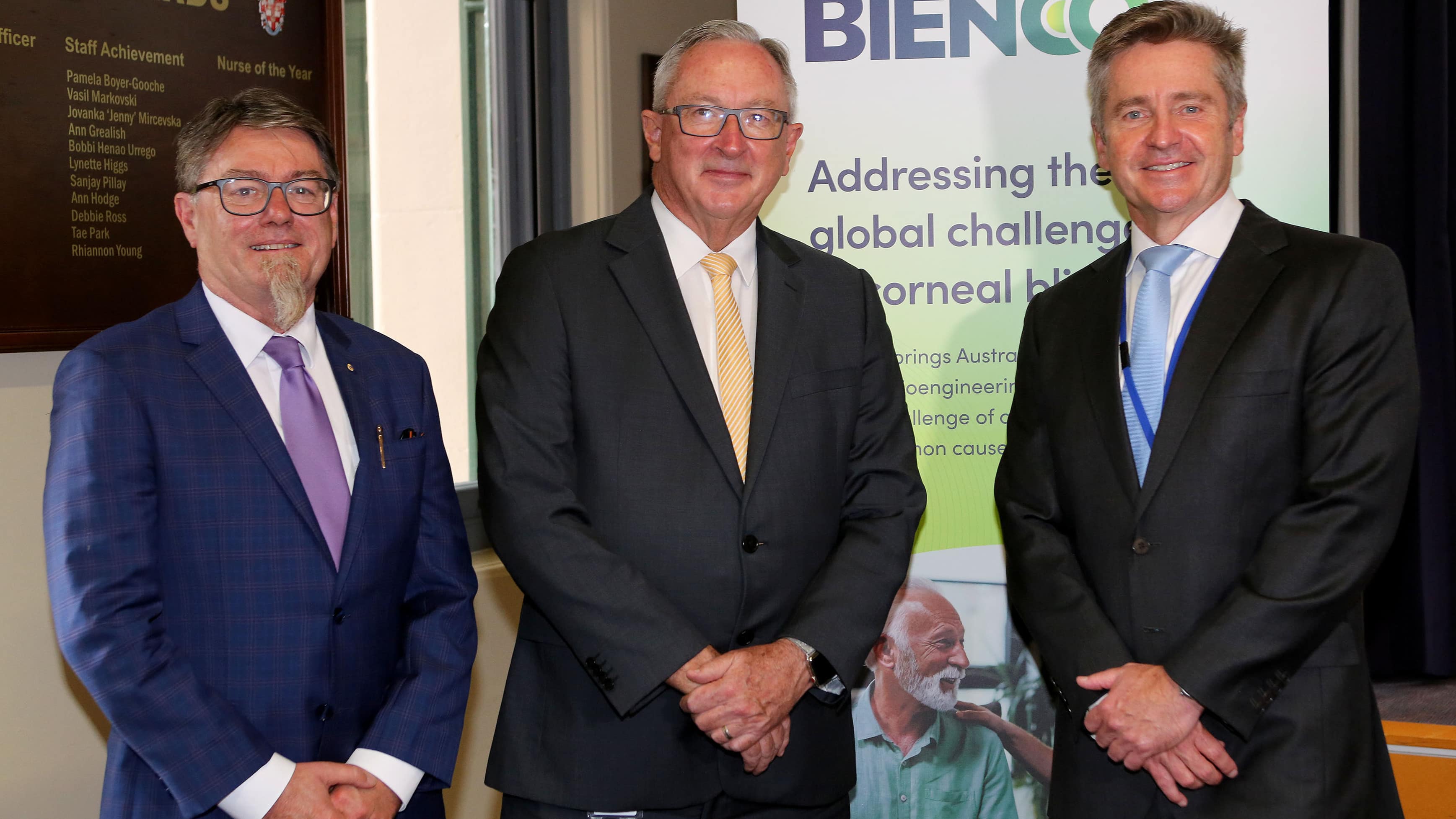
"Now we can envisage what the manufacturing line is going to look like," Professor Wallace said. "There is no standardised manufacturing line for bioengineered products in Australia, so this project truly leads the way. If we can manufacture bioengineered corneas, it paves the way for bioengineered bone and skin and other products."
Importantly, BIENCO is embedding quality management systems and Good Manufacturing Practice (GMP) principles into its research and manufacturing processes from the outset, ensuring that scientific innovation is developed with clinical translation, regulatory requirements and scalable production in mind.
Every element of the project is groundbreaking, Professor Wallace said, including building the manufacturing process from the ground up. He believes UOW's global reputation in materials science has underpinned its ability to deliver world-first projects like this one.
"UOW have a really strong profile for this type of research. All our bioengineered products projects have been instigated by a medical professional in the field, who has called us for help to solve a problem."
For a scientist, it's also a rare and special opportunity to see a project through from start to finish.
"It's very satisfying to follow an idea all the way through, from a problem to a product, with everyone pulling in the same direction. This is the pinnacle, to have the opportunity to take an idea from discovery through to development," Professor Wallace said.
"It is truly a world first and I feel very lucky to be working with this fully integrated, interdisciplinary team who are committed to completing this journey."