Biodiesel is a renewable fuel and offers a sustainable and potentially carbon-neutral alternative to petroleum products. Yet production costs remain a hurdle to its widespread use. Now, researchers have developed an inexpensive way to make biodiesel from materials found along the banks of their Louisiana bayou: algae and oyster shells.
The researchers will present their results at the spring meeting of the American Chemical Society (ACS). ACS Spring 2026 is being held March 22-26; it features nearly 11,000 presentations on a range of science topics.
Ana Elashry
Biodiesel is manufactured and used around the world, but its production is not without challenges. The plants, such as soy and rapeseed, that provide the initial oils require vast areas of land that could otherwise be used for food crops, and in some regions, expanding farms can damage and destroy valuable natural ecosystems. Production can also be expensive because of the high cost of components such as calcium oxide-based catalysts.
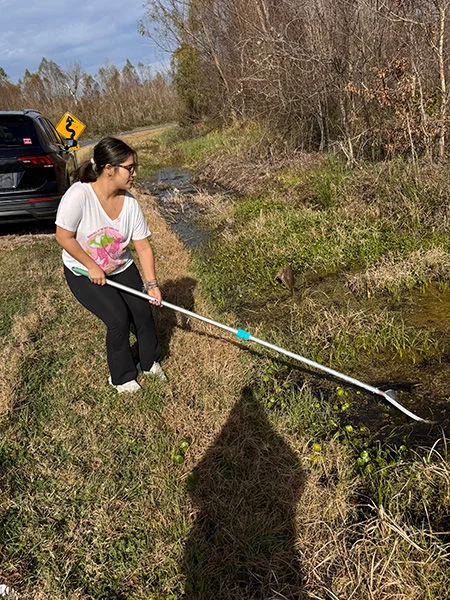
These two challenges were key motivators for Bello Makama and his research group at Nicholls State University, who turned to their local environment for solutions. From a ditch near the lab, they harvested algae rather than traditional crops and oyster shells to produce the catalyst.
"As a chemist, I sat down and started thinking about projects I could do with my students," recounts Makama. "Looking at southern Louisiana, where you have an abundance of algae growing in the ditches and the bayou, we wondered what if we could take something that poses an environmental and logistical issue and add value to it?"
So, Makama and Samia Elashry, an undergraduate researcher in his lab, worked together to create a new biodiesel. First, they crushed algae collected from a ditch near the university to extract their oils. Next, they combined the oil with methanol and a chemical catalyst under heat, generating glycerin and biodiesel. The chemical catalysts usually used in this process, such as quicklime or caustic soda, are expensive. For a cost-effective alternative, the researchers developed their own catalyst from the locally sourced calcium-rich oyster shells. They put powdered shells in a furnace and converted the shells' calcium carbonate to calcium oxide. Makam's initial cost modeling suggests that the oyster-based catalyst reduced the price of their biodiesel production by about 70-85% compared to commercially available calcium oxide catalysts.

Samia Elashry
At the meeting, Elashry will present the results of the team's efforts to optimize the algae-oyster biodiesel's yield and quality by varying production parameters such as catalyst concentration and methanol-to-oil ratios. She will also present preliminary testing data determining whether their biodiesel meets international standards, as well as cost efficiencies. Critical to the success of this effort will be evidence demonstrating the energy balance of algae biodiesel; that is, does it require less energy to produce the final product than the energy generated by its combustion?
"One of my colleagues at Louisiana State University told me that energy balance is one of the things killing biodiesel," recounts Makama. "You put in more money than you get out."
Now, the researchers are partnering with a company in Louisiana to expand their standards testing efforts, such as cold-weather utility and flammability.
"Where we live, we have all these renewable resources that are not being taken advantage of," says Elashry. "Going out into the field, collecting the algae and seeing the algae become biodiesel showed me how we need to work more towards bettering our environment and creating more sustainable resources."
The biodiesel processes they developed are not restricted to Louisiana, Makama stresses. "Algae grow in almost every corner of the globe; it has a high lipid content, and it does not compete with arable lands," he says, adding that oyster shells are similarly ubiquitous and are otherwise landfill waste.
Makam says he will be happy if this research can be used by people around the world to economically produce biodiesel with their local resources.
The research was funded by a Nicholls State University Research Council grant.
Visit the ACS Spring 2026 program to learn more about this presentation, "Converting southern Louisiana algae to biodiesel using waste oyster shell:derived catalysts," and other science presentations.