There is something instinctive that happens when we hold a coin in our hands.
First comes the movement, the way it balances between thumb and forefinger, turning over almost absent-mindedly as we examine its surface. Then comes the heat, as the round metal settles into the fold of our palm and slowly absorbs our warmth. In that moment, a small object becomes symbolic of a much larger history carried across generations, empires and continents.
It is a sensation that we experience less often. In an increasingly cashless society and digitised world, the physical presence of coins is slowly fading from everyday life.
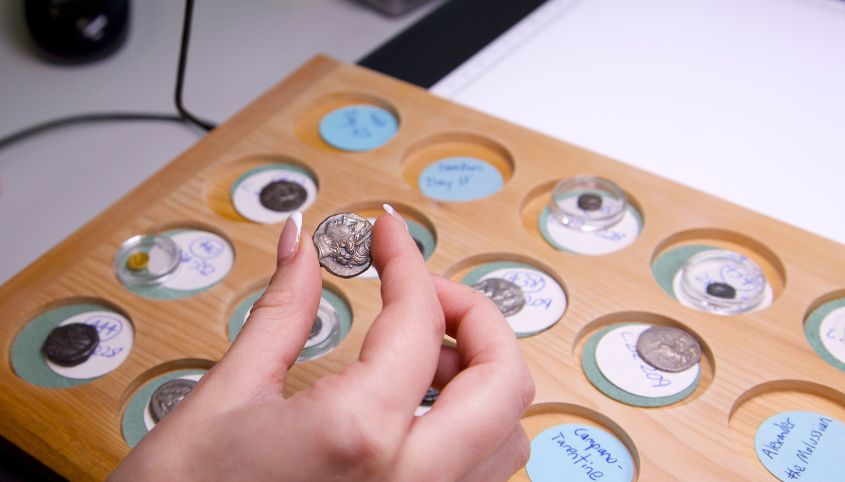
The physical presence of coins is slowly fading from everyday life. Photo: Elaine Obran
At Macquarie University's Australian Centre for Ancient Numismatic Studies (ACANS), however, that connection is exactly what the institution exists to preserve, home to one of Australia's most significant collections of ancient coins.
Inside its vault and across its long worktables is a space designed for careful handling, study and collaboration - where each object is treated not simply as an artefact, but as a fragment of a much larger story.
More recently, the preservation of these stories has taken on a new form. ACANS has begun the meticulous process of digitising its entire collection, creating detailed records that will allow the coins to be studied, shared and explored far beyond the walls of the vault itself.
Associate Professor Peter Edwell, recently appointed as Director of ACANS, is overseeing the project. It was the brainchild of the centre's now retired former director, Ken Sheedy. Edwell hopes the digitised collection will make it easier to explore individual coins and themes in detail.
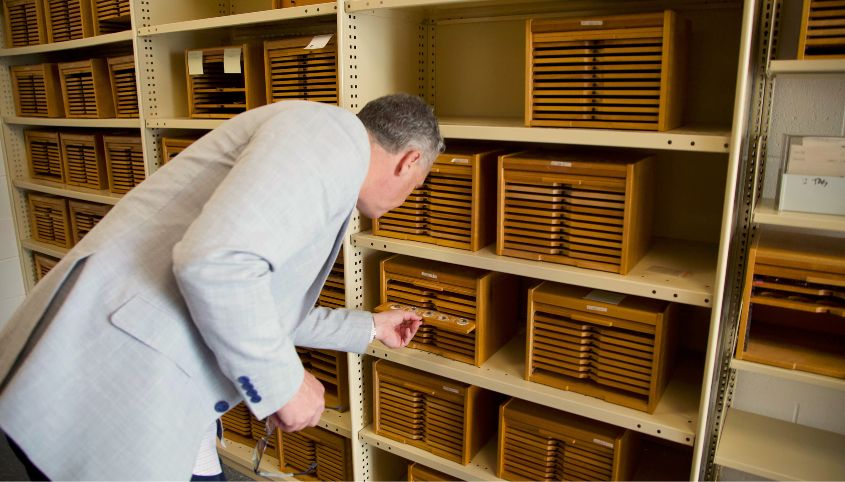
Associate Professor Peter Edwell and recently appointed as Director of ACANS inside the coin vault. Photo: Elaine Obran
"In having around 6,000- 7,000 coins in this collection, we want to be able to access those in in a way that is accessible beyond just visiting the centre in person," says Edwell.
"But we need that data to be accurate, consistent and also searchable. Which then allows you to go into the collection and search for specific images like a horse, for example, or a particular ruler, like Emperor Marcus Aurelius.
"It also allows us to feed into that broader numismatic community. Even though we are well regarded internationally, it will help us connect more closely with organisations such as the American Numismatic Society."
But this process is no easy feat. Each coin must first be photographed, catalogued and accurately identified - a challenging process when dealing with objects that have survived for centuries and travelled thousands of kilometres from their place of origin.
As Edwell explains, parts of the collection reveal just how interconnected the ancient world was. Roman gold coinage has been unearthed in Vietnam, Roman silver in India and Athenian silver coinage in Arabia.
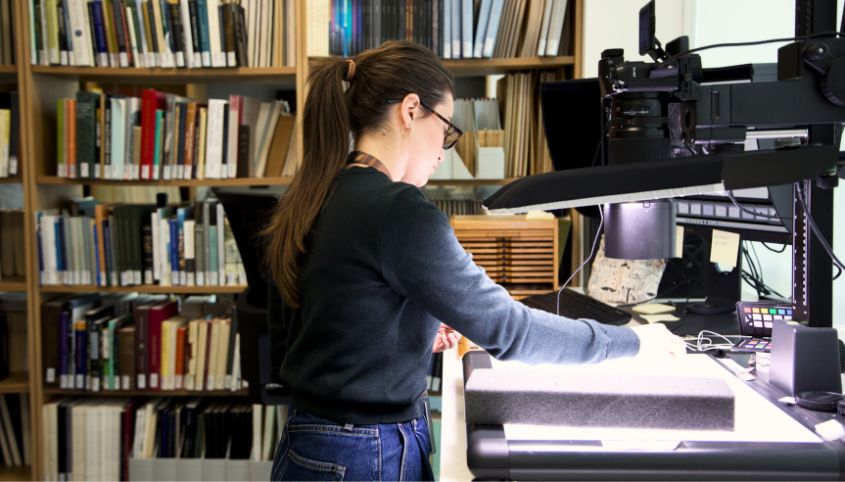
Emily Salhab, the digitisation specialist who is photographing the entire ACANS coin collection. Photo: Elaine Obran
Alongside Roman imperial portraits and Greek mythological designs, the collection includes some of the most recognisable ancient coins, from Athenian "owl" tetradrachms to Corinthian Pegasus staters, as well as a diverse collection of Roman Republican coinage.
Others, coated in fingerprints as much as they are in history, include the enigmatic lion coins struck in ancient Thrace by an unidentified mint - small silver pieces dating back more than 2,000 years that continue to baffle historians, their origins still widely debated.
"Coins are very important as historical sources," explains Edwell.
"One of the reasons for that is they're contemporary. The rulers have chosen the images and design very carefully and deliberately as part of the way to legitimate their own power, positions and communicate information out to the populations that they're in control of."
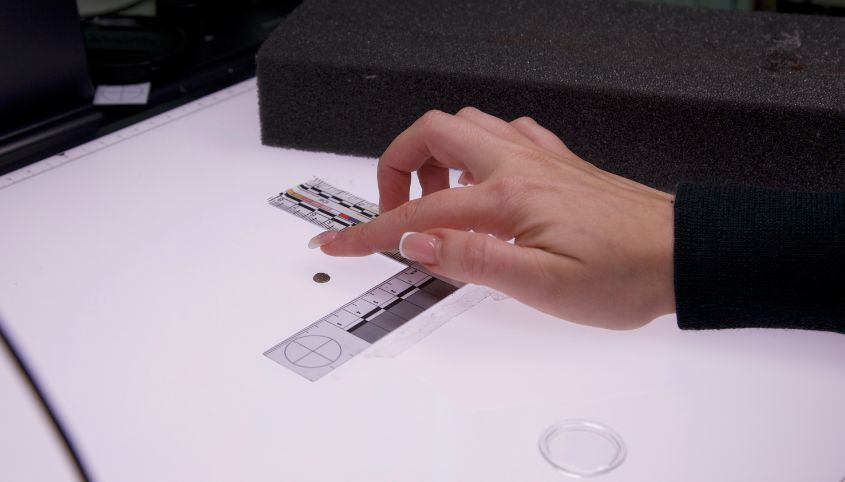
The coins are coated in fingerprints as much as they are in history. Photo: Elaine Obran
For Edwell, these ancient coins also offer a lens in which we can understand the political messaging embedded in modern currency.
"We see similar processes playing out in modern coinage when it comes to messages of legitimacy and power. Take the timeless image of Queen Elizabeth on Australian coinage and attempts by the Trump administration to mint a one-dollar coin and a $250 note containing the president's image as examples.
"While the coins (and notes) some of still use on a daily basis might not grab our detailed attention every time we use them, the images contained in them become familiar symbols of power, legitimacy and stability over time. Ancient coinage operated in a similar way."
But beyond access, digitisation also changes the way we see ourselves reflected in these timeless objects.
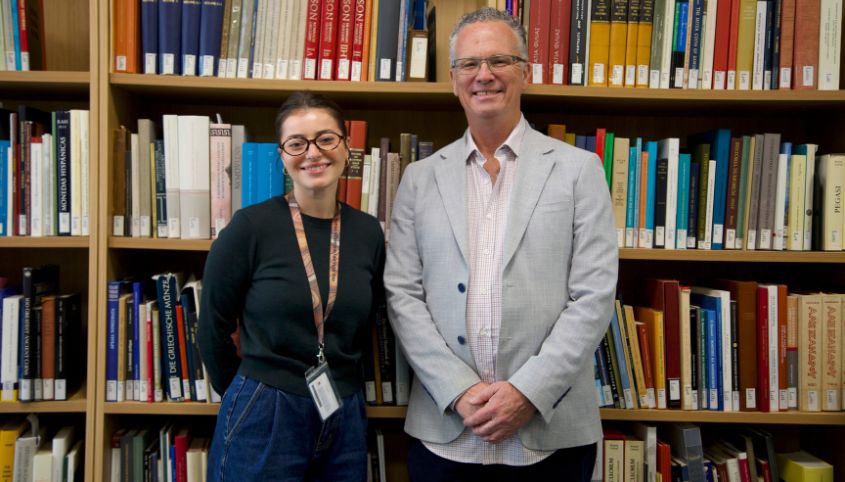 Associate Professor Peter Edwell, and Emily Salhab. Photo: Elaine Obran
Charlotte Mann, Deputy Director of ACANS, says that by capturing the small details of a coin's surface, the project brings into focus much larger human stories, that can often be overlooked by history.
"Through the incredible photography of Emily Salhab, who is our digitisation specialist, we can also explore the tiny nuances that make these coins and their histories so unique," says Mann.
"Often, these stories aren't just those represented in ancient texts - they weren't Caesar fighting Octavian in the Battle of Actium, they were ordinary people just buying a drink or a pie on their way to school. These stories don't really make it into the history books, but ironically, the stories that make history real to us because we can see ourselves in them."
The scale and detail of this enormous project mean safeguarding these stories won't be a coin toss, but a considered curation - held carefully in place until they are once again warmed in the palms of the next generation.
"In 50 or 100 years I hope that people can look back at the digitisation project as something that has allowed us to build on knowledge for generations to come," adds Edwell.
"That is something that is really exciting and significant."
To browse the digitised collection, visit: https://collections.mq.edu.au/new/