

New international research, in collaboration with academics from the University of St Andrews, reveals how a woman who lived with a lifelong physical impairment more than 1,500 years ago was supported, valued and buried with honour in early medieval Scotland.
Her story is at the centre of a new exhibition at The McManus: Dundee's Art Gallery & Museum.
History in Our Bones: Uncovering Stories of Disability Through Time, delivered by Leisure and Culture Dundee in partnership with researchers from the School of History at St Andrews, brings together history, archaeology and science to explore how people with disabilities lived in Scotland and England between 500 and 1600 years ago.
The exhibition invites visitors to rethink assumptions about disability, showing how community, care and contribution have long gone hand in hand.
At its heart is the story of LL11, whose remains are cared for by The McManus. Her story combines the latest osteological and biomolecular analysis with a striking facial reconstruction created using advanced forensic techniques.
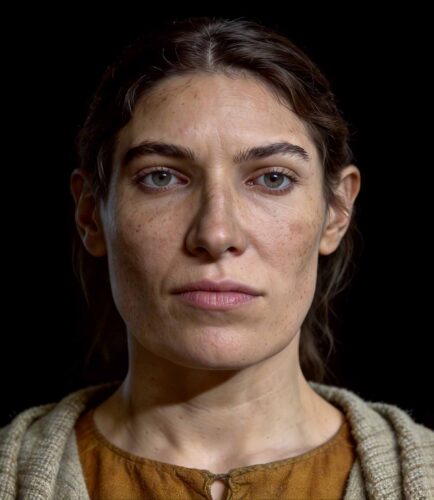
LL11 was buried at Lundin Links in Fife, one of the most significant Pictish cemetery sites ever discovered in Scotland, dating from around 450-650 CE. New analysis of her skeleton shows she had a visible physical impairment from early childhood. She lived into adulthood and was buried with care in a prominent cairn complex, indicating she was valued within her community.
Christina Donald, Curator of Early History at The McManus said:
"LL11's life shows that disability did not mean exclusion in early medieval Scotland. She was supported, valued and buried with honour by her community.
The research challenges long‑held assumptions that people with disabilities in early societies were marginalised or unlikely to survive. Instead, the evidence demonstrates that LL11 was supported throughout her life and remained part of her community."
Dr Tobias Houlton, Craniofacial Anthropologist and Forensic Imaging Consultant, said: "This exhibition offers an opportunity to encounter those who came before us not as distant archaeological remains, but as people whose lives and experiences still resonate today.
Through individuals such as LL11, we are reminded that the past was shaped by care, connection and community just as much as our own world is today. Facial estimation helps unite the evidence of archaeology, medicine and forensic science to restore a more human presence from the past, creating a powerful connection between past and present, science and humanity.
"By bringing these stories back into view, we are encouraged to reconsider modern assumptions surrounding disability, care and social value across history."
Professor Alison Beach, Professor of Medieval History and Archaeology at the University of St Andrews, added: "This research shows the power of combining the humanities and science. Historians, archaeologists, and biomechanical engineers from the University of St Andrews, the University of Dundee, University College Dublin and the University of Bonn each contribute a different piece of the picture.
"Together we uncover the stories of four past individuals, not as people defined by impairment, but as men and women who acted, belonged and held their place in communities that chose to honour them in death."
Using detailed 3D scans of her skull, forensic imaging specialist Dr Tobias Houlton has created a facial approximation, offering a powerful and personal connection to an individual who lived more than a millennium ago. The reconstruction transforms archaeological evidence into a human story, inviting audiences to see LL11 not just as remains, but as a person with a lived experience.
Through immersive display stations, the exhibition introduces four individuals whose lives reveal how disability, care and contribution were part of everyday experience in the past.
This new research offers a powerful perspective on how communities in the past supported people with lifelong needs.
Category Research


