Motivated by personal loss, two veterans are preparing to take on an annual Arctic endurance race to raise funds for a UK Armed Forces charity.
Working alongside a team of researchers and scientists, including experts from the University of Portsmouth, Freddy Drummond-Brady and James East are preparing to take on the ICE Ultra - an annual extreme endurance race organised by Beyond the Ultimate (BTU) - in memory of military friends who have tragically lost their battle with mental health.
The pair have already raised an impressive £50,000 for UK Armed Forces charity Head Up and aim to reach £75,000 , supporting the charity's mission to reduce suicide and improve quality of life within the Armed Forces community.
Assisted by the University of Portsmouth's Extreme Environments Laboratory (EEL) to experience the Arctic's harshest conditions, the duo are gearing up for a five-day, 230 km ultra-marathon across the Arctic Circle, beginning 17 February, facing freezing temperatures and fierce winds.
Freddy and James will tackle the annual race in temperatures as low as -40°C, running on average, a marathon each day for five days, with the final day featuring a 15 km sprint - an extreme test of both physical and mental endurance.
Freddy said: "We decided to take part in this for a few reasons - personal challenge, achievement, but most importantly to raise money for Head Up, a UK military mental health charity.
"We're both veterans and have seen the drop-off in support over the years. Mental health isn't like a physical injury - it manifests over time, and this support shortfall is coinciding with a rise in mental health cases. We wanted to do something meaningful to help and Head Up works with serving personnel and veterans to address mental health issues early, before they reach crisis point, and that's why supporting them matters so much to us."
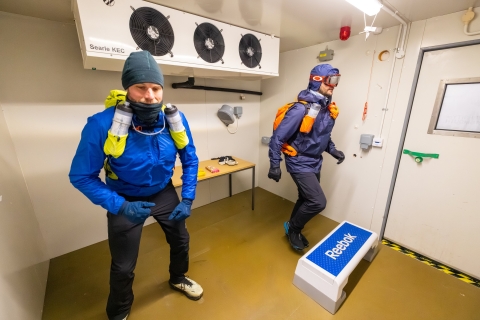
Freddy Drummond-Brady and James East at the Extreme Environments Laboratory at the University of Portsmouth. Image credit: University of Portsmouth
Real-time physiological data was collected from both individuals at Portsmouth's Extreme Environments Laboratory (EEL), a facility renowned for researching human performance in extreme conditions. Measurements will include body temperature, cognitive performance, dexterity, and clothing durability, helping the pair understand how they cope in these conditions and carry out simple tasks, such as grabbing a snack from a pocket.
"I've experienced extreme environments before, but the Extreme Environments Laboratory visit will be the first time we face temperatures of -20°C and below, with wind chill," said James. "It's a chance to test our kit and see how our bodies cope, helping us prepare for the Arctic by replicating the conditions we'll encounter during the race."
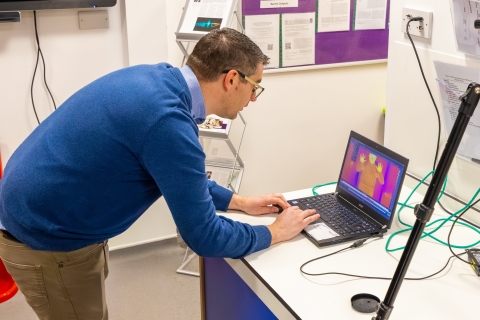
Dr Joe Costello from the University of Portsmouth. Image credit: University of Portsmouth
Dr Joe Costello , Theme Lead for the Extreme Environments and Occupational Performance Research Group at the University of Portsmouth, said: "We are proud to support Freddy and James' Arctic expedition for such an important cause, using our facilities to recreate the challenging conditions they are preparing to face.
"While they have extensive experience in tough conditions from their time in the armed forces, they have never faced temperatures like these. Being able to practise simple tasks, such as drinking water in this environment will help them prepare effectively for the expedition.
"The University's testing includes metabolic and thermal monitoring, followed by cold exposure to assess effects on movement, comfort, dexterity, and body temperature - all of which should prepare them for their upcoming trip."
About the Extreme Environments Laboratories
The University of Portsmouth is recognised for its Extreme Environments Laboratories , which enhance understanding of human comfort, performance, and survival in challenging conditions such as high altitudes, humid jungles, and rough seas.
Insights gained from these labs are applied across diverse fields including sport, product development, emergency rescue, military training, polar exploration, and film production.
The University regularly collaborates with esteemed partners such as the Ministry of Defence, the Royal Society for the Prevention of Accidents, the RNLI, and Olympic and Paralympic athletes.
More recently, the University provided scientific support to the Turner Twins as they tested George Mallory and Andrew Irvine's 1924 Everest expedition kit ahead of a pioneering Himalayan expedition. Notably, in 2013, actors Jake Gyllenhaal and Josh Brolin used the University's temperature and altitude facilities to prepare for their roles in the film Everest.