
Above-normal temperatures are expected across most parts of Southeast Asia during June to August (JJA). The exception is over the southern Maritime Continent and parts of northern Viet Nam and northern, southern and coastal Myanmar, where near- to above-normal temperatures are predicted.
Recent sea surface temperature anomalies over the equatorial Pacific Ocean during April-May 2026 overall indicated El Niño-Southern Oscillation (ENSO) neutral conditions were present. However, persistent warming over most of the Niño regions, together with atmospheric indicators such as decreased cloudiness over most parts of Southeast Asia and anomalous low-level westerlies east of the Philippines, supports the development of El Niño-like conditions. Meanwhile, the Indian Ocean remains in a neutral Indian Ocean Dipole (IOD) phase.
International climate outlooks predict a moderate El Niño is likely to develop during June to August (JJA) 2026. After JJA, most models predict continued strengthening into a strong to very strong El Niño, while the rest predict only moderate El Niño conditions to persist through the remainder of the year. If a very strong El Niño occurs, this does not necessarily indicate bigger impacts on Southeast Asia's climate but rather that typical impacts from El Niño events are more likely to occur. The IOD is also predicted to transition to positive IOD conditions through the latter part of 2026, although with less confidence than the predicted El Niño.
The onset of the 2026 Southwest Monsoon season has been or is expected to be near-average across much of the ASEAN region, except over Viet Nam and the Lao People's Democratic Republic (PDR), where a later-than-average onset occurred. Overall, the strength of the Southwest Monsoon is predicted to be near or stronger than average over most parts of Southeast Asia.
For JJA 2026, tropical cyclone frequency is predicted to be below- to near-average across the region.
Rainfall
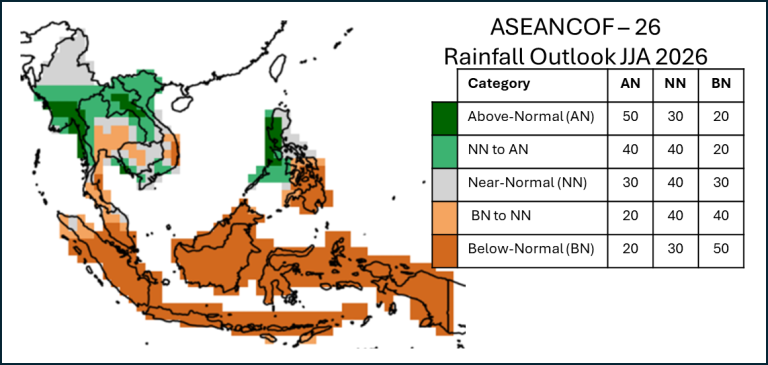
Below-normal rainfall conditions are likely over much of the Maritime Continent, including the southern Philippines, Brunei Darussalam, and Singapore. The exception is over Malaysia, where below- to near-normal or near-normal rainfall is predicted for much of the country, and the central and northern Philippines, where a mix of near- to above-normal rainfall is predicted.
A mix of below- to above-normal rainfall is predicted over mainland Southeast Asia. Below- to near-normal rainfall is predicted over central Thailand, parts of southern Thailand, central Cambodia, and southern Viet Nam. Near-normal rainfall is predicted over the northern half of Myanmar, southern Lao PDR, and mountainous regions of northern Viet Nam and southern Viet Nam. Above-normal rainfall is predicted over coastal and southern Myanmar and parts of northern Lao PDR, with near- to above-normal rainfall over parts of northern Thailand, Cambodia, and Viet Nam.
Temperature
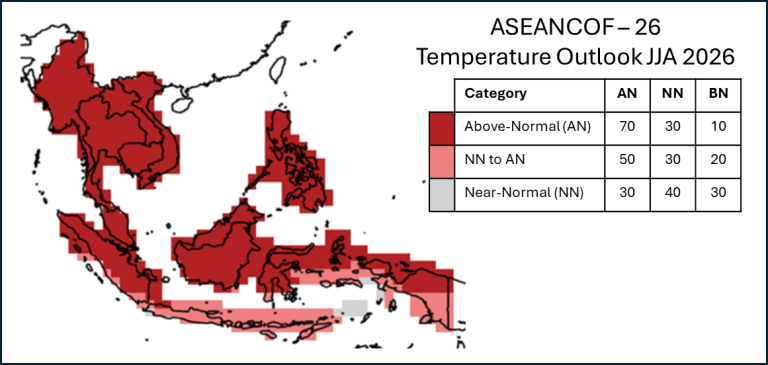
Above-normal temperatures are expected across most parts of Southeast Asia. The exception is over the southern Maritime Continent and parts of northern Viet Nam and northern, southern, and coastal Myanmar, where near- to above-normal temperatures are predicted.
Background
The ASEAN Climate Outlook Forum (ASEANCOF) is an avenue to collaboratively develop consensus-based seasonal climate outlooks and related information on a regional scale. The forum's outlook and its activities contribute significantly to one of the key roles of the ASEAN Specialised Meteorological Centre (ASMC), which is to conduct climate and seasonal prediction for the Association of Southeast Asian Nations (ASEAN) region through pooling the expertise of ASEAN National Meteorological and Hydrological Services (NMHSs).


