
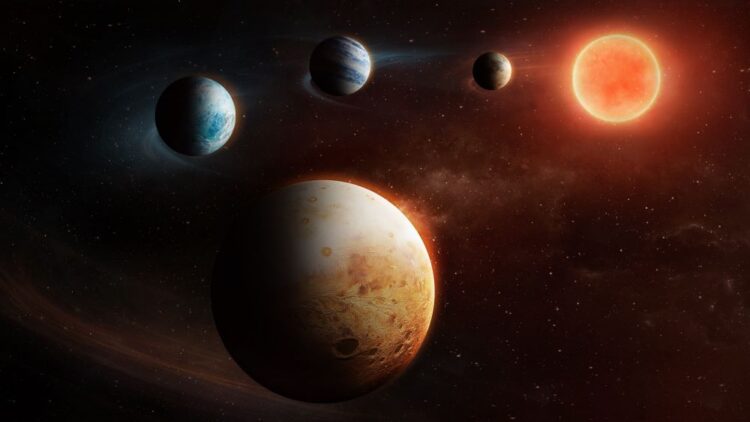
A global team of astronomers, in a project conceived at and co-led by the University of St Andrews, have used a European Space Agency (ESA) telescope to discover a planetary system that turns our understanding of planet formation upside down, with a distant rocky world.
In our Solar System, the inner planets, Mercury to Mars, are rocky, and the outer planets, Jupiter to Neptune, are gaseous. This planetary pattern, rock then gas, is consistently observed across the Milky Way.
However, in a paper published today (Thursday 12th February) in Science, an international team of researcher's findings reveal a system of four planets that breaks this convention.
The team, led by Assistant Professor Tom Wilson at the University of Warwick, examined a cool, faint red dwarf star known as LHS 1903 and confirmed that its inner planets follow the expected pattern: a rocky world orbiting close to the star, followed by two gas giants farther out. But when the astronomers used ESA's CHaracterising ExOPlanet Satellite (CHEOPS) to study the system in more detail, they discovered an unexpected fourth planet on the outer edge. Surprisingly, this distant planet turned out to be rocky rather than gaseous creating a rare "inside‑out" planetary system that defies conventional formation theories.
Traditional models suggest that the closest planets to stars are rocky because stellar radiation sweeps away their gaseous atmospheres, leaving dense, solid cores behind. Gas giants form farther out in cooler regions where gas can accumulate, and planets can hold onto it. Yet the distant rocky world orbiting LHS 1903 appeared to have either lost its gaseous atmosphere or never formed one.
The team set out to explore various explanations for this rogue rocky planet. They found evidence that the four planets did not form at the same time but instead formed one after another, a process called inside-out planet formation, which could explain the rocky planet.
According to current understanding, planets form from discs of gas and dust around stars (called protoplanetary disc). The gas and dust clumps together into planetary embryos all at roughly the same time. These clumps then evolve into planets of different sizes and compositions over millions of years, but all the planets began forming in the same environment at the same time.
In contrast, the most compelling theory to explain the rocky planet says that LHS 1903 gave birth to its four planets one after another from the inner to outermost planet, instead of bearing quadruplets at once. This means that each planet evolved separately, sweeping up nearby dust and gas, with further out worlds waiting their turn for the next planet to form.
Much like how younger siblings grow up in a world that is different from their elders, this small rocky planet seems to have evolved and formed in a very different environment than its older sibling-planets – in an outer area of the disc where gas had already run out.
The project was conceived at the University of St Andrews and much of the data was analysed by the School of Physics and Astronomy, that led to the discovery of two additional planets in the system, and measuring of their radii and masses. St Andrews researchers discovered that the star had exoplanets using ground and space-based telescopes. They then worked out the "order" of the planets from closest to furthest from the star. These early investigations in St Andrews laid the solid foundation for the overall study.
Co-author Professor Andrew Cameron from the School of Physics and Astronomy said: "The differences between sibling planets in this closely packed family of four offer important new clues to their birth environment around a small star much older than the Sun."
Category Research


