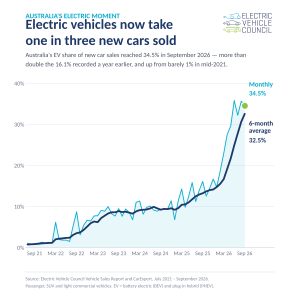
Electric vehicles account for more than one-third of new car sales in Australia as six-month rolling average reaches a record high.
Battery electric vehicles (BEVs) have outsold petrol cars in Australia for the second consecutive month, underscoring a sustained shift towards electric vehicles.
Australians bought 26,287 battery electric vehicles in September, representing 24.9% of new car sales, ahead of petrol cars at 24.7%.
Other key results for September included:
- Combined BEV and plug-in hybrid (PHEV) sales accounted for 34.5% of the market, more than double the 16.1% recorded in September last year.
- Combined EV sales reached 36,359, up 119% year-on-year, while the overall new car market grew just 2.3%. Petrol sales fell 36.2% and diesel sales declined 18.4% compared with September 2025.
- The six-month rolling average for combined EV market share reached a record 32.5%, up from 30.6% in August.
Electric Vehicle Council CEO, Julie Delvecchio said that while delivery schedules would continue to influence monthly results, the longer-term trend showed a clear change in consumer preferences.
"Battery electric vehicles holding the top sales spot for a second consecutive month is a huge milestone in Australia's transition to electric transport," Ms Delvecchio said.
"More than one in three new cars sold in September was electric, and the record six-month rolling average shows this is a sustained change extending well beyond a single strong month. Australian consumers are showing us clearly what they want.
"Record diesel prices are the sharpest reminder yet that the cheapest fuel is the one you never have to buy. High fuel prices hit households, tradies and small businesses where it hurts most – at the bowser.
"Australians are doing the maths, and the maths says electric. More models at more price points mean more households can find an EV that fits their life and their budget. Australians are being given the choice, and they're taking it.
"As more Australians make the switch, the focus now needs to be on scaling charging infrastructure and making it easier for more households and businesses to choose electric."