
When Professor Jamie Spangler, Engr '06, walked into the Johns Hopkins University board of trustees meeting on Thursday, she thought she was just there to give a presentation on her work with the Johns Hopkins Center for Translational ImmunoEngineering (JH-TIE).
Instead, she walked out with a President's Frontier Award, $300,000 in research funding, and a glass of sparkling cider.
"I actually pride myself on the fact that I'm literally never surprised by anything," said Spangler, an associate professor in the university's departments of Biomedical Engineering and Chemical and Biomolecular Engineering. "I would say this is easily the first time that I've been surprised in so many ways."
Video credit: Aubrey Morse / Johns Hopkins University
Spangler is not just an internationally recognized leader in molecular immunoengineering—she helped define the field. Her groundbreaking work has created novel approaches to engineering cytokines, antibodies, and other proteins, allowing for greater control of the body's immune responses. This includes engineering molecules and protein platforms that do not exist in nature, leading to new therapeutic strategies that would otherwise be impossible. Spangler's innovations have a wide range of potential uses, including cancer immunotherapy, tissue regeneration, and treating infectious and autoimmune diseases, a testament to the potential for research to save lives.
With this in mind, Johns Hopkins leaders—with a consulting panel of experts from Penn, Princeton, Stanford, and Yale in enthusiastic agreement—saw Spangler as the obvious choice to receive one of the university's top honors: the President's Frontier Award, an annual prize given to a faculty member making transformative contributions to their field.
After Spangler finished her presentation alongside JH-TIE leaders Jonathan Schneck and Jordan Green, JHU President Ron Daniels called her back up to the podium. At that moment, over 30 of her coworkers, students, mentors, and family members filed into the room.
"Jamie, the cross-cutting interdisciplinary methods that you pioneered at the intersection of structural biophysics, biomolecular engineering, and translational immunology have already accomplished so much," Daniels said. "Your work represents not just a single breakthrough, but an inflection point in the way we understand and treat complex diseases. One that stands to give us the ability to rewire the human immune system, to resist and even reverse disease processes. ... [Your innovations] are not only defining the field of molecular immunoengineering with your colleagues, but they are truly helping us chart new pathways to Hopkins' founding goal: bringing the benefits of discovery to the world."

Image credit: Will Kirk / Johns Hopkins University
Added Ted DeWeese, dean of the medical faculty and CEO of Johns Hopkins Medicine: "It is so fabulous to know someone like you who embodies what I think are the best attributes of Hopkins, and that long arc of history to get to today is wonderful. ... Immunology is one of the key future pieces of this institution and of science more broadly ... and you are right at the forefront with your colleagues in doing it. I can't actually wait to see what is next."
Spangler was completely stunned by the award—and by the arrival of her mother, who had avoided any suspicion by switching her phone's location to a spare device in Chicago.
The President's Frontier Award was launched in 2015 thanks to a generous gift from trustee Louis J. Forester, A&S '82, SAIS '83. Past winners include trauma surgeon Joseph Sakran in 2024 and Indigeneous health researcher Melissa Walls in 2023.
Spangler joins their ranks with more than 70 publications and 13 patents under her belt, as well as industry uptake of her lab's technologies. Her innovations have also influenced real-world pharmaceutical research and development, with one of her autoimmune patents licensed for drug development.
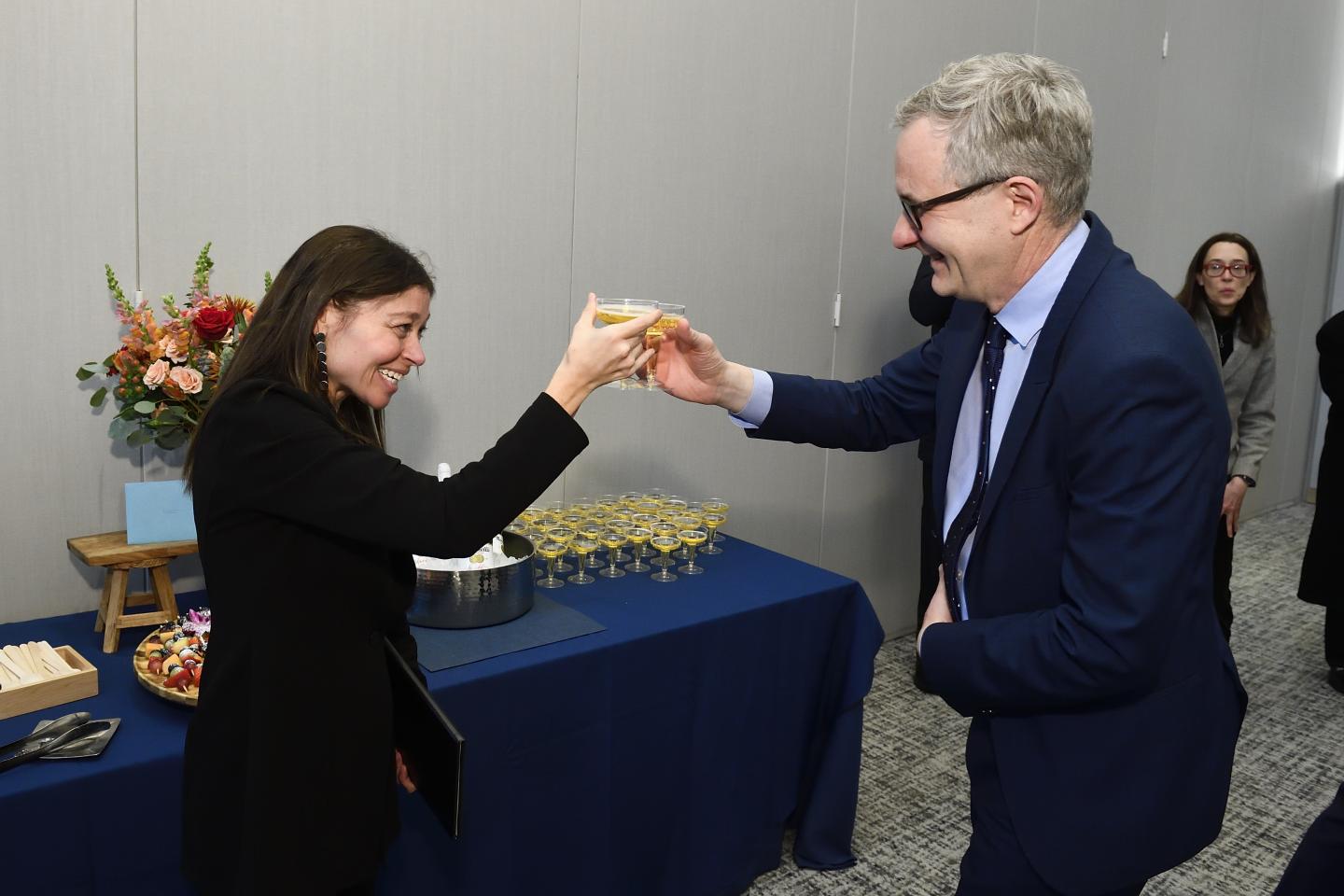
Image credit: Will Kirk / Johns Hopkins University
Beyond her scientific contributions, Spangler is also a respected teacher, mentor, and leader who regularly gives back to the Baltimore community through STEM education programs.
After the surprise, several of Spangler's peers gave toasts in her honor, including Professor Jennifer Elisseeff, who leads JHU's Department of Chemical and Biomolecular Engineering.
"It really brings me back to the beginning, ... scheming of how I was going to get Jamie here at Hopkins," Elisseeff said. "It was tough competition. And so I was there in the lobby telling her how Hopkins is the best place to be and you're going to love it and all the great collaborations and its great, great researchers. And still to this day, when I travel, people will say, 'You got Jamie. We had an offer for her!'"
When asked, Spangler said she will use the funding to continue her lab's immunoengineering research.
"This is such a critical time to be supporting science and to be supporting translation, especially in the protein engineering field," Spangler said. "I really, really hope to be able to use this money to further the translation of our discoveries and bring those to people, bring those to society, and just bring those to the world."
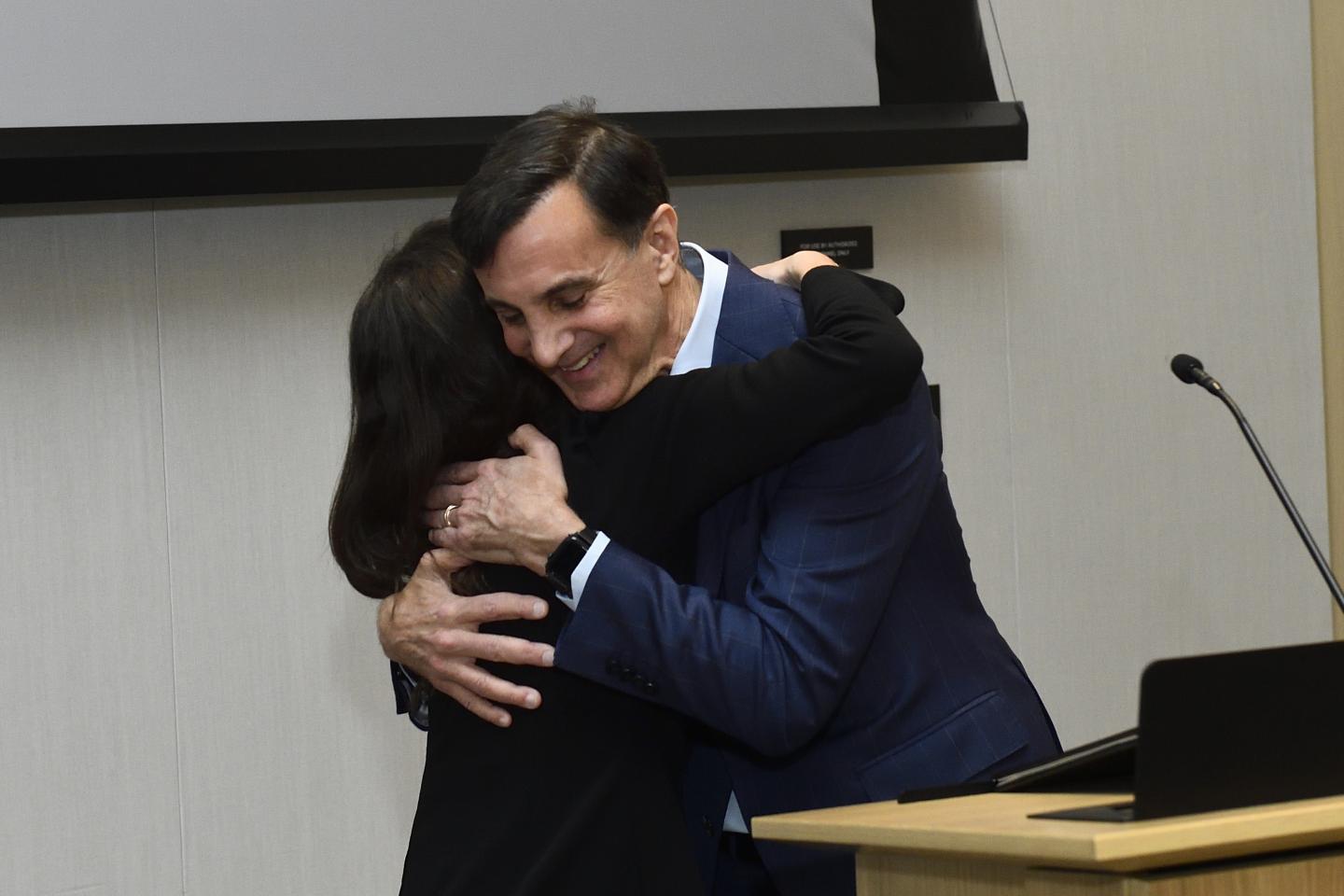
Image credit: Will Kirk / Johns Hopkins University


