
Cabo Verde launched the implementation of the United Nations Secretary-General's Early Warnings for All (EW4All) initiative through a national roll-out and consultation workshop held on 16-17 December 2025.
This milestone marks a significant step toward strengthening multi-hazard early warning systems (MHEWS) and protecting people, livelihoods and development gains from climate and weather-related hazards.
The consultation followed recent hazardous events that affected the archipelago, including the islands of São Vicente and Santiago. These events reinforced the urgency of strengthening end-to-end, multi-hazard early warning systems that translate risk information into timely, coordinated action at national and local levels.
Participants emphasized that more frequent and intense weather and climate-related hazards are already testing existing systems, underscoring the need for sustained investment, clearer institutional roles, and stronger linkages between forecasting, warning dissemination, and preparedness and response.
Whole-of-system approach across the MHEWS value chain
The national roll-out was led by the Minister of Agriculture and Environment, H.E. Gilberto Silva, Cabo Verde's national EW4All focal point, underscoring high-level political commitment to advancing MHEWS as a national priority.
The event brought together institutions across the full MHEWS value chain, with each national pillar lead formally assuming their coordination role to drive implementation. The National Civil Protection Service (SNPCB), the National Institute of Meteorology and Geophysics (Instituto Nacional de Meteorologia e Geofísica - INMG), the Economic Regulation Agency (Agência Reguladora Multissetorial da Economia - ARME), the Cabo Verde Red Cross, and the National Secretariat for Climate Action (Secretariado Nacional de Ação Climática - SNAC) joined the event as national technical leads for the initiative.
Together, these institutions committed to strengthened collaboration across risk knowledge, monitoring and forecasting, warning dissemination, and preparedness and response, reflecting the core ambition of EW4All to ensure that early warnings translate into timely, people-centred action.
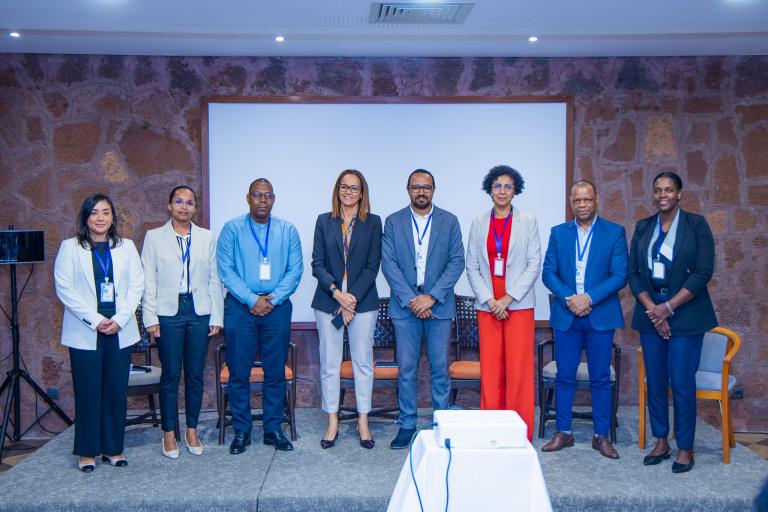
The Consultation Workshop
The roll-out was coupled with a two-day multi-stakeholder consultation workshop, bringing together national institutions, partners, and stakeholders to:
- Map existing capacities, systems, and investments across the MHEWS value chain;
- Identify gaps and bottlenecks limiting end-to-end early warning effectiveness;
- Highlight opportunities for coordination, system strengthening, and investment alignment; and
- Build a shared understanding of priority actions needed to scale impact nationally.
These discussions provided a strong evidence base for strategic planning, ensuring that EW4All implementation in Cabo Verde builds on existing strengths while addressing critical gaps.
National EW4All roadmap advancing toward validation and implementation
A national EW4All roadmap was first drafted during the workshop, setting out priority actions, institutional responsibilities, and sequencing across pillars for a five-year implementation period. The roadmap is now moving swiftly toward public review and validation in 2026, with implementation expected to begin in 2026 and extend over a five-year period. The roadmap is designed to align with national development priorities and climate resilience objectives, while reinforcing coordination mechanisms across institutions responsible for early warning and early action.
Linking planning to financing
Efforts are also underway to align national budget resources and cooperation projects to strengthen national MHEWS capabilities. Cabo Verde is advancing on the preparations of a MHEWS proposal to the Green Climate Fund (GCF) to support implementation of the national EW4All roadmap. Altogether, this financing pathway aims to translate the EW4All vision into sustained investments that strengthen technical capacities, institutional coordination, and people-centred warning services. By bringing together political commitment, technical coordination, and financing pathways, the country is laying the foundations to ensure early warnings lead to early action, reducing losses and safeguarding lives in the face of increasing climate and weather extremes.


