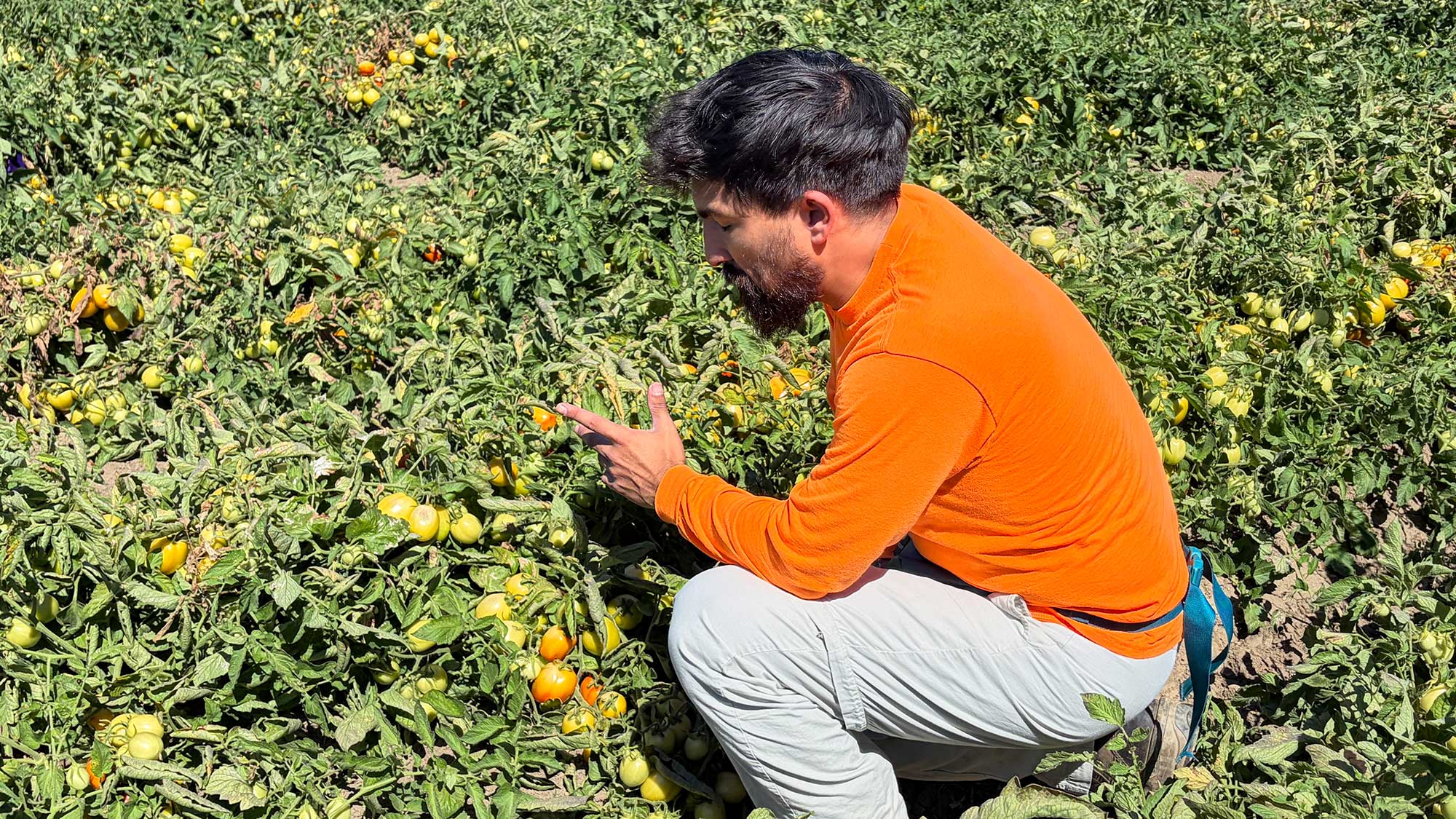
Majdi Abou Najm stands in a tomato crop under the summer sun in UC Davis's agricultural research fields. A few hours after sunrise, the sun is beginning to feel less like warmth and more like a weight - the kind of heat that could scald tomatoes on the vine.
"If you live in the Central Valley, you realize two things: We don't have a lot of water, and we have a lot of sun," said Abou Najm, a soil biophysics professor in the Department of Land, Air and Water Resources.
Too much sun, and crops can fail. As California grows hotter and water becomes scarcer, farmers are looking for ways to protect crops from both. That's the problem Abou Najm has spent years trying to solve.

"This is where agrivoltaics comes into play," he said.
Agrivoltaics uses solar panels in farm fields not just to produce energy from the sun, but to shield the plants from too much of it.
"When the plant gets less sun, it will be less thirsty. We worry less about heat-induced stress and heat-induced diseases and damage," Abou Najm said.
The stakes go beyond one tomato field. Feeding a growing population on shrinking farmland, in a climate that's only getting harder on crops, means every acre must work harder. Agrivoltaics is a bet that the same acre can grow food and generate power at once.

Testing solar panel designs side by side
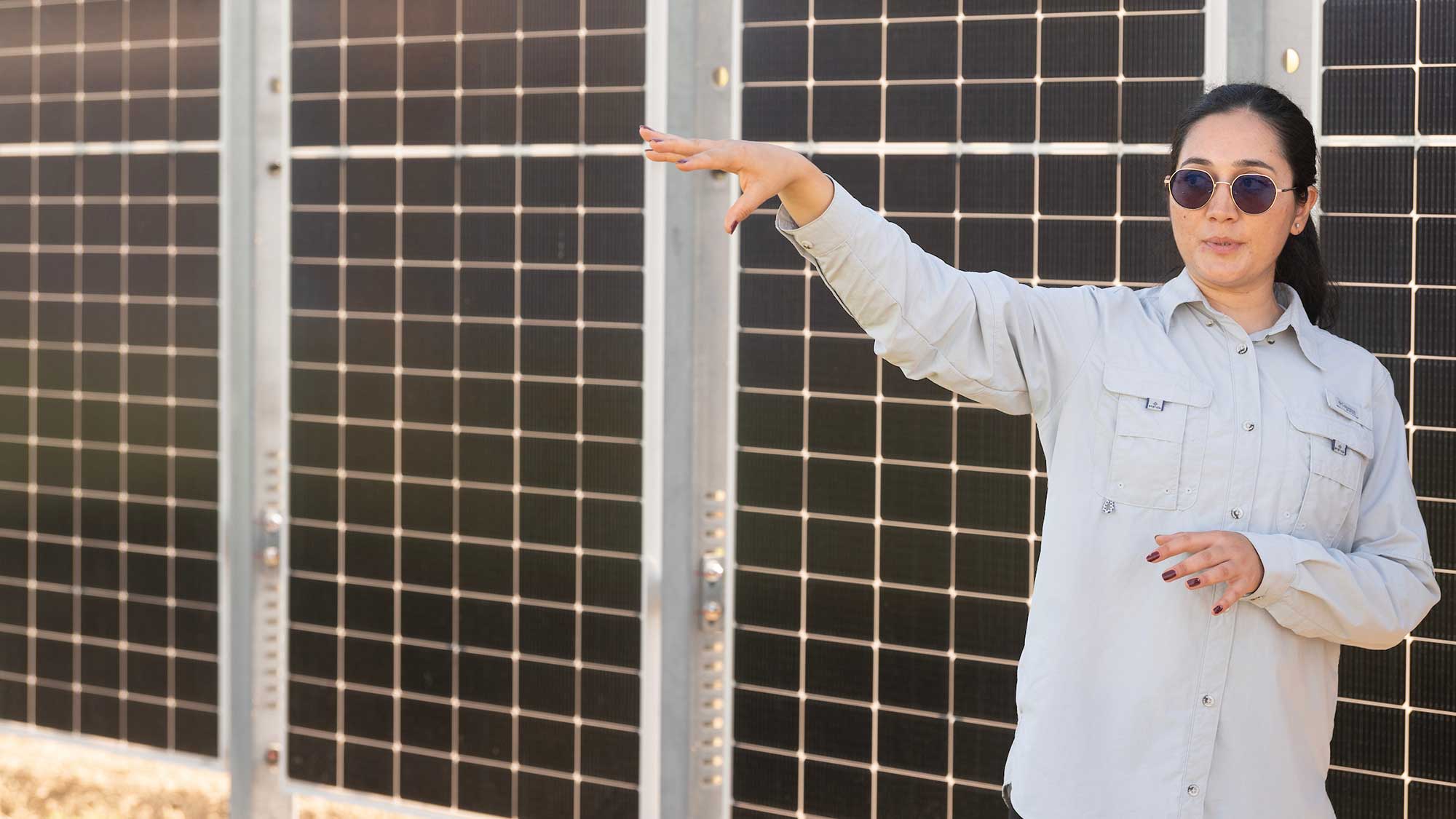
The UC Davis agrivoltaic site is testing four solar designs side by side under the same soil, climate and crop.
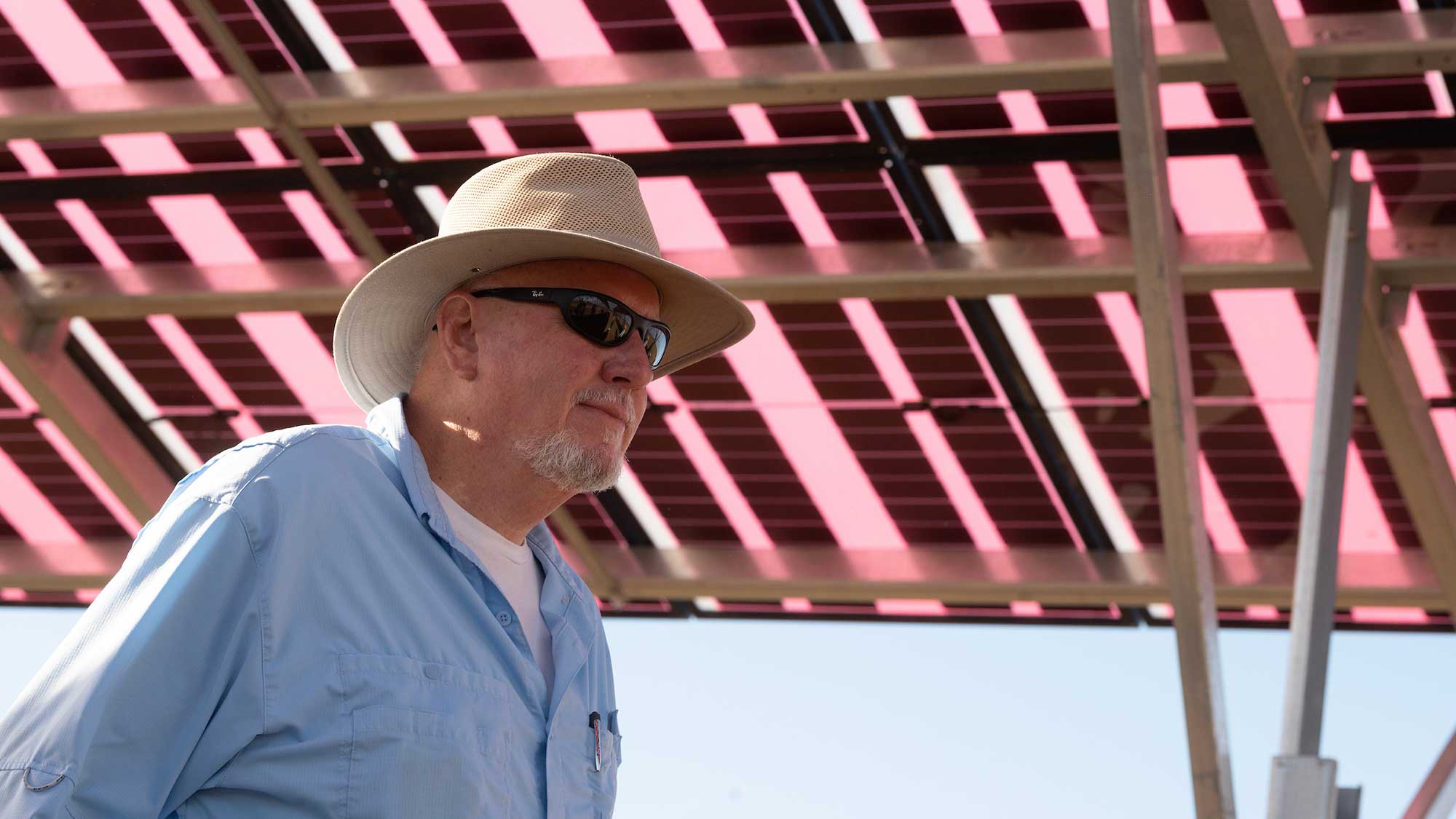
Vertical solar panels harvest light on both sides and shade different parts of the crop as the sun's light moves across the field. Two single-axis systems track the sun east to west. A tall fixed-tilt array uses "spectrally selective" red-tinted panels that allow red light to pass through to the plants, which is best for photosynthesis. Other wavelengths are used to generate electricity.
"We're not only optimizing light, but we're also optimizing every single spectrum of it," Abou Najm said.
Subsurface irrigation lines feed two adjacent tomato fields. One receives 100% of the water the crop typically needs, the other gets just half. The researchers are measuring water use efficiency: how much crop can be produced with the least amount of water. Farmers already know roughly how much water a crop needs under normal conditions. But solar panels can change the environment around the plants by creating shade and a different microclimate.
The three-year project, funded by the California Department of Food and Agriculture, is testing agrivoltaics with both summer and winter crops to better understand how the different systems affect water use and crop production.
Can agrivoltaics save water?
That's where Gavin Chaboya, a doctoral student in Abou Najm's lab, comes in. He's trying to determine how much water these tomato plants pull from the soil and release into the air - a process called evapotranspiration - and how that changes under solar panels.
The standard formulas that farmers and water regulators rely on assume full sun. When a panel shades part of a field, those formulas may no longer accurately estimate how much water the plants need. Chaboya is building a model to account for any changes.
"We also need to understand the problems directly caused by the deficit irrigation and how these vertical solar panels may help address them," said Chaboya. "We'd expect the tomato row completely covered in shade for the majority of the day to have a lower yield, but we need to figure out to what degree."
Unlike tomatoes, more shade-tolerant crops, like peppers, might not have any yield losses in agrivoltaic systems. And lower yield doesn't necessarily mean less money for farmers if they're also generating energy.
The team's findings could eventually help growers weigh whether agrivoltaics pencils out for them and could help them meet water conservation requirements.
Agrivoltaics: an industry in its infancy
Yuba City-based Sunlight Energy worked with Abou Najm to engineer and build these solar systems. Business Development Director Kevin Logue said he sees agrivoltaics as necessary under a changing climate.
"I saw this as an avenue not just to build our business but to help farmers grow food and to really help make farming more sustainable," Logue said.
He said the industry is still in its infancy. Nationally, agrivoltaics - a category that includes grazing livestock and pollinator habitat as well as growing food - covers roughly 85,000 acres, according to a federal tracking database. Crop production specifically, the kind Abou Najm is testing, accounts for a much smaller slice of that, according to the database: only about 5,000 acres.
Logue said the UC Davis agrivoltaics site is a testing ground for growers to see what type of design might work best on their farms before committing to one.
The cost barrier for farmers
Committing to agrivoltaics isn't like deciding to throw compost on your crop one year, said Abou Najm.
"It is a major capital investment," he said. "If you commit to agrivoltaics, you've also transformed your field for the next 25 years, if not forever."
Costs vary depending on design, but a 100-kilowatt system - enough to power 10 to 15 homes for a year - can easily run between $250,000 and $300,000 installed.
"Most farmers can't afford to do this," said Logue.
Financing hasn't caught up either. Banks lend for rooftop solar but not for agrivoltaics - a barrier that may hit smaller farmers harder. At a recent demonstration at the UC Davis site, growers were intrigued but cautious.
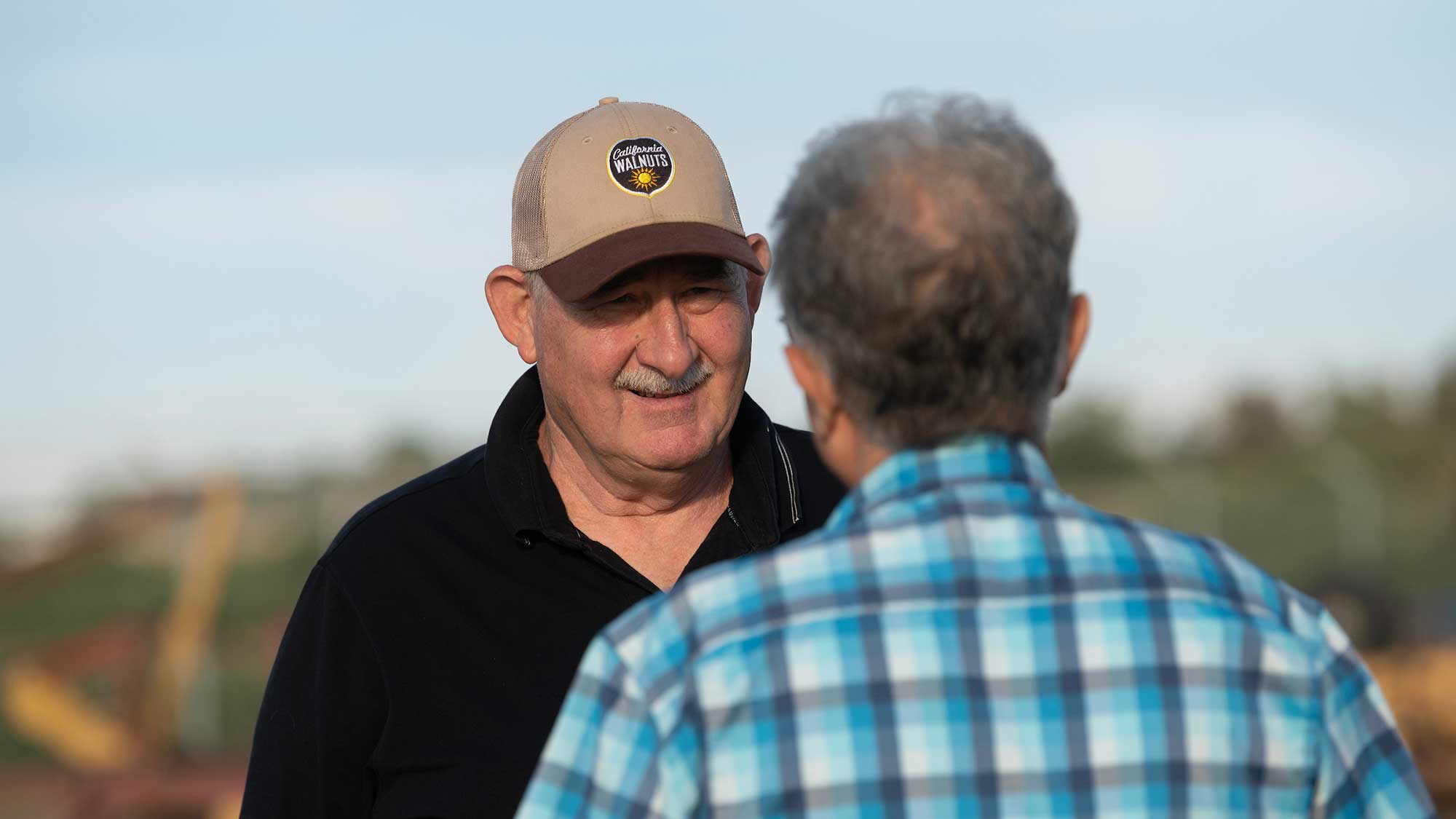
Greg Roth, a Winters walnut farmer, said he was struck by the vertical solar panels' small footprint. He said it could work on his family's farm in Michigan, where they grow corn, wheat, soybeans and sugar beets.
"They wanted to add solar panels to a wind farm they currently have, but because it takes up so much land, it makes it really difficult to continue regular agriculture with tractors," Roth said. "But this vertical approach is very exciting because it keeps the roads clear."
Even with a slight yield loss from shaded plants, he said, "you can still add back the energy generation. That's really exciting to us. It almost gives you more stable income when crop prices go up and down."
Some orchard crops - like olives, grapes, apples and pears - benefit from shade that solar panels would provide.
Bruce Rominger, who grows a variety of crops in Yolo County, already has a small solar project on his farm. He uses the panels to offset the energy needed to run his irrigation pumps.
"We're interested in a larger-scale project where we can be selling power to a utility, but we'd also have irrigated pasture underneath to graze sheep," he said.
A hotter, drier planet
For Abou Najm, the question is how agriculture can adapt to conditions that are already changing.
"We're living on a hotter and drier planet, and it's getting hotter and drier as we speak," he said. "Agrivoltaics is a way to make the heat ... into energy generation, and as you do that, you create a microclimate that will make agriculture feasible even in a drier place."
Whether that vision works for growers will depend on what researchers learn about water, yields, crops and costs. But the challenge is getting harder to ignore: California will need to produce food with less water and limited farmland in a climate that is becoming hotter and drier. The goal of the research is to find out whether agrivoltaics can help growers make that equation work.