Key Takeaways
- Researchers used X-rays from Berkeley Lab's Advanced Light Source to measure degrees of misorientation between nanoscale crystals in tooth enamel.
- Their analysis of teeth spanning primate species, time periods, and diets shows that the degree of misorientation increases in relation to the hardness of foods in a species' diet.
- The study also found that significant increases in misorientation tracked with historic shifts in humanity's diet, from wild fruits to meat to the adoption of agriculture.
At the nanoscale, our teeth aren't perfectly straight, and it's probably for the best. New research shows that the nanoscale crystals inside tooth enamel don't line up neatly with their neighbors, and this misorientation has been increasing over millions of years of evolution, likely making our teeth tougher in the process. The findings, published in Nature, offer the first look at how humanity's major dietary shifts, from wild fruits to meat to processed grains, left their mark on the nanostructure of our teeth.
Researchers studied 12 teeth spanning species, time, and diet, including an extinct ape that munched fruit in Kenya more than 17 million years ago, a Paleolithic hunter-gatherer who lived in Spain some 40,000 years ago, and a modern-day human from the United Kingdom, among others.
Researchers imaged the teeth with X-rays at the Advanced Light Source (ALS) at the U.S. Department of Energy's (DOE) Lawrence Berkeley National Laboratory (Berkeley Lab). They found that modern primates who eat harder foods consistently show higher levels of nanocrystal misorientation - a pattern that suggests the disorder helps enamel hold up against tougher food.
"This correlation between degrees of nanoscale misorientation in our tooth enamel and changes in diet informs our understanding of fundamental natural processes, our own evolution, and biomimetic design for better, more resilient materials," said Pupa Gilbert, visiting faculty scientist at Berkeley Lab, and professor of physics at the University of Wisconsin, Madison.
What teeth can tell us
Lead author of the study, Gilbert studies biomineralization, the process by which living organisms like snails, corals, and humans produce rock-hard minerals such as shells, skeletons, and tooth enamel. "I'm fascinated by how squishy, soft organisms produce tough, nanocrystalline materials, and how they do it better and more efficiently than anything else in nature," Gilbert said.
Understanding these nature-made crystals informs fields ranging from materials design to human evolution.
"In tooth enamel, nature offers a blueprint for the design of highly resilient ceramic materials," said Barat Achinuq, Berkeley Lab project scientist and author on the paper. Insights from enamel research have shaped the design of dental crowns, microchips, and even aerospace heat shields.
Because enamel is the most heavily mineralized tissue in the body, it preserves a remarkably durable record of our deep past.
"Teeth resist deformation during fossilization much better than bone, and they're far more resilient than DNA," said Mackie O'Hara, a dental anthropologist and evolutionary biologist at Ball State University and author on the paper. "From one tooth, we can derive information about a species' diet, general health, and up to three years' worth of data about an individual's life - if they were eating well, and even when they were stressed."
Disorder at the nanoscale
Gilbert spent years studying tooth enamel at the macroscale, looking at its overall shape and strength, and at the microscale, where a crisscrossing pattern of enamel rods helps prevent cracks. A few years ago, she decided to look closer still, down to the nanoscale, and made a surprising discovery: although the nanocrystals within each enamel rod were geometrically aligned and parallel to one another, their crystal structures were not aligned - contrary to what scientists had previously assumed based on the form of the enamel rods.
"Each crystal was several degrees misoriented with respect to their neighboring crystals," Gilbert said. "We hypothesized that somehow this misorientation contributed to enamel's toughness, but we couldn't be sure without studying more teeth."
Working with collaborators from the National Museums of Kenya, the University of Kent, and Ohio State University, the team sourced teeth from humans and ancient human ancestors, other great apes, and monkeys - one of the most extensive collections of teeth ever used for a study of this kind.
At the ALS, they imaged the teeth using X-ray photoemission electron microscopy, which relies on bright, polarized, low-energy X-rays tuned to a specific element - in this case, calcium.
"This technique allows us to determine the orientation of these crystals and their neighbors, and the degree of misorientation across the exposed surface of the tooth," said Achinuq, who manages the operation of the ALS instrument the team used.
Misorientation across diet and time
The team mapped degrees of misorientation against each primate's diet and found a sharp contrast across six samples. At one extreme, the sooty mangabey, a monkey from the tropical forests of West Africa, showed unusually high misorientation. "Mangabeys eat these everlasting gobstopper-like seed casings," O'Hara said. "They are twice as hard as a cherry pit, and yet this monkey chomps right into them." The chimpanzee, which prefers soft fruit like bananas and figs, showed much lower misorientation. The other teeth, from primates with more varied diets, fell between these edge cases and tracked closely with diet.
A subset of the samples - those from human and human ancestors - told a parallel story over time. In humans, misorientation increased alongside two major dietary transitions: the shift from a largely plant-based diet to one incorporating meat around 2 million years ago, and the shift to agriculture roughly 12,000 years ago.
"With the shift from wild plants to meat, there was an increased strain on teeth that were now tearing, grinding, and chewing tougher food," Gilbert said.
The adoption of agriculture left an even starker mark. Compared to a pre-agriculture individual living 40,000 years ago, samples from agricultural populations living just 1,500 to 700 years ago showed nearly twice as much misorientation.
"This one can surprise people," O'Hara said. "While processed grains like oats and bread are softer than unprocessed plants and meat, the grindstones that were originally used for milling actually introduced a lot of grit - essentially, small rocks - into our diets, which took a toll on our teeth."
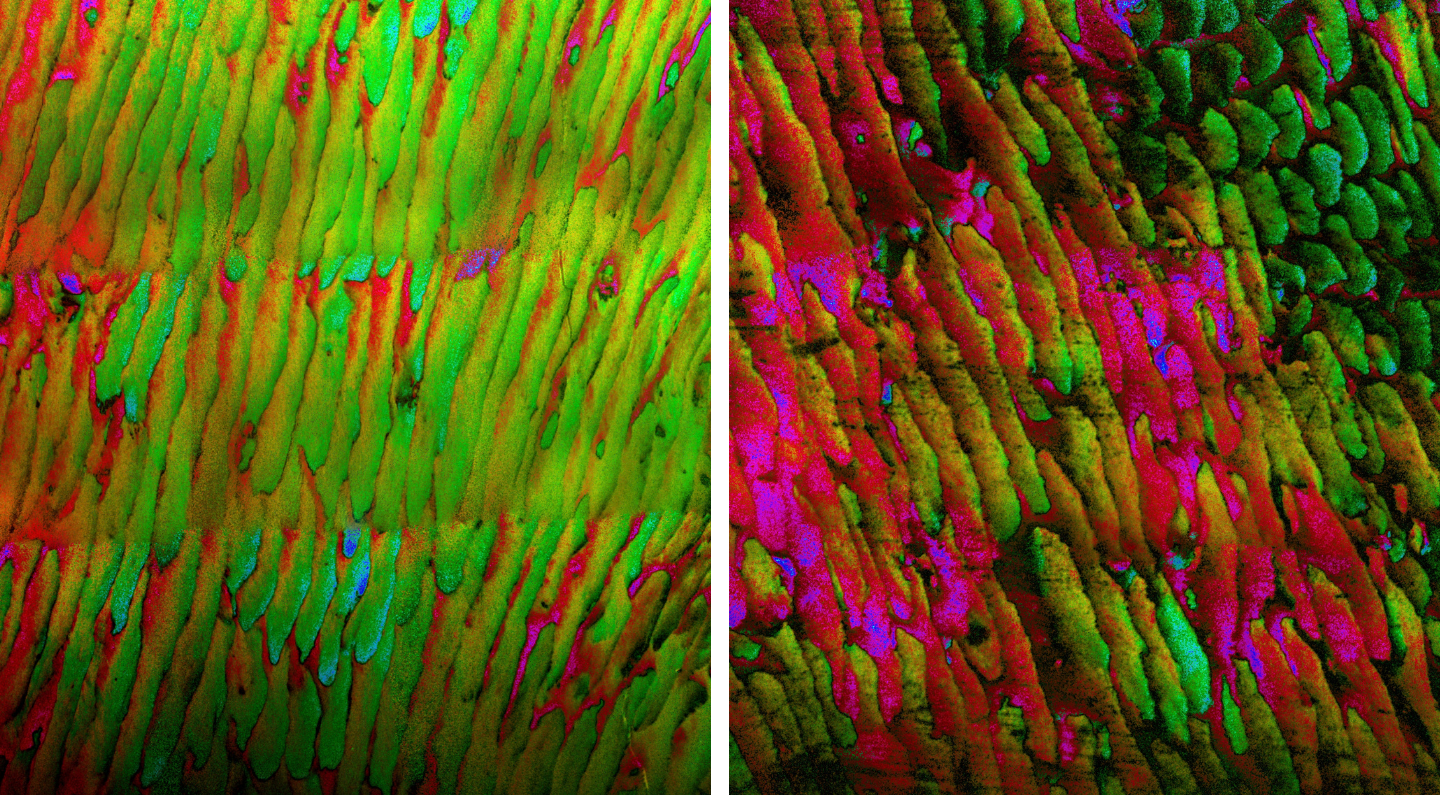
Both transitions required teeth to withstand more mechanical stress, and in both cases, the enamel appears to have responded by becoming more structurally disordered, and likely tougher, at the nanoscale.
Curiously, the Industrial Revolution, another major dietary shift in human history, left no measurable mark on enamel nanostructure. "It didn't make the slightest change from the misorientation point of view," Gilbert said, noting that 250 years may be too short a span for genetic changes to develop, or that earlier dietary shifts may have toughened enamel enough that no further adaptation was needed.
In the future, the team hopes to add more teeth to their timeline. "With more data points, we can get an even sharper understanding of the role of these nanoscale misorientations and how they have responded to diet over time," Gilbert said.
This research was supported in part by the DOE Office of Science and the National Science Foundation. The Advanced Light Source is a DOE Office of Science user facility at Berkeley Lab.