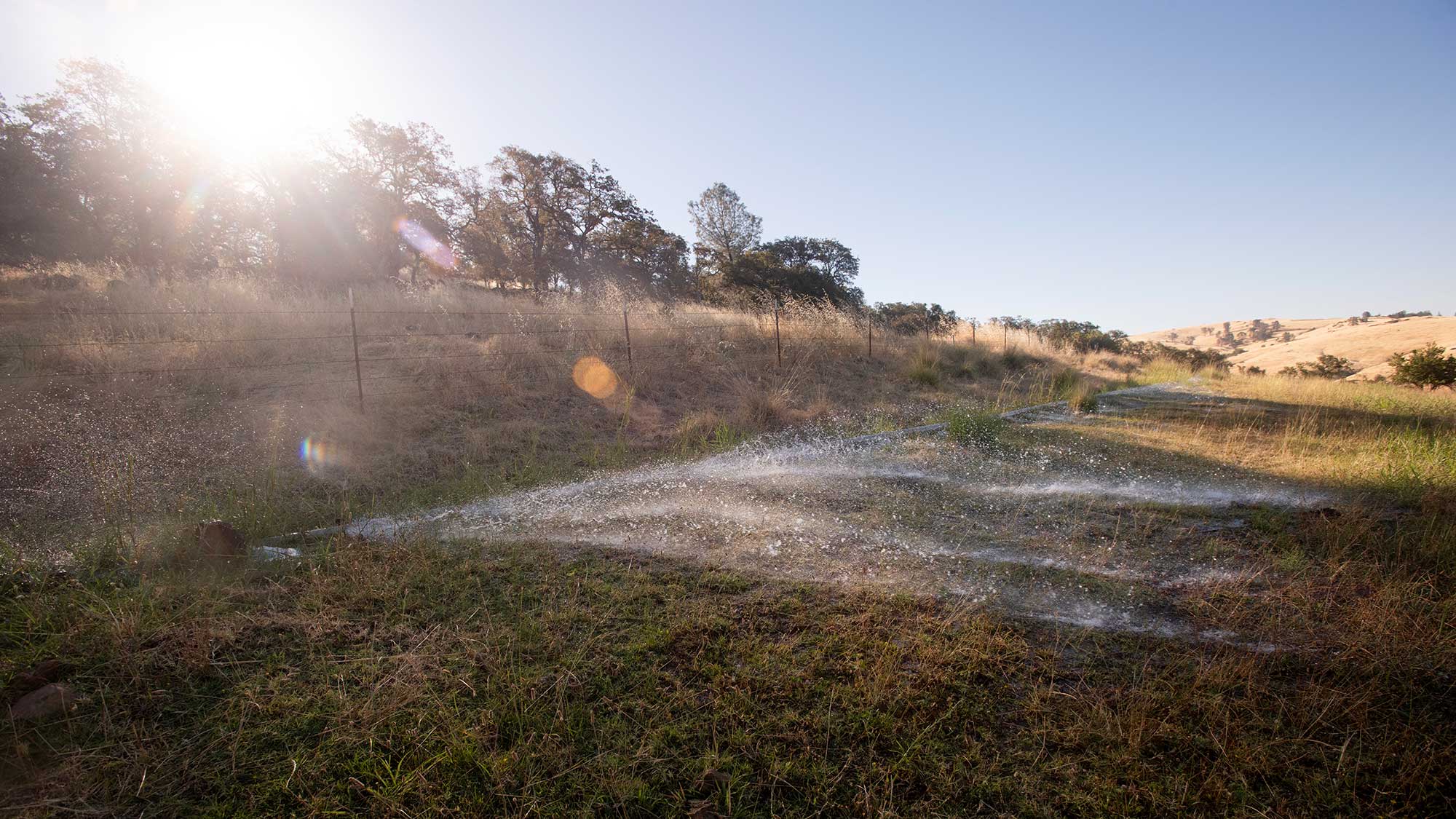
Water flooded the pasture, spilling from an irrigation pipe tucked alongside a hill at the Sierra Foothill Research and Extension Center, a University of California research facility located about 20 miles east of Yuba City. For more than three hours, starting at 6 a.m. this summer day, the water had seeped into the soils beneath the yellow-green grass, spreading to various depths while flowing downslope toward its destination.
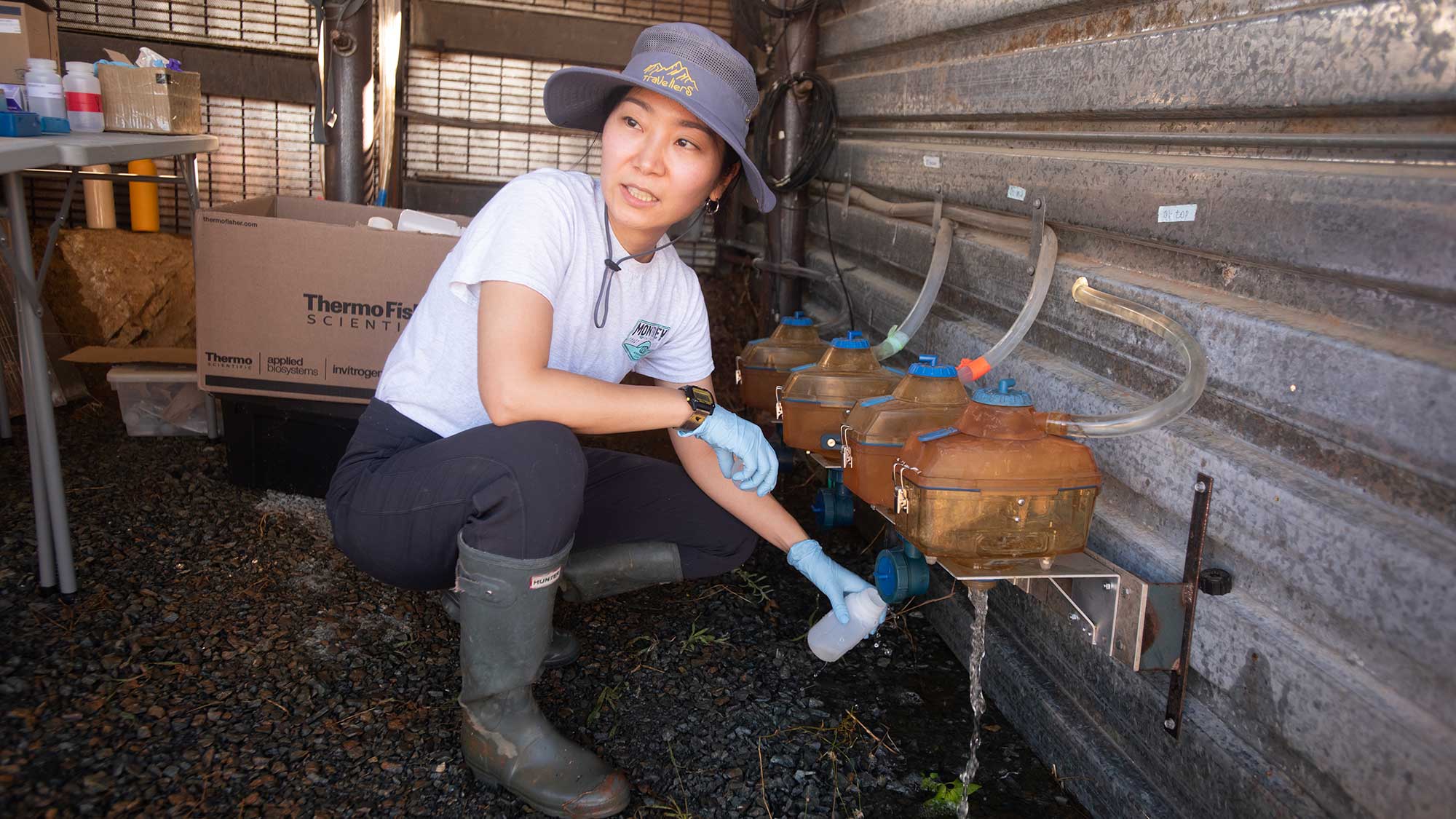
Downhill, Jaeeun Sohng donned rubber gloves and grabbed a sampling bottle. She stood inside an open-air shed built inside a trench cut into the hillside. Sohng knelt and collected water from one of the four spouts releasing the liquid after it had flowed down through the soil. A staccato-like clacking sound punctuated the white noise of running water.
"We are trying to be very particular about sampling," said Sohng, a postdoctoral scholar at the UC Davis Institute of the Environment. "We want to capture the water sample before it interacts with the atmosphere too much. For us, it's vital to understand the chemistry of the water as it exists in the soil."

Sohng is part of the California Collaborative for Natural Climate Change Solutions, a UC Davis interdisciplinary research team studying the efficacy of enhanced rock weathering, one of Earth's most powerful and ancient natural chemical reactions. For billions of years, the Earth's climate has been regulated by the ebbs and flows of this process, in which excess carbon dioxide in the atmosphere is soaked up by the natural breakdown of silicate rocks around the planet.
But our current climate moment is a unique one. Since the Industrial Revolution, the planet's atmospheric carbon dioxide levels have increased exponentially, hitting levels not seen in nearly 14 million years. Humanity's input of carbon dioxide into the atmosphere has outpaced the climatic benefits of the planet's natural rock weathering process.
With current carbon dioxide levels hovering around 425 parts per million, more than 50% higher than preindustrial levels, researchers are interested in enhancing the rock weathering process as part of a mosaic of solutions to help humanity navigate climate change.
"We're taking one of nature's most powerful and longest-lived chemical reactions and trying to take a geo-engineered approach to it," said Isabel Montañez, a professor in the Department of Earth and Planetary Sciences. "Why can't we speed up this process artificially by applying the very rock that does this chemical reaction so efficiently to agricultural lands? We can do this by using what is considered a waste product for the mining industry: rock dust."
Montañez and Toby O'Geen, a professor in the Department of Land, Air and Water Resources, are leading a multi-year, comprehensive study to quantify the benefits of applying pulverized basalt rocks to agricultural fields. This not only has the potential to benefit decarbonization efforts, but it could also improve the nutrient content of the soil, a boon for healthier crop production.
How does enhanced rock weathering work?
The science behind enhanced rock weathering is fairly straightforward. When rain falls and mixes with carbon dioxide in the atmosphere, it creates carbonic acid, an important driver of the global carbon cycle. Due to its acidity, carbonic acid dissolves rock. This chemical interaction allows for the capture of excess carbon, which is soaked up by soil and groundwater.
"Naturally, this is just a very slow process that can take hundreds of thousands of years to have any effect on the carbon dioxide in the atmosphere," Montañez said. "But importantly, it's what made for a habitable planet."
When geochemists look at the geological record, they can pinpoint times in Earth's history when rock weathering led to lower carbon dioxide levels in the atmosphere and thus a cooler climate. For example, when the Himalayas formed tens of millions of years ago, the planet "was weathering like mad," as Montañez put it.
At the global scale, rock weathering allowed for the formation of an environment that was eventually favorable to humanity. But as carbon dioxide emissions increased, both naturally and from human activity, that trend has reversed, leading to our precarious climate conditions.
"Even if we went fully to green energy, we have to be removing carbon dioxide from the atmosphere because there is legacy carbon dioxide residing in the atmosphere that we must remove to get to net zero carbon targets," said Montañez. "We have no choice."
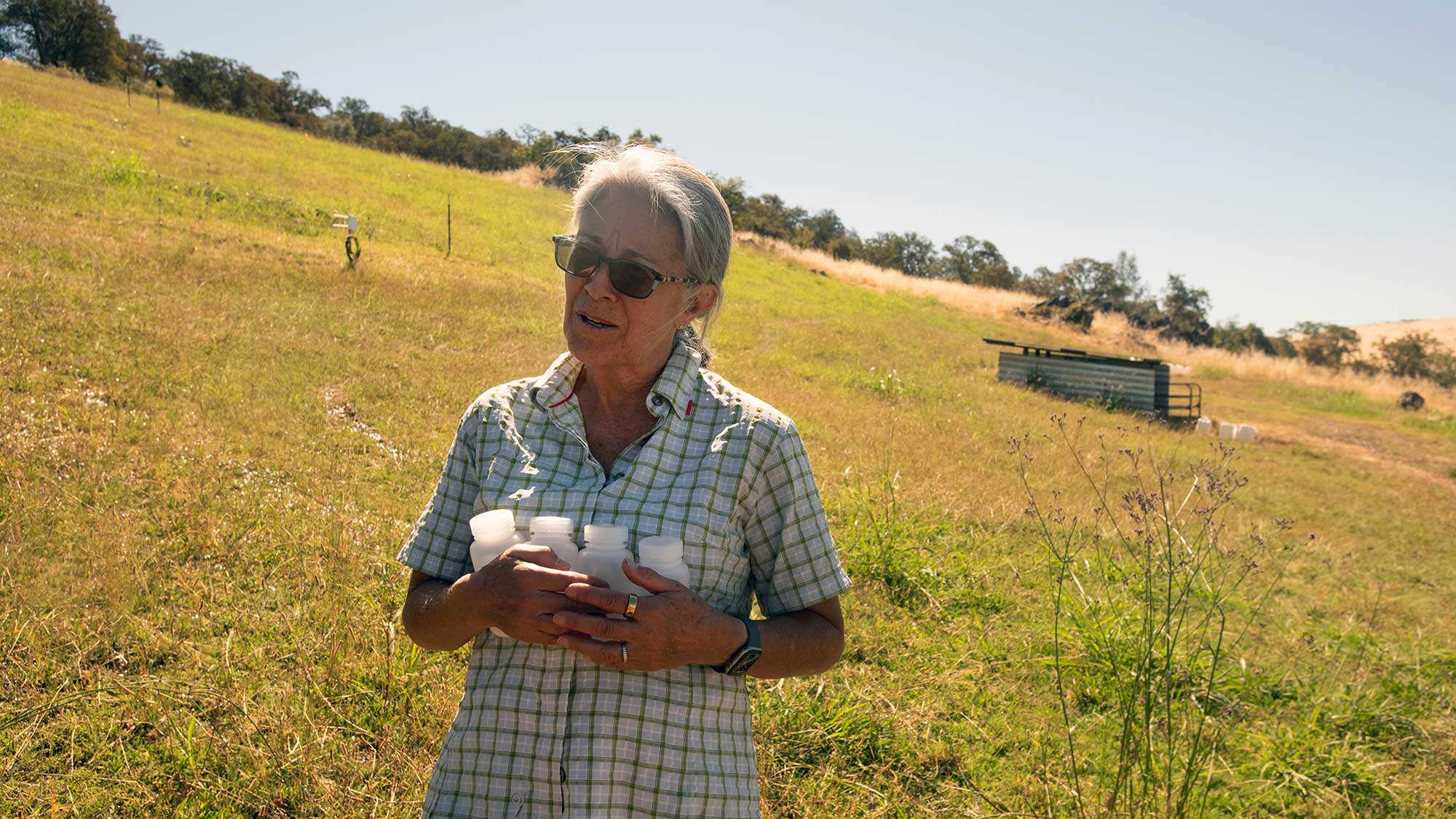
Realizing this, researchers around the globe have been exploring the climatic and agricultural benefits of enhanced rock weathering. Pulverizing basalt rocks to a fine sand and applying it to agricultural lands could speed up the decarbonization process.
"The estimates are that 37% of Earth's landscape has agricultural or ranch land that could do this successfully," Montañez said. "If that were the case, the estimates are it could bring down about 1 to 5 billion tons of carbon dioxide per year."
"What enhanced rock weathering is doing is taking that carbonic acid and turning it into bicarbonate," explained Seth Whiteaker, a Ph.D. student who is co-advised by Montañez and O'Geen. "That means that at the end, we've got carbon that stays in the water longer and either precipitates in the soil, essentially forming limestone in soils, or it gets washed out to the ocean and remains sequestered for thousands of years."
The complexity of soils: a proving ground for foundational science
Some companies have embraced the potential of enhanced rock weathering. In 2025 and 2026, Microsoft and Google were among corporations that invested hundreds of millions of dollars into startups researching the process. Montañez herself has been an unpaid advisor for Microsoft and worked with the company to develop criteria for large-scale deployment.
While the idea of applying pulverized rock to agricultural lands sounds simple, there are many unknowns about its efficacy.
"There's just not enough science to show how, where and why this works best," O'Geen said. "If we can discover those things, then we have a much stronger case for convincing people that this practice is not only good for the environment, but it might actually benefit the bottom line for farmers by making the soils healthier."
"The money is ahead of the science," O'Geen added. "We're not able to monetize correctly because we don't understand the magnitudes of carbon sequestration."
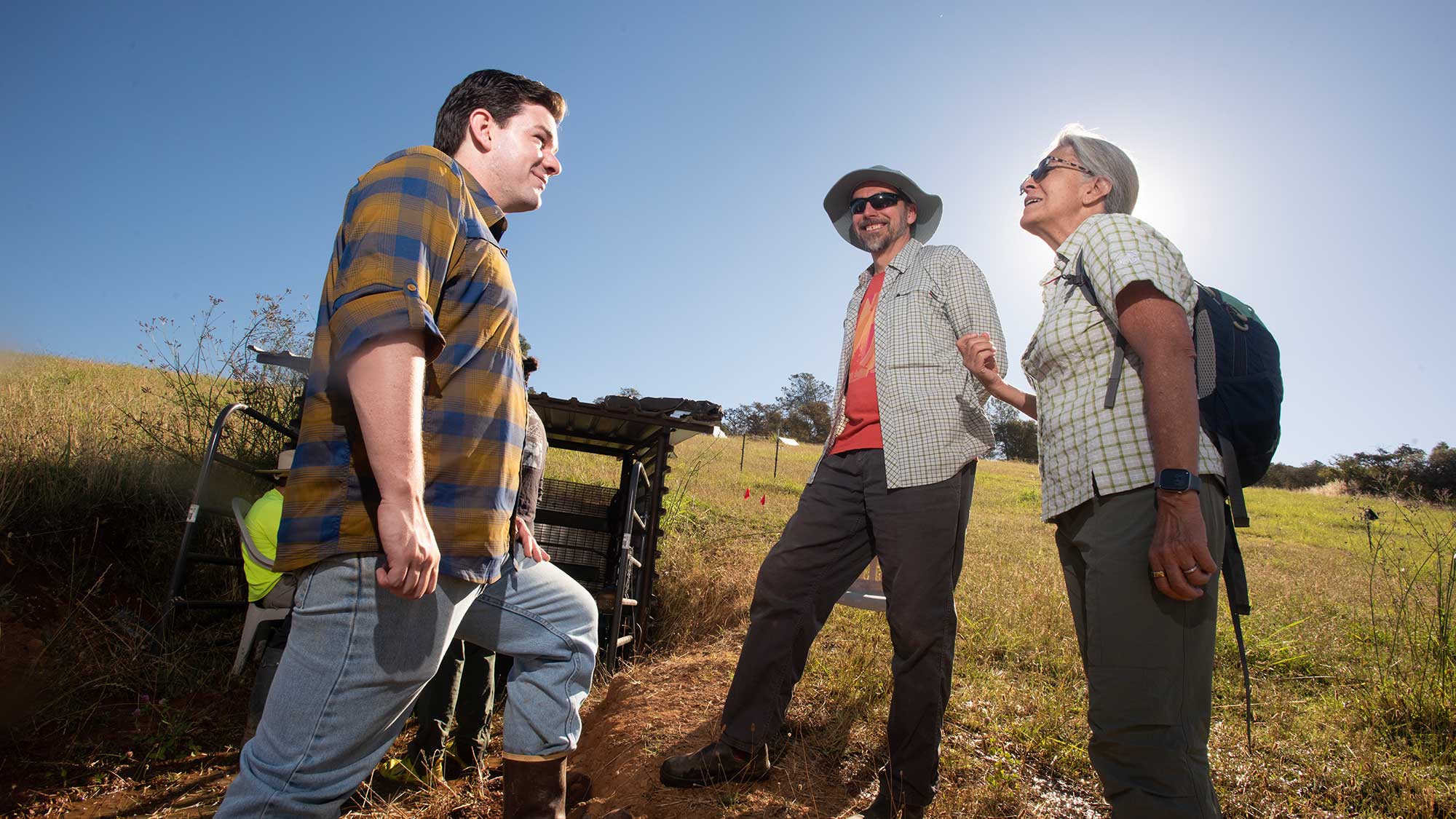
That's why O'Geen and Montañez have partnered on their research. Montañez brings the geochemical expertise while O'Geen is an expert in soil sciences. For close to two years, their field site at the Sierra Foothill Research and Extension Center has acted as an enhanced rock weathering proving ground, with the goal of detecting the rate of weathering and learning how soils influence the movement of carbon through Earth's water system.
"Soils are alive," explained O'Geen. "We think of it as brown, crumbly stuff on the surface, but they are structured, they are layered, they have a variety of colors, they are breathing, they are replicating. In a teaspoon of soil, there are over 5 billion organisms."
All that complexity influences the efficacy of the enhanced rock weathering process. In their experimental pastures, the team has spread pulverized basalt rock across the top layer of soil. Every two weeks, they flush the field with irrigation water. Every eighth week, they take solid soil and soil water samples.
Radomir Schmidt, a UC Davis project scientist, manages the research team's field site at the Sierra Foothill Research and Extension Center. Schmidt was the person who started irrigating the team's field site at 6 a.m. on their sampling day. As he drove around on a four-wheeler, he explained the thought process behind the experimental setup.
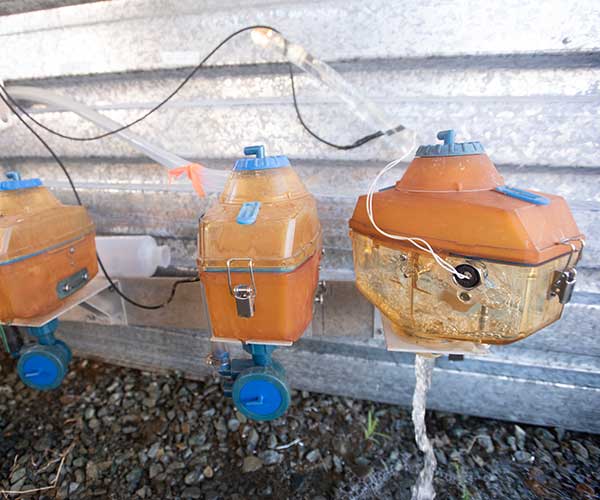
Water, whether from irrigation or rainfall, is essential for the chemical reactions of weathering. The water seeps into the soils, which soak up the liquid like a giant sponge. Once the soils reach a certain threshold, they release the water, leaking it downslope. That leaked water picks up subtle telltale signs of weathering. The water is then sampled at the foot of the hill in a dugout trench that looks like an open-air shed. The various spouts from where the water is collected correlate to soil layers at different depths.
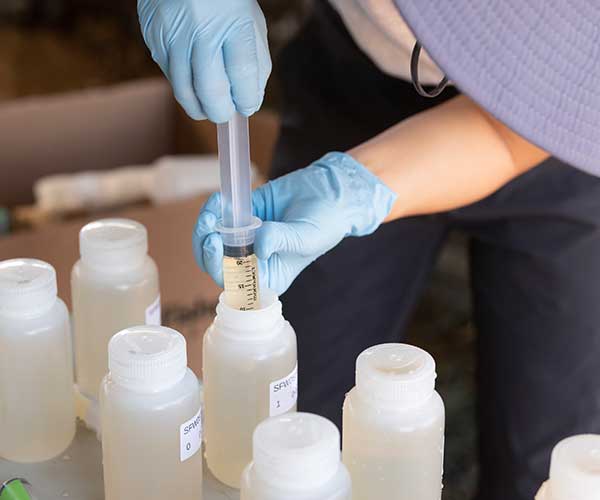
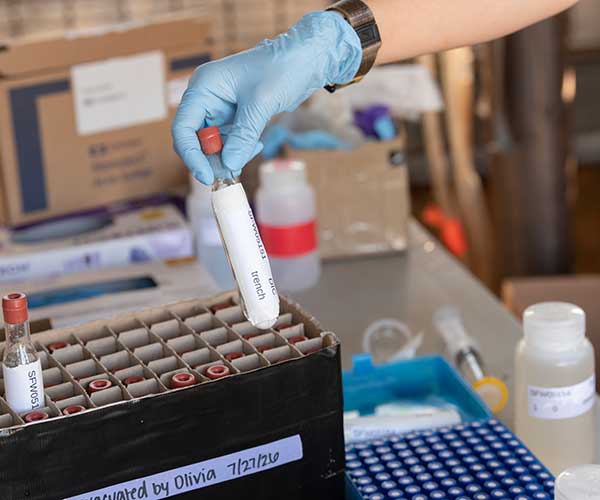
On sampling day, Sohng and other members of the research team logged water flow rates and collected samples, which will be analyzed for their carbon, nutrient and isotope contents later in a lab. The data is helping the team understand how enhanced rock weathering changes soil-water chemistry and carbon dynamics, providing indicators of how quickly the rock powder is weathering and how much carbon could potentially travel through waterways to the ocean for long-term sequestration.
Quantifying carbon benefits: a slew of questions
While preliminary results look promising, the team also is interested in understanding the carbon costs of the enhanced rock weathering process.
"There's a balance between how much energy you use getting the rock out of the ground, crushing it, getting it out into the field and then how much carbon it takes up," said Schmidt. "Is this actually going to make a difference? Or are you producing more greenhouse gases in the process of getting the rock to the field?"
To help answer these questions, Whiteaker developed an online decision support tool that aggregates information from 4,000 mines across the United States. The tool shows how far you can transport pulverized rock material while still getting a carbon benefit.
"If you're trucking heavy things around, you're burning fuel and that has a carbon impact," Whiteaker said. "For this to really work from the carbon perspective, we need industry-wide coordination on standards to make sure that the rocks that we're spreading are of high quality and that there is coordination around how we're moving things."
Essentially, the tool maps out mines across the United States, estimates how quickly the mineral material from those mines could weather and then maps the transportation mechanisms - including road, rail and barge - to get that pulverized material to land.
"If you leverage all three, there's actually a surprising amount of the United States that is accessible to be able to get a carbon benefit," O'Geen said.

Interdisciplinary science amidst an uncertain future
Montañez, O'Geen and their fellow researchers are hard at work quantifying the benefits of enhanced rock weathering, but hurdles to the science have emerged. In 2025, the team was informed that they lost their federal funding for the project. O'Geen said federal support will dry up around the fall or winter of 2027. Some of that financial gap has been filled by generous philanthropic support.
"We're trying to do everything we can to keep it going so that we can continue this work," he said. "I'm hoping to keep it open as long as we can."
The importance of the science can't be understated. Enhanced rock weathering is not only a crucial piece of the climate solution's puzzle, but it's also a process that requires interdisciplinary and sustained research to understand. Making an impact requires the concerted effort of geochemists, soil experts and agricultural scientists and buy-in from farmers and corporations.
"This kind of work will never be successful unless you bring in people from truly different walks of academia," Montañez said.