
Nutrition educator Taylor Rollins usually does cooking demos in her classes. But at a recent class in a Watertown, New York senior apartment complex, she set up a science experiment instead.
About a dozen elder women looked on as Rollins soaked two piece of bread - one white, another whole grain - in containers of water, to demonstrate the importance of eating whole grains.

Taylor Rollins, nutrition educator for CCE Jefferson County, distributes information on whole grains to participants in the North Country Fruit and Vegetable Prescription Program, in Watertown, New York. From left, Doris Mitchell, Gail Parsons, Rollins, Laura Paddock and Kathie Crescenzi.
"Oh, poor guy. Our white bread is kind of falling apart," Rollins said, as the disintegrating slice slipped through her fingers.
Then she held up the slice of whole grain bread. It was waterlogged, but intact.
"It's because that whole kernel of grain is in there, so it takes longer for it to break down," Rollins said. "It keeps our stomachs full longer between meals, and it allows our bodies to absorb all of the nutrients that we're eating."
Rollins was teaching the fifth of six classes in the North Country Fruit and Vegetable Prescription Program, run by Cornell Cooperative Extension (CCE) Jefferson County. The program helps participants with or at risk of diet-related chronic disease learn new, healthy ways to eat more fruits and vegetables. They attend one class per week for six weeks. At the end of each class, they receive a $25 voucher for fruits and vegetables, for a total value of $150. And the classes offer the many elderly participants social interactions that support their mental health.
"I think it's important for people our age to be aware of nutrition," said participant Laura Paddock, 67. She used to train horses for a living and now struggles with asthma and severe COPD - chronic obstructive pulmonary disease. "I recently learned that we need more protein, because our muscle mass decreases as we age. When you age, your whole nutritional need changes."
Rollins, a former middle school teacher with a national certification in nutrition, dished out servings of a cobbler she had prepared with canned peaches, canned pears and a homemade oatmeal granola topping. "I do make my own granola for this, because it's expensive for a bag of granola - like $5, $6, $10," she said. "So I make it. I just use oats, a little bit of olive oil, cinnamon, vanilla and honey, and it turns out great every time."
CCE Jefferson County administers the program throughout the North Country, in Clinton, Essex, Franklin, Lewis, Jefferson and St. Lawrence counties. Since the classes began in 2024, the participation rate has increased dramatically. In 2024, 15 participants graduated by completing four or more classes. In 2025, 148 graduated - an increase of 887%. And the program distributed nearly $30,000 in vouchers for fresh produce in 2025.
Thanks to the class, Paddock has increased her intake of vegetables, she said. "I'm trying to work with vegetables that I do like," she said. "I learned that carrots have a lot of nutrition to them, and I like carrots, so I've been incorporating them more."
Closing the knowledge gap
At the beginning of the sessions, many participants are simply unaware of nutrition fundamentals, Rollins said, and misinformation on social media only exacerbates the problem. "A lot of people think that potatoes are a grain, or they think that green beans are a protein," she said. "So just breaking it down, back to basics, to show people what we should be eating, really does make a big difference.
"The first time I heard somebody tell me that green beans were a protein, I could not believe it. But that is a real gap."
Rollins and other CCE educators use the MyPlate and Cooking Matters curricula, developed by the USDA, which aim to inspire people to make healthy, affordable food choices. In the first week, Rollins demonstrates with teaspoons of Crisco how much fat is in a typical McDonalds meal as participants look on. "They're baffled," she said.
They're even more shocked to learn a box of Kraft mac and cheese has as much fat as a Taco Bell meal of two tacos, nacho fries and a soda. "A lot of people think it's easier or better for you to go home and make a box of macaroni and cheese," Rollins said. "But in reality, it can be the same as eating out and eating those fast food choices."
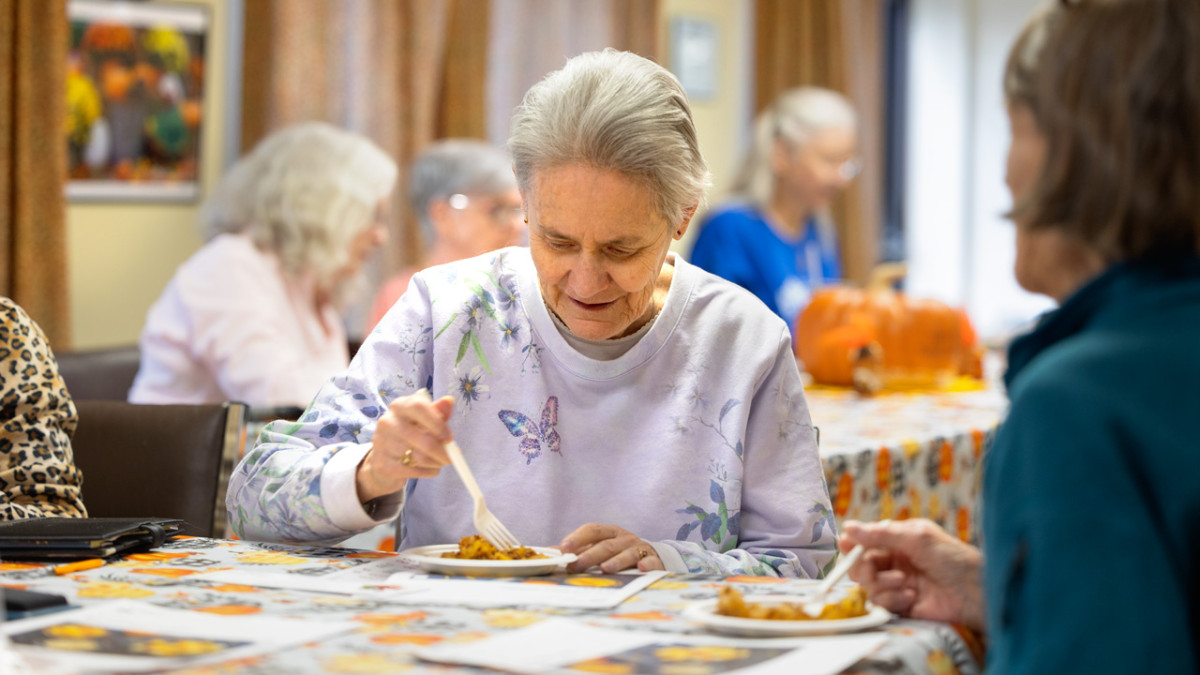
Gail Parsons of Watertown, New York, digs into a healthy peach and pear cobbler with a whole-grain granola topping at a session of the North Country Fruit and Vegetable Prescription Program.
She also covers the benefits of whole fruits versus fruit juices; the nutrients found in different colored fruits and vegetables; when to use fresh, frozen, canned or dried produce, depending on the season; and grocery store hacks to buy healthier foods. Throughout, Rollins centers the lessons and demos on the fruits and vegetables currently in season. In the summer, she'll make pizza topped with roasted eggplant; in the fall, she'll make a dish with spaghetti squash.
And she tailors the classes to the specific chronic diet-related diseases affecting her students, from obesity to elevated blood sugar, high blood pressure, Type 2 diabetes, heart disease, cancer and diverticulosis.
Paddock increased her intake of fruits and protein thanks to the classes. That's especially important for her, because COPD diminishes muscle mass and dampens appetite. "It's hard for me to want to eat sometimes," said Paddock, who is 5 feet, 5.5 inches tall and weighs 100 pounds. "I'm way underweight, but when you can hardly breathe, you don't feel like eating. You have to make yourself."
Some participants use the class as motivation to set other health-related goals, like increasing mobility and strength. One participant set a goal of moving around without her walker by the end of the six weeks. A recent CCE survey showed surveyed participants reported fewer doctors' office visits after taking the classes, said Hilary Moore, health and wellness program manager for CCE Jefferson County CCE.
"They're engaged, they're participating, they're asking questions and they really are trying to make a difference," she added. "They're actively engaged in trying to make better decisions when it comes to their health."
Food and socialization as medicine
At the end of the six-week session, the biggest change Rollins sees in her students is they are excited to shop for groceries. Sometimes she'll see them at local farmers markets. "My participants see me, and they're like, 'Taylor, look what I got with my vouchers,'" she said.
A recent CCE survey found that before the classes, 50% of participants ate vegetables less than once a week. After, that number dropped to 13%, Moore said.
Participants include young single mothers and military families who aren't always able to make in-person meetings due to work and child care schedules. To meet the demand, CCE Jefferson has instituted virtual Zoom classes. And it is working on asynchronous classes to better accommodate busy schedules, Moore said.
But the biggest demographic of participants is elders, Moore said; the average age of participants is 61, and 27% are over 65. That's largely thanks to CCE Jefferson County's collaboration with Gilbert "Mac" McEachern, an account clerk at the Jefferson County Office for the Aging.
McEachern does outreach in community settings from churches to libraries and Veterans of Foreign War (VFW) posts, to tell seniors and others about services available to them - including the Fruit and Vegetable Prescription program.

Gilbert "Mac" McEachern, an account clerk at the Jefferson County Office for the Aging, has referred more than 300 elders to the North Country Fruit and Vegetable Prescription Program, run by Cornell Cooperative Extension Jefferson County.
He has also connected seniors to a Watertown CSA, Miracles by the Acre, where they can redeem their vouchers. He assists by delivering the fruits and vegetables right to the senior living complexes, as many of the seniors lack transportation. So far he has referred 300 people to the Fruit and Vegetable Prescription Program.
"When I started my program, I went to Cornell because they are in the community," McEachern said. "They know the shakers, the movers, who's doing what, because everybody comes and asks them for advice. We started small, but over the last year, we've ramped up, because Cornell has helped us."
A former veteran, he also works with a dietician at nearby Fort Drum, who refers members of the military to the program. "It's just really amazing what Cornell does for the community," he said.
The vouchers help seniors stretch their food dollars - an important benefit when many are raising grandchildren, McEachern said. He makes sure seniors know they can give their vouchers to family members and that the vouchers are valid for a year.
McEachern sees the program's emotional benefits especially in the summer, when the fresh produce is abundant. One participant saved up her $150 to can tomato sauce. "They say, 'My grandchildren are here, and we're going to cook this and that.' You can see how happy it makes them to know that they have fresh produce. They can show the children how to eat properly. I believe a lot of it is mental, and it really helps them out."
The classes also offer an important opportunity to socialize, Rollins said. "A lot of times, it's one of the only classes happening at some of these senior housing sites," she said.
A recent group of participants at a North Country VFW proposed that instead of Rollins doing a cooking demo for the last class, they'd cook a dinner together using MyPlate guidelines. "They were so excited to celebrate with each other and really show off what they had learned," Rollins said.
Paddock sees the social benefits too, she said.
"Any opportunity to get us out of our apartments and be around people is good," she said. "It feels nice to have people care. The elderly can feel very pushed aside by society, so this is really nice that people think of us and come here."


