
Scientists thought they had finally stumbled upon a possibly positive side effect of climate change. While rising CO₂ levels have been linked to various effects, from rising sea levels to changing temperatures, could an increase in CO₂ also be good for something? Plants use carbon dioxide and sunlight for photosynthesis, so more CO₂ could theoretically mean more food.
Author
- Sterre ter Haar
PhD researcher and lecturer, Industrial Ecology Department of the Institute of Environmental Sciences (CML), Leiden University
It sounds almost too good to be true, but science backs part of this up. Plants do grow faster when CO₂ levels increase , but this doesn't mean we will have more food and less hunger. Other research has shown that where we can grow our food is not only shifting, but also shrinking .
Changing weather patterns and extreme weather events, such as heat waves , drought , or extreme rainfall , will become more frequent and limit our global food production .
So increasing CO₂ might be good for how fast a plant grows and not so good for where it grows, but what about the effect on the plant itself ? The majority of our diets come from crops or from animals that eat (mostly) plants. If plants respond to rising CO₂ levels, that could mean their nutritional value is also changing.
The first studies were inconclusive. The way to test this sounds simple: grow two plants under identical conditions, except one is given more CO₂, and then compare them. Scientists observed differences, but they couldn't say if the result was significant or merely a coincidence.
Comparing many studies together would help, but that is harder than it sounds. Due to our ever-increasing amount of CO₂ emissions , the study baselines were also increasing, so we couldn't directly compare studies from different years to each other. We had a lot of data, but few answers.
My new analysis with colleagues shows an interesting picture: each bite of food is becoming comparatively higher in calories but lower in nutrients. We compiled 59,048 measurements from 109 studies and compared results at a baseline of 350 ppm of atmospheric carbon dioxide to an elevated level of 550 ppm.
We looked at 32 nutrients across 43 different crops. For the first time, we could see a clear shift in plant composition across a wide range of species and essential nutrients.
As carbon dioxide increases, so does carbon uptake, and more carbon means more carbohydrates, like sugars and starch. However, critical nutrients such as iron, zinc, and protein all decreased. Our food might have more carbs but fewer essential nutrients. While the average decrease in nutrition was only a few percent, certain foods saw large decreases , such as a 38% zinc reduction in chickpeas (Figure 1).
What also stood out were heavy metals such as lead . They might be increasing in our food - a serious concern because lead is toxic even at very low levels and can harm the brain, heart, and nervous system - but that's not something we can say for sure based on our study.
Biologists tend to study plants to understand what is happening to the nutrients they need, while researchers who focus on human health examine plants to see what is happening to the nutrients we need. But neither plants nor humans require heavy metals such as lead, so very few studies tracked them.
The few that did recorded a concerning increase . Coincidence? We're not sure - which is precisely why we need to start taking a closer look.
We might need to reconsider what a healthy diet looks like in the coming decades. Food security will not necessarily imply nutrient security. A healthy diet today might contain too few nutrients in the future due to the shifting composition of our crops, despite still containing enough calories.
Think of our diet like a recipe. Changing the amounts of one ingredient can change the entire outcome. Not only will the nutrient values of our food change, but also our ability to cook with it. The changing plant composition may also affect our ability to bake bread or make pasta .
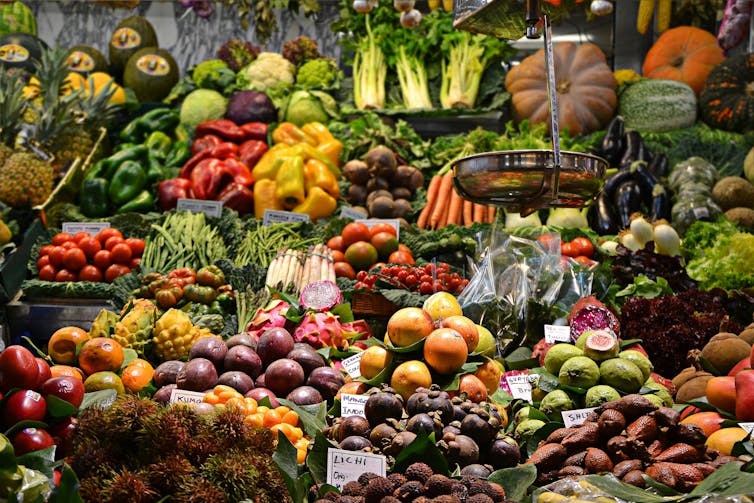
If our food is becoming more calorific for relatively fewer nutrients, in extreme cases, we could see increases in both average body mass and undernutrition. Scientists are now looking at what this means for our diets, but in the meantime, a good way to buffer these potential effects would be to eat a diverse diet.
Climate change feels like a faraway problem, but it's already here. A substantial part of our increasing food prices has already been linked to climate change. Certain foods are getting harder to obtain . Weather disasters alone accounted for $20.3 billion in damage to American farmers last year.
Our study looked at the effect of increasing CO₂ from 350 ppm, which is sometimes referred to as the last "safe" level for humans , to 550 ppm. We are currently at around 426 ppm , putting us almost halfway through the modelled effects. Climate change is happening now, and the effects are already on our dinner plates.

This study was supported by the European Union's Horizon 2020 Research and Innovation program under grant agreement no. 101003880. Sterre ter Haar receives funding from the Frontiers Planet Prize.


