
An increase in civilian deaths and injuries caused by cluster munitions should trigger united action among the 124 countries that are members of the Convention on Cluster Munitions, Human Rights Watch said today on the release of the "Cluster Munition Monitor 2026" by the Cluster Munition Coalition. Human Rights Watch is a founding member of the coalition and contributed to the report.
The 150-page report assesses all countries' adherence to the 2008 convention. Cluster munitions killed or injured at least 1,063 people globally in 2025. This figure is among the highest annual totals recorded by the Cluster Munition Coalition. The actual number is most likely higher as many casualties go unreported. New casualties were recorded in nine countries in 2025: Afghanistan, Cambodia, Iraq, Laos, Lebanon, Myanmar, Russia, Syria, and Ukraine. Cluster munitions continued to disproportionately affect civilians, whether from direct attacks or the remnants they leave behind. Civilians accounted for 87 percent of casualties recorded for 2025, where the civilian status was recorded.
"It's critically important for countries to renew their commitment to the international treaty that seeks to rid the world of the scourge of cluster munitions," said Verity Coyle, deputy crisis, conflict and arms director at Human Rights Watch. "The clearest way to do that is for all convention member states to condemn continued production, stockpiling, and transfer of cluster munitions."
In recent months, both the United States and Türkiye have disclosed plans to transfer cluster munitions to Ukraine. Both Russia and Ukraine have used cluster munitions during the war in Ukraine. Lithuania's withdrawal from the treaty, the first member state to do so, became final in March 2025.
The country delegations meeting at the convention's Third five-year Review Conference in Vientiane, Laos on September 14-18, 2026, should condemn the production, transfer, and use of cluster munitions by other countries and reaffirm their commitment to pressing for universal support for the ban treaty. Laos hosted the first meeting of states parties to the treaty in 2011.
There has been no confirmed use of cluster munitions by any state party since the convention was adopted in May 2008. Cluster munitions were used by non-state parties Iran, Myanmar, Russia, Thailand, and Ukraine during the reporting period of mid-2025 to mid-2026. Iran repeatedly used cluster munitions in Israel in 2026, while Thailand used them in Cambodia in 2025 in the context of their border conflict. Cluster munitions were used in northern Mali in May 2026, but it was not possible to confirm who used the weapons.
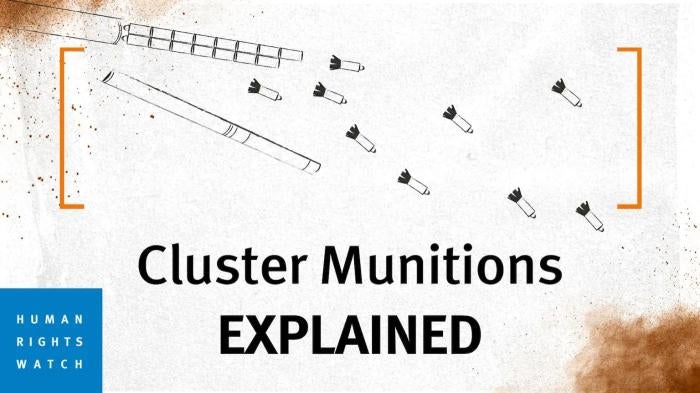
Cluster munitions can be fired from the ground by artillery, rockets, missiles, or mortars, or they can be dropped by aircraft. They typically open in the air, dispersing multiple explosive submunitions or bomblets over a wide area. Due to their wide area effect, the weapon cannot distinguish between civilians and combatants, especially when they are used in populated areas. In addition, many submunitions fail to explode on initial impact, leaving unexploded duds that can indiscriminately injure and kill-like landmines-for years, until they are found and destroyed.
The Convention on Cluster Munitions prohibits the use, production, transfer, and stockpiling of cluster munitions and requires the clearance of explosive remnants. The Third Review Conference will address the potential for expanding treaty membership, closing funding gaps for explosive ordnance clearance programs, and providing assistance to affected communities.
The Convention on Cluster Munitions has 112 states parties and 12 signatories. The most recent country to accede to the treaty was Vanuatu in September 2025. Prior to that, South Sudan and Nigeria were the last countries to become parties, joining in 2023.
During the current reporting period there was evidence of cluster munition production in China, India, Israel, Myanmar, North Korea, Poland, Romania, Russia, and South Korea. Eighteen countries outside of the treaty actively produce cluster munitions, maintain the capacity to do so, or have not formally committed to never producing them.
Approximately US$116 million in international and national funding was provided in 2025 to address the impact of cluster munition contamination in states parties to the convention. The US foreign assistance freeze in February 2025 disrupted the clearance of cluster munition remnants in several regions, notably in Southeast Asia. Subsequent grant terminations reduced clearance capacity in Afghanistan, Iraq, and South Sudan. Other major donors have also begun to reduce allocations and narrowed their geographic focus in response to changing political priorities.
"In the face of the continued use of cluster munitions and rising civilian casualties, member countries to the convention need to send a clear message that they will stand firm in their commitment to end all use of these indiscriminate weapons," Coyle said.
The Cluster Munition Monitor 2026 is the 17th annual monitoring report by the Cluster Munition Coalition, the global coalition of nongovernmental organizations co-founded by Human Rights Watch in 2003. The report will be presented to countries attending the Third Review Conference of the Convention on Cluster Munitions in Vientiane, Laos on September 14-18.


