
UConn School of Public Policy associate professor Thomas Craemer analyzes years of news coverage
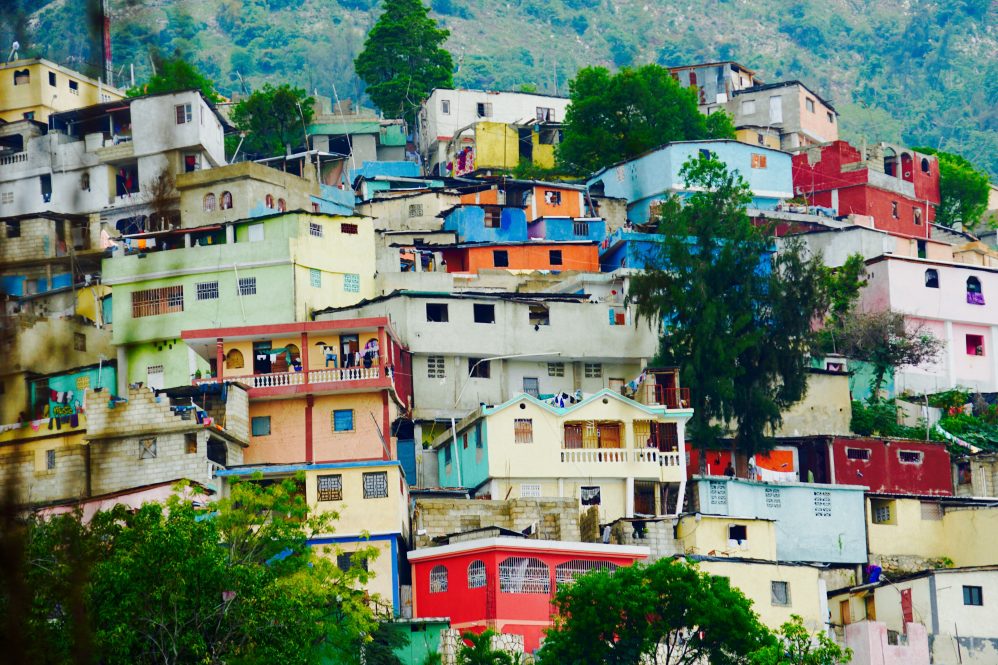
Houses built on the mountains just outside of Port-au-Prince, Haiti (Unsplash)
Thomas Craemer first traveled to Haiti in the aftermath of the country's devastating 2010 earthquake, as part of an aid group. Most of what he knew about the country came from the US media, which emphasized familiar themes: poverty, corruption, and violence.
Craemer, who is an associate professor in UConn's School of Public Policy (SPP), expected to find the nation in a state of complete disrepair, with its citizens completely dependent on foreign aid to help rebuild from the chaos.
Instead, what he found was "a beehive of activity," filled with "well-dressed, active people walking the streets and going about their business."
"Obviously," he says, "people were working and doing business and building houses without any foreign aid. Neighborhoods were pulling together and rebuilding. And I saw this nowhere in the news coverage I had read. The coverage I had read did not prepare me for what I saw in Haiti."
He realized quickly that life in Haiti - even after a natural disaster - didn't align with the US media portrayal of rampant violence and squalor. People were actively organized in rebuilding their own communities, and the cities bustled with vibrant informal economic, social, and political activity.
As he returned to Haiti many times over the next few years (with UConn students in tow), Craemer got curious about how US news coverage had gotten so far off course. Weren't the American journalists writing about Haiti walking the same streets he was? Couldn't they see the political complexity playing out in front of them?
Through the media's lens, Craemer noticed, the very same action - burning tires, for instance - could be interpreted as a bold, nonviolent protest when undertaken by French demonstrators in Paris, and as a symbol of unchecked violence when undertaken by Haitian demonstrators in Port-au-Prince.
This year, Craemer has completed a decade-long research project investigating the stereotypical narratives embedded in US media coverage of Haiti. The 2010 earthquake provided an interesting case study for his work:
"An earthquake is a random event — it has no relevance to ethnic or racial stereotypes," Craemer says. "So, I was looking whether the coverage of the earthquake was biased in terms of these stereotypes, and I found out that yes, it was quite significantly biased."
Craemer analyzed American news coverage (newspapers, TV, and radio) spanning six years, looking for six stereotypes about Haitians: "poverty"; "lack of intelligence"; "laziness"; "being unfit for self-government"; "criminality"; and "violence."
In the aftermath of the 2010 earthquake, he found, a baseline of 66% of references to Haiti in all American news media conformed to these stereotypes; in newspapers, where the bias was most pronounced, the figure was 76%. The newspaper bias ratio increased to roughly 80% in the periods following the assassination of President Jovenel Moïse in 2021 and a period of heightened gang violence in 2022-2024.
A Thorny History
To understand Haiti's place in present-day American consciousness, turn back a couple centuries: to the Haitian Revolution in 1791-1804. For scholars like Craemer, the Haitian Revolution represents a sea change in global politics - one whose impacts have been historically understudied.
Craemer's doctoral research focused on implicit and explicit racial biases in the United States, and how these biases influence people's opinions on race-related policies such as affirmative action and reparations. During this research, he found that all roads were leading him back to the Haitian Revolution.
"I was surprised that I knew so little about it and that it's so under-emphasized, when it is really an earth-shattering event," he says.


