
© 2025 EPFL/ A.Herzog
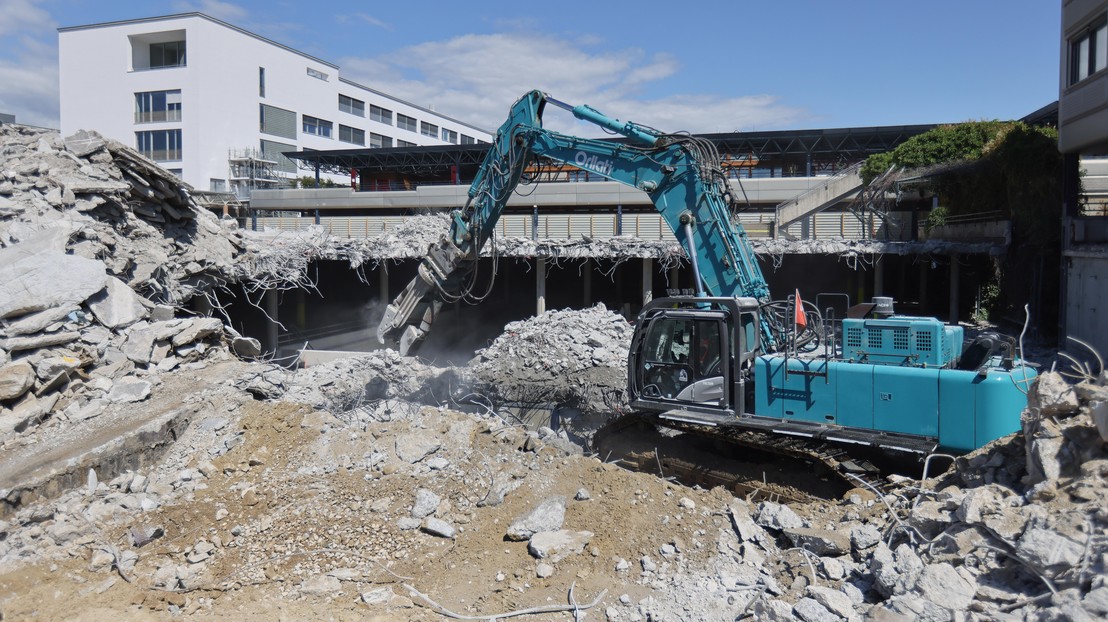
The demolition part of the Double Deck project began in July 2025 and was completed in the fall. It was a complex phase of work that presented some unique technical - and organizational - challenges.
EPFL's main campus has seen its fair share of building projects over the past two decades, but Double Deck stands out for several reasons. First, the project has taken over the Esplanade - a major junction in the heart of campus. Second, the construction site abuts several buildings that house labs and classrooms. Third, preparing the site required removing an old civil protection shelter. And fourth, the construction team had to ensure that the demolition work didn't interfere with the day-to-day activities of the School's researchers or the start of classes in September when thousands of students would descend on campus. For all these reasons, carrying out the demolition work was a little like trying to control a bull in a china shop.
Double Deck is a four-year project, from summer 2025 to summer 2029, designed to bring a much-needed upgrade to EPFL's teaching infrastructure. The School's student body swelled from just over 10,000 in 2017 to 14,000 in 2025, pushing classrooms and study areas to their capacity limit.
"Room occupancy studies show that the pressure is greatest on lecture halls with 200 or more seats," says Franco Vigliotti, director of Development and Construction (VPO). "The solution we settled on, together with the Vice Presidency for Academic Affairs, is large, modular lecture halls that can accommodate up to 500 students."
At the same time, pedagogical approaches are changing fast, with a growing emphasis on digital tools, online courses and in-class group work. The new classrooms will accommodate all these changes and provide the necessary resources and equipment.
"The classrooms we currently use were designed in the 1980s, when lectures were the norm. But teaching practices have changed," says Roland Tormey, head of EPFL's Teaching Support Center. "It's more common now for students to work in small groups, engage in in-class discussions and do online research. But it's really hard to hold discussions in rooms with acoustics designed for just one speaker."
The Double Deck project, designed by architect Dominique Perrault, consists of two parts: the construction of a new building and the renovation of the Coupole building. The project will provide 1,500 additional lecture-hall seats and 600 study spaces in rooms that are flexible, modular and equipped for today's learning approaches.
Modeling clay
From an engineering perspective, the worksite presented some interesting challenges. The first related to the very nature of the soil. "EPFL sits on a geological stratum made up of lacustrine deposits," says Scott Favre, head of unit at De Cérenville Géotechnique, a company that often works on EPFL construction projects. "These deposits consist of sand that, after soaking up runoff water, behaves like modeling clay. That's why many of the campus buildings sit on top of concrete pilings. For Double Deck, we ran a lot of models in search of a less expensive and more environmentally friendly solution. Ultimately, we decided to compact the soil."
The neighboring ArtLab/EPFL Pavilions building was another wild card. This long structure is constructed from wood, features large glass walls, and does not extend below ground level. All those factors make it highly sensitive to vibration and the pounding caused by compaction. To stabilize the building, the construction team took special measures. "We created a reinforced base with jet grouting, injecting a mix of cement and water 11 meters below ground," says Verena Pierret, a civil engineer at Atelier -T- ingénieurs créatifs. "We didn't have to do that on the CO building side of the worksite, as that structure is built on pilings. But there we had to excavate between the pilings, a relatively low-risk operation that was still pretty impressive to watch."
Another key step in this phase of the project was removing an old civil protection shelter with concrete walls up to 70 centimeters thick.
Concerns aplenty, complaints afew
While most people agreed on the need for this project, many voiced serious concerns before the work started. Numerous researchers feared that the recurring vibration would throw off or even damage their precision equipment; that dust would find its way into the labs and play havoc with sensitive experiments; that the noise would make it impossible to teach; or that the construction work would interfere with the reproductive behavior of the rodents in the animal facility. The elimination of 160 parking spots in the Esplanade lot was not a welcome perspective either.
"A lot of times, the researchers' initial reaction was that they simply wouldn't be able to carry on with their work or their research, that everything would come to a standstill for months," says Pierre Gerster, head of Construction Administration at EPFL.
The construction managers took these concerns very seriously. "These were legitimate fears and absolutely had to be addressed - people had to be reassured," says Frédéric Rauss, head of internal communications at Mediacom. "We focused hard on communications from the very start."
Regular information sessions were held to keep the EPFL community up to date on the project and answer their questions. A webpage with project updates was set up and a dedicated email address was created so that people would get prompt replies. People could also consult an online "construction forecast," which listed potential disruptions on the horizon so that the labs could plan their work accordingly. Over a dozen vibration sensors were installed in the most susceptible places.
"But there's always some uncertainty," says Gerster. "It's impossible to predict exactly how noise and vibration are going to propagate." Pierret agrees: "We're talking about waves that are measured in millimeters per second and affected by a large number of factors: ambient sound and vibration absorption, the shape and stiffness of the surrounding materials, the density of the ground and, indirectly, environmental conditions like soil humidity."
All those preparatory measures paid off. "We put in place a broad range of mitigating measures and resources to allay people's fears," says Marta Paternain, a project manager at EPFL's Construction Administration. "In the end, we received very few complaints in this phase of the project, and most of them were for relatively minor issues."
Once the work started, the other challenge was to adhere to the schedule. A bulletproof coordination process was needed to address the specific needs of the various groups of campus users. "Work on the project began just after the exams," says Gerster. "And we had to get as much as possible done over the summer to be sure the worst of the nuisances were behind us by the time the fall semester started. It wasn't a linear process, as there was a whole series of steps: demolish one section, put up retaining walls, demolish the next section, and so on. The workers from Orllati, the company in charge of this part of the project, threw themselves into it, putting in long hours and even coming in on Saturdays when necessary."
Accommodating teaching and research activities
An absolute priority was to limit the project's impact on campus activities and the academic calendar. Early studies identified where and when teaching and learning would be most disrupted. "When you work in an office, noise is generally more tolerable," says Tormey. "But when you're in class, you need to concentrate, you need to listen, you need to take notes. And all that's much more difficult when you're being bombarded with distracting, intermittent sounds."
That led to the creation of a red zone on campus that was off-limits to the EPFL community. There were 12 rooms in the red zone, including one large and two medium-sized lecture halls - their temporary closure reduced the School's room capacity by 8%. There was also an orange zone with rooms that were only closed on certain days.
"These zones gave rise to lively discussions with the academic teams and required considerable coordination," adds Tormey. "One priority was to ensure freshmen were able to attend classes in-person, since the first year is particularly important in students' degree programs. Direct interaction with teachers is essential to help students adopt effective study habits and get used to the structure of their classes at EPFL. They also need to start building relationships with their peers." For non-freshmen, measures were put in place to make up for the fact that, given the space constraints, only some of their classes could be held on campus. Various resources were provided to teachers, including through the MOOC Factory, a service that lets them give classes in an online format.
"Thanks to all these efforts, everyone was able to roll with the punches without losing their cool," says Tormey. He notes that Double Deck is much more than a construction project: it's tangible proof of EPFL's commitment to its teaching mission, with a clear focus on its students.


