
For International Women's Day we spotlight the achievements of AIMS senior research scientist Dr Jessica Benthuysen , recognised as one of Australia's leading oceanographers.
Dr Benthuysen is a physical oceanographer. She uses ocean observations and numerical models to understand tropical ocean phenomena that affect ecosystem health.
Her work focuses on the physical processes driving variability in ocean currents and temperature.
How it began
Dr Benthuysen grew up in a small coastal town in the northwest United States and undertook research in a fisheries lab during university.
"One of my math professors encouraged me to do research in fluid dynamics, which had a profound impact on my life," she said.
"I went to graduate school in oceanography because I liked the way problems were solved with mathematics and working with others."
She first came to Australia in 2010 to take a CSIRO research position in Hobart studying the Leeuwin Current: an unusual current, off Western Australia, that brings warm water down the coast from the North West Cape to Cape Leeuwin and into the Great Australian Bight.
It's unusual because most currents along west coasts flow equatorward and are cool and upwelling (a wind-driven motion of deeper, cooler water replacing the warmer surface water). Cool, upwelling systems are nutrient rich.
Understanding marine heatwaves
"I'd been here for less than a year when an ecological disaster occurred offshore of Western Australia - a marine heatwave," she said.
"Many fish died as well as seagrass and kelp.
"I developed an ocean model to determine how atmospheric changes, such as weaker southerly winds along the coast, could warm the ocean, while the unseasonally strong Leeuwin Current brought a strong pulse of warm water.
"I quantified the contributions from these two different processes and proposed a methodology for doing so with a numerical model.
"Since then, I've used similar approaches to understand other marine heatwaves.
"We are trying to understand why and when these extremely warm, prolonged conditions will occur."
Dr Benthuysen began at AIMS in Townsville in 2014, moving to our Perth office in 2018.
"During that time, we have seen more of these extremely warm water events occurring around the world and Australia," she said.
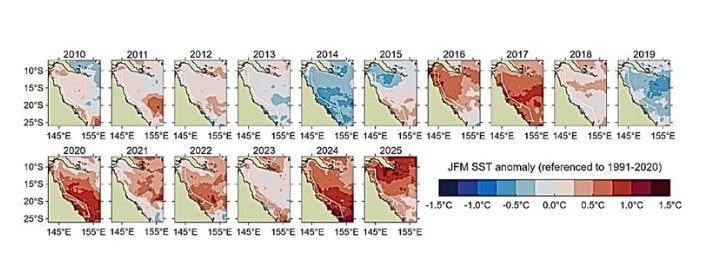
"Marine heatwaves damage critical ecosystems like coral reefs, driving mass bleaching events like the six we have seen on the Great Barrier Reef since 2016."
"We need to keep building our understanding of them through sustained and targeted monitoring to inform management actions.
"I can help make a difference by figuring out why they are occurring, through analysing data from satellites, ocean gliders, moorings, and numerical models."
She integrates ocean observations, temperature and velocity with ocean models to investigate how ocean temperatures change over time.
"I managed AIMS' Sea Temperature Observing Program for the tropics and have held leadership roles through the Integrated Marine Observing System (IMOS)," she said.
International leader
Dr Benthuysen was the first chair of the national committee for IMOS Event Based Sampling for several years, developing strategies for using autonomous ocean gliders to sample marine heatwaves around Australia.
The program was extended to sample other kinds of extremes like tropical cyclones. At the time, it was the only such program in the world with a national approach to sample marine heatwaves with gliders.
"It allowed me to work with the Australian science community to monitor these events," Dr Benthuysen said.
"My dream is that we work together to develop a system for predicting when and where marine heatwaves will happen to better understand this changing planet."
Dr Benthuysen is a partner investigator for the new ARC Centre of Excellence for Our Future Oceans where she helps investigate how Australian ocean temperatures and currents will change in the future.
"We are transforming large scale predictions to finer scales to address questions for marine industries and coastal communities about how marine heatwaves and other extremes will change.
"For example: What causes multiple marine extremes to occur and what are the impacts from marine heatwaves, low oxygen, extreme acidity? How do we help industries plan for this future? Where will we see changes and over what time scales?".
Dr Benthuysen works with other leading international climate scientists in a CLIVAR (Climate and Ocean Variability, Predictability and Change) research focus group on marine heatwaves in the global ocean.
While most of her work is done at her desk, she has clocked up more than two months at sea on five research voyages, including on the USA's northeast continental shelf, Australia's North West Shelf, in the South Indian Ocean, and the southeast tropical Indian Ocean.
She was the lead nighttime oceanographer on the RV Investigator voyage in 2019 for Australia's contribution to the 2nd International Indian Ocean Expedition.
Honours
Dr Benthuysen is on the Clarivate's Highly Cited Researchers 2025 list for Geosciences, one of only 159 researchers in the world, and the only AIMS scientist on the list with AIMS as their primary affiliation. She was on the 2024 list for interdisciplinary contributions.
For the third year in a row, The Australian Research Report 2026 named Dr Benthuysen as Australia's lead oceanography researcher.
Advice for early career researchers
- Reflect on the skills you've developed during your training. What do you enjoy? What do you need to develop further?
- Seek and take advantage of opportunities that align with your career aspirations and values.
- Discuss your training and career plans with your supervisor. Be clear about the support you need.
- Develop connections in and outside of academia. Participate in networking events, conferences, present your work, promote what you have discovered, share ideas with someone new.
- Explore job opportunities more than a year prior to completing. How are your skills aligned with currently advertised jobs in your field?


