
RMIT's Centre for Cyber Security Research and Innovation (CCSRI) with the RMIT School of Law brought together international researchers, industry leaders, legal experts, and government regulators at Storey Hall for Cyber Law Day 2026.
The event explored the pressing legal, regulatory, ethical, and human rights challenges posed by emerging technologies, including AI governance, augmented reality privacy, and platform safety.
Under the theme of Law. Cyber. Rights., the event highlighted how legislative frameworks and policy mechanisms must adapt to shape the responsible use of technology in an increasingly automated world.
Professor Diana Bowman, Dean of RMIT's School of Law, reiterated the importance of events that contribute to meaningful conversations about policies that affect everyone.
"Cyber Law Day highlights the critical role of legal scholarship and cross-sector collaboration in shaping the future of governance.
"As rapid advances in AI, digital platform governance, and data infrastructure reshape our society, bringing together legal experts, industry leaders, and policymakers is vital to ensure innovation is guided by law, ethics, and fundamental human rights."
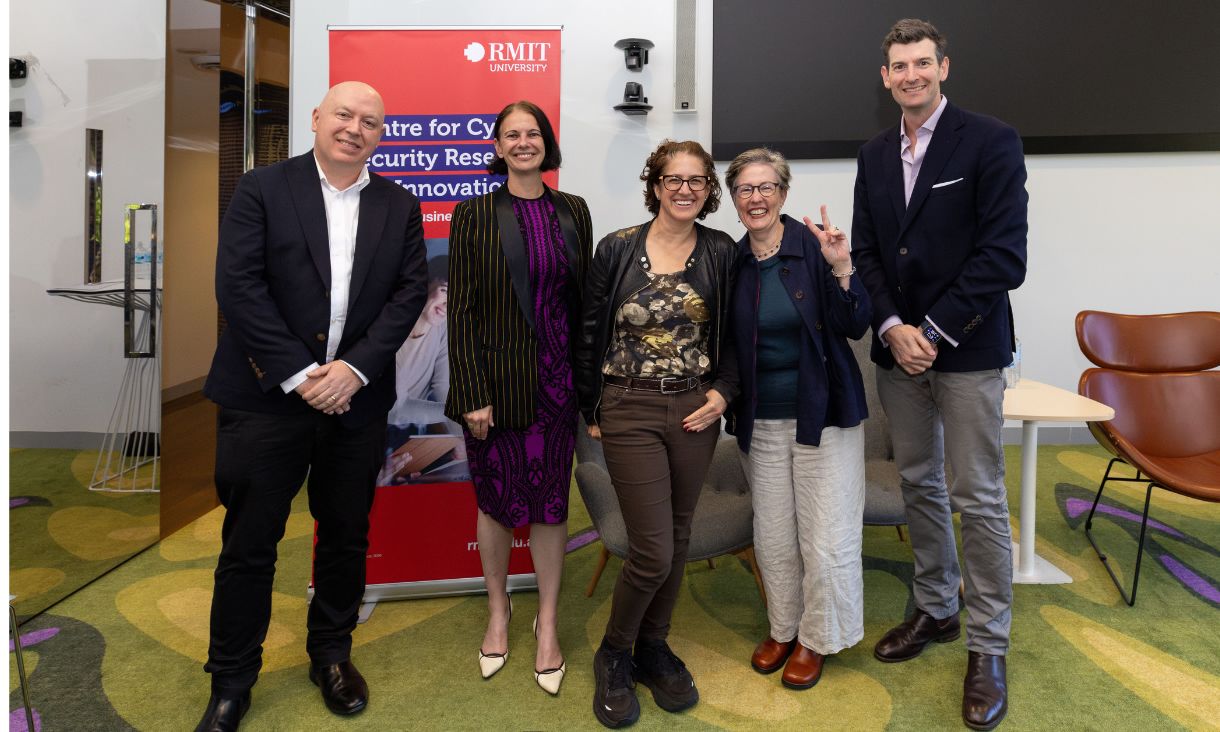 (L-R) Distinguished Professor Matthew Warren, Professor Diana Bowman, Professor Lyria Bennett Moses, UNSW, EJ Wise and Professor Nicholas Davis
The international keynote address laid out global and local blueprints for managing AI. Professor Paulius Pakutinskas, Head of the LegalTech Centre at Mykolas Romeris University in Lithuania and UNESCO Chairholder on AI, talked through global AI governance trends and lessons from the European Union AI Act.
Drawing on his work with the European Working Group of Competent Authorities on AI, Professor Pakutinskas examined how multi-jurisdictional frameworks can balance systemic risk mitigation with innovation.
Professor Nicholas Davis, Co-Director of the Human Technology Institute at the University of Technology Sydney (UTS), delivered the Australian keynote on closing the AI governance gap. Professor Davis emphasised that governments must adopt agile, experimental digital policy mindsets, while industry must strengthen internal compliance, embed ethics into development pipelines, and pilot governance-enabling technologies.
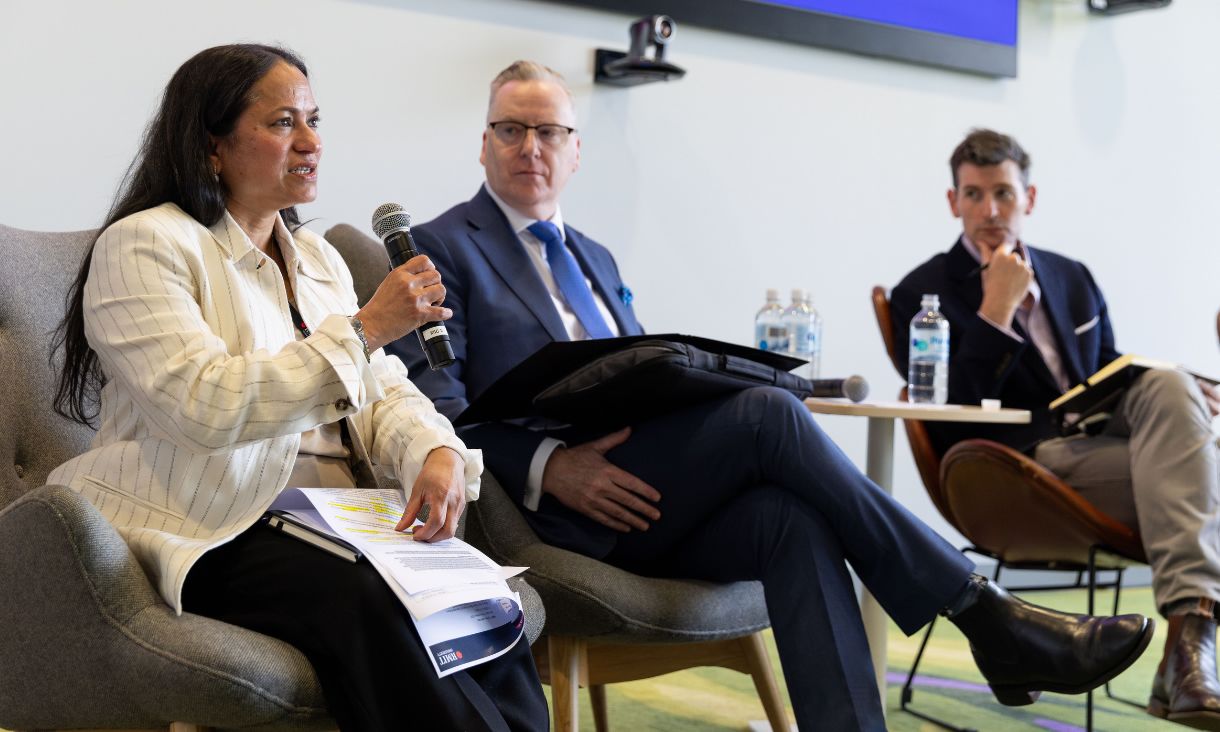 (L-R) Professor Priya Rajagopalan, Mark Cochrane-Holley, Professor Nicholas Davis.
Throughout the day, three panel discussions explored AI and data centres, smart glasses and privacy implications and social media and duty of care.
Chaired by Distinguished Professor Matthew Warren, Director of CCSRI at RMIT, the opening panel explored the rapidly expanding digital infrastructure behind AI. Panellists Mark Cochrane-Holley, Professor Nicholas Davis and Professor Priya Rajagopalan addressed critical infrastructure security, cloud jurisdiction, and resource demands.
The panel discussed how data centres have evolved from traditional server rooms into massive computing hubs. Panellists highlighted the economic and national security necessity of building sovereign capabilities while ensuring data transparency, resource efficiency, and tangible community benefits.
Chaired by Associate Professor Dana McKay, the second panel addressed the privacy implications of camera-equipped augmented reality (AR) smart glasses. Featuring Dr Arathi Arakala and Professor Lyria Bennett Moses, the panel analysed how wearable recording technology challenges traditional notions of consent in public spaces.
The experts evaluated potential regulatory interventions, such as mandatory physical recording lights on hardware, manufacturing standard compliance for imports, and clear boundaries around facial recognition to safeguard individual privacy without blanket bans on technology.
Chaired by Dr Nicole Shackleton from the RMIT School of Law, the final panel evaluated platform responsibility, online safety, and proposed statutory duties of care. Featuring Heidi Snell, Dr Caitlin McGrane, and Dr Tina Popa, the session tackled systemic harms and platform design.
The discussion explored how online safety regulation is shifting from reactive measures toward a future-proof, proactive digital duty of care. Dr Tina Popa presented research into excessive short-form content consumption and perceived mental fatigue, often termed "brain rot". She advocated for a legal digital duty of care requiring tech giants to take reasonable, practical steps to design safer online environments.
 Dr Caitlin McGrane
Can Victoria's planning keep pace with its $25 billion data centre boom?
Coinciding with the discussions at Cyber Law Day, the RMIT Centre for Cyber Security Research and Innovation launched a research white paper The Data Centre Boom in Victoria: A Gap Analysis of the Technological, Environmental and Social Issues.
Distinguished Professor Matthew Warren, Director of the RMIT Centre for Cyber Security Research & Innovation and lead contributor to the research, stressed the urgency of updating planning oversight.
"Victoria is experiencing an unprecedented data centre boom, presenting significant economic opportunities but also major planning challenges. With more than $25 billion in developments in the pipeline, we need to ensure the pace of construction doesn't outstrip our ability to manage its impacts."
"While the Victorian Government has introduced new requirements, many developments already underway won't be covered by these changes. The challenge isn't whether Victoria should embrace data centres in a secure way from a cyber security perspective, but how we ensure the industry grows responsibly and it a trustworthy manner."


