Two UConn senior leaders attended an international summit in Johannesburg, learning that peer universities all over the globe are facing familiar challenges to research and higher education.
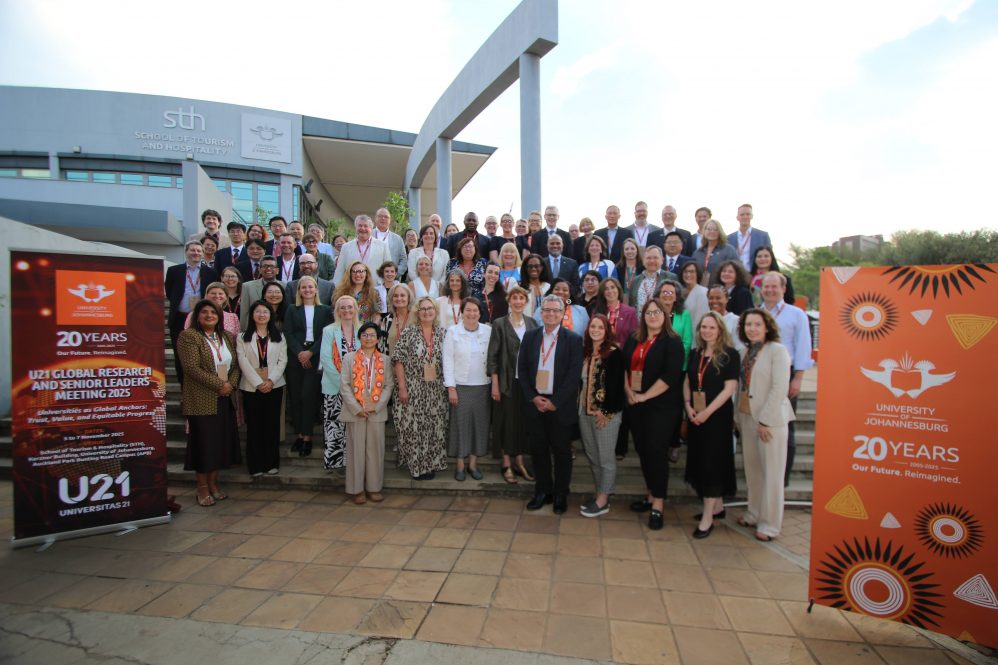
Attendees at the Unversitas 21 Global Research and Senior Leadership Meeting in Johannesburg, South Africa. Contributed photo.
Regardless of hemisphere or continent, universities around the world are facing unprecedented challenges to research. Two UConn leaders explored those hurdles and much more at an international gathering held in Johannesburg, South Africa.
This year's Universitas 21 (U21) Global Research and Senior Leadership meeting brought together partner institutions from all over the globe for honest discussions about hurdles in academia. It was held from Nov. 5-7 at the University of Johannesburg.
Lindsay DiStefano, UConn's interim Vice President for Research, Innovation, and Entrepreneurship, and Ngozi Taffe, associate vice president for Global Affairs made the trek to South Africa. The summit explored the role that universities play as global anchors in an evolving world, especially against a backdrop of geopolitical fragmentation and growing skepticism toward research and higher education.
"We learned that despite international borders, our roles are not unique," says DiStefano. "Along with our peers, UConn has identified ways to raise public trust in our research institutions, and we share a responsibility to be conduits of societal progress."
U21is devoted to making positive impacts at societal and institutional levels, as well as enabling personal career development and growth. Fellow American partners in the consortium include major R-1 research institutions the University of Maryland, University of Illinois, and University of California-Davis. There are a total of 30 members, spanning Europe, Asia, Australia and New Zealand, North America, South America, and Africa.
"By being in this consortium of top universities from around the world, UConn is positioned to partner with top scholars to engage in cutting edge research and projects," says Ngozi Taffe, UConn's associate vice president for global affairs. "Beyond access to research collaborations, as a U21 member, our students are able to engage in academic exchange programs with any of our members."
DiStefano co-led a discussion on regaining trust and served on a panel exploring the value of research into nature. She and Ngozi met with a wide range of delegates and leaders, learning strategies to drive UConn's international reputation as a powerhouse in research and innovation.
The UConn faction collaborated on best practices to swing the tide back in favor of investing in research, DiStefano says, including strategies that UConn's Office of the Vice President for Research (OVPR) are utilizing. Beginning last spring, the OVPR has been actively pushing resources to UConn researchers, such as workshops to help faculty members advocate for themselves in a challenging landscape. Other outreach efforts include an Impact website and a frequently updated FAQ page on the main UConn research site that tracks legislation and other policies that impact University research.