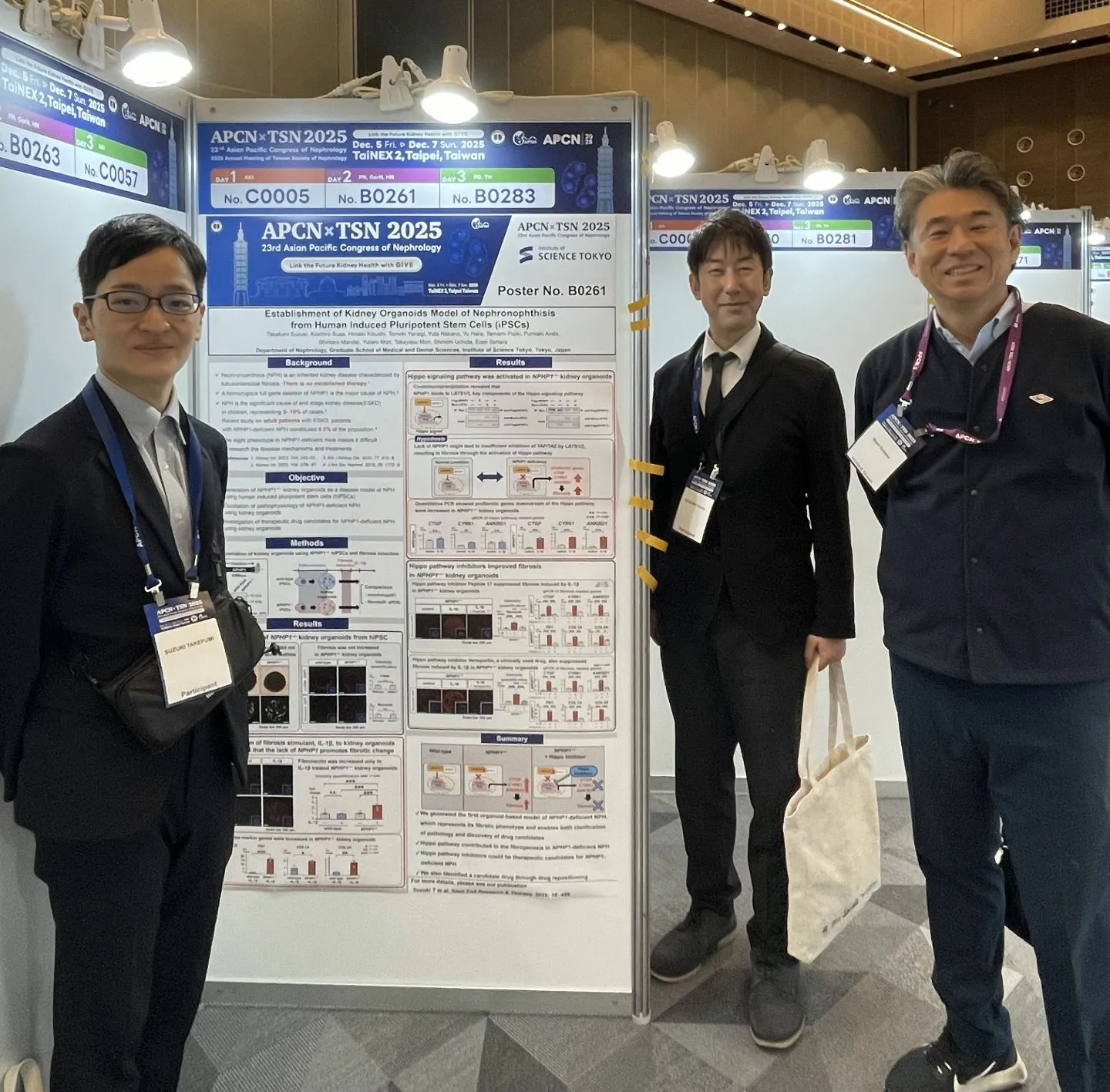
What the research is about
Our kidneys work tirelessly every day to filter our blood and keep it clean. They also carefully regulate the balance of water and salt in our bodies, as well as the condition of our blood, helping to maintain a stable internal environment.
However, there is a disease that quietly progresses inside the kidneys despite their vital role. This disease is nephronophthisis (NPH), a major cause of kidney failure in children and young adults. NPH is classified as a government-designated rare disease in Japan, and no established treatment has yet been developed.
NPH can be caused by several genetic factors. Among them, deletion of the NPHP1 gene is the most common, accounting for about half of all cases. In this type of NPH, a process called fibrosis occurs, in which normally soft kidney tissue gradually becomes stiff and loses its function. Although the loss of the NPHP1 gene was known to be the cause, how it led to kidney fibrosis remained a mystery.
Researchers attempted to reproduce human-like kidney failure and fibrosis using mouse models, but these efforts were unsuccessful. To overcome this challenge, the team turned to organoids-artificially created mini-organs grown in the laboratory.
Why this matters
A research team led by Associate Professor Eisei Sohara, Junior Associate Professor Koichiro Susa, and graduate student Takefumi Suzuki at Institute of Science Tokyo (Science Tokyo) used 3D kidney organoids (mini kidneys) made from human iPS cells. Using this approach, they successfully reproduced kidney tissue fibrosis caused by NPHP1 gene deletion for the first time using human cells.
This breakthrough allowed the researchers to closely examine what happens inside the kidney as the disease develops. They discovered that NPHP1 normally acts like a "guardian," preventing fibrosis from spreading within the kidney.
In healthy kidney cells, a regulatory signaling system known as the Hippo signaling pathway helps maintain tissue balance by preventing excessive cell growth and tissue damage. NPHP1 supports this control system, effectively acting as a brake that suppresses fibrosis and keeps kidney tissue healthy.
When NPHP1 is missing, this protective function is lost, and fibrosis progresses uncontrollably. The research team further demonstrated, using kidney organoids derived from human iPS cells, that certain drugs-peptide 17 and verteporfin-can restore this braking function and suppress fibrosis by regulating cellular activity.
What's next
These findings provide a new foundation for drug development for NPH, a disease that previously had no effective treatment. Notably, verteporfin is already used clinically for other conditions. By repurposing existing drugs-a strategy known as drug repositioning-new treatments may be delivered to patients more quickly.
In addition, a deeper understanding of fibrosis shared among hereditary kidney diseases could lead to new strategies for preventing kidney failure. Kidney organoids may also serve as a powerful experimental model for studying a wide range of kidney disorders beyond NPH.
Comment from the researchers
I began working on NPH 20 years ago during my time studying abroad, and we have finally obtained results that may lead to treatment. Based on this discovery, we are now working hard to deliver drugs that are easy for patients with NPH to use.
(Eisei Sohara:Associate Professor, Department of Nephrology, Graduate School of Medical and Dental Sciences, Institute of Science Tokyo)
The advent of iPS cells has made possible what was once impossible. Our research is one such example. As clinicians, we aim to translate these findings into practical treatments that can bring hope to patients.
(Koichiro Susa:Junior Associate Professor, Department of Nephrology, Graduate School of Medical and Dental Sciences, Institute of Science Tokyo)
We hope that the insights gained from our study will further advance research on NPH. We also aim to continue developing kidney organoids as experimental models that can help us understand not only NPH but many other kidney diseases.
(Takefumi Suzuki:Graduate Student, Graduate School of Medical and Dental Sciences, Institute of Science Tokyo)