
Key points
- Petalite is a lithium aluminium phyllosilicate mineral which forms colourless, pink, grey, yellow or white crystals according to the levels of trace impurities present.
- With lithium demand soaring, recycling and new sources of the metal are needed to keep up supply.
- Petalite is emerging as an important alternate source of lithium to meet this global demand.
Demand for lithium is surging, as the world transitions to renewable energy and adopts new technologies.
Lithium-ion batteries play a central role in this shift, powering everything from cars to portable electronics.
To meet the increasing demand, companies are recycling lithium from old batteries and also looking for new sources and better ways to extract it. While recycling supports a circular economy, experts agree that recycled lithium alone will not meet projected future needs.
This growing gap is driving the industry and researchers to explore alternative minerals and technologies for lithium extraction.
Mineral sources of lithium
When it comes to lithium, there's more to the story than just one mineral.
Spodumene is the most widely used due to its high lithium concentration and established processing techniques. Other notable lithium-bearing minerals include lepidolite , amblygonite and lesser-known petalite.
But perhaps petalite deserves a higher profile. Afterall, it played a central role in getting lithium onto the periodic table. It was first discovered in 1800 by Brazilian naturalist José Bonifacio de Andrada e Silva. A few years later, in 1817, Swedish scientist Johann August Arfvedson identified lithium as a previously undocumented element.
Sometimes called castorite, petalite is a lithium aluminium phyllosilicate (LiAlSi₄O₁₀). It forms in lithium-rich pegmatites alongside minerals like spodumene and lepidolite, and is found in well-known deposits in Zimbabwe, Canada, Brazil and the Yilgarn and Pilbara Cratons in Western Australia .
Petalite is a hard mineral (6 to 6.5 on the Mohs scale ) with a high melting point making it particularly well-suited to use for heat-resistant and scratch-resistant glass and ceramics.
Unlocking lithium
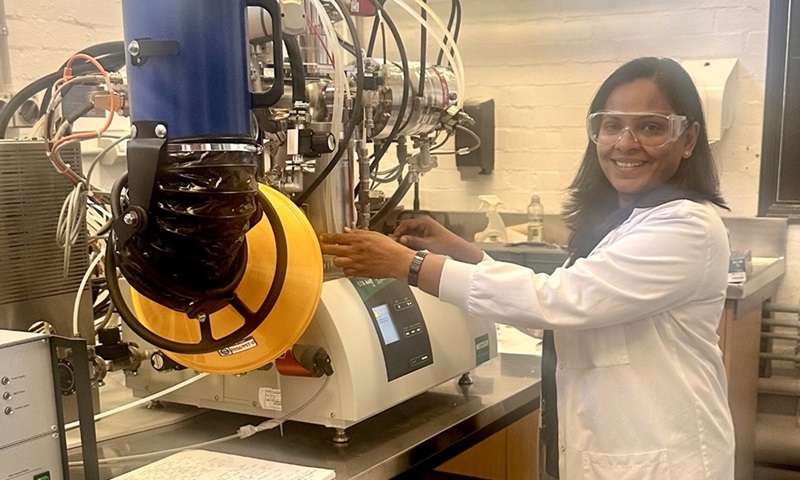
Although petalite has a simpler mineralogy than spodumene, lithium extraction from petalite is more complex. Something CSIRO scientist, Dr Leena Melag, is keen to understand.
"Lithium extraction processes from spodumene are well established, but with petalite, the process is trickier and involves extra steps," says Dr Melag.
"Petalite must be treated with both heat and pressure to convert it into a form that's easier to chemically process and liberate the lithium."
Despite these challenges, petalite remains an attractive supplementary lithium resource.
New technologies for a diversified lithium supply chain
With lithium in high demand, the industry is looking for new ways to find and use it. New technology is helping.
Funding from the Critical Minerals R&D Hub enabled CSIRO to develop the LithSonic™ process, an advancement of its earlier MagSonic™ technology
Lithium is a highly reactive metal and although it can be made using similar techniques to iron, it very quickly reacts again to revert to another form. The LithSonic™ process uses super-sonic flow to quench the lithium metal before it can react, making it an attractive route for extracting lithium from minerals like petalite. These technologies promise cleaner and greener production methods and may reduce the environmental impact of traditional lithium extraction.
"We're looking at different feedstocks, like petalite, to use in our LithSonic process," said Dr Melag.
Advancements in extraction technology and the use of supplementary resources like petalite are set to transform lithium production, making it more efficient and sustainable.
By diversifying sources and refining extraction processes, the industry can better meet growing demand and support a cleaner, more reliable energy future.


