
When winter weather settles on the Oregon Coast, crab boats wait for the all-clear announcement from the Oregon Department of Fish and Wildlife.
Ready to deploy their pots, fisherfolk refresh the online bulletin to see if the Dungeness crab fishery will open on Dec. 1 or be delayed, as has become the norm over the past decades.
But marine biologist Alan Shanks is in no rush. He doesn't bother with the opening-day updates. Instead, he waits two to three months later, when most of the season's crabs have already been hauled in. By then, he'll know if his predictions were accurate.
For the past 25 years, Shanks has compared the yields of the winter commercial catch to the baby crabs his water-jug trap collects each summer. He's found that the number of baby crabs that arrive on the coast can be used to estimate the size of the state's commercial harvest of adult Dungeness crab years in the future, with a 12 percent margin of error.

"I can predict, four years in advance, the commercial landings from the Oregon-Washington border all the way through California, just from a simple trap in Coos Bay," said Shanks, a professor emeritus of the Oregon Institute of Marine Biology in the University of Oregon's College of Arts and Sciences.
Shanks spoke to OregonNews about how he predicts good and bad crabbing seasons, why the fishery rarely opens on Dec. 1, and what climate change might mean for the crab.
Why is the Dungeness crab such a big deal in Oregon?
Native to the Pacific coast from Alaska down to Mexico, the crustacean supports Oregon's most valuable single-species fishery, Shanks said, accounting for 40 percent of the total value of all locally harvested seafood.
With six major crabbing ports bordering the state, Oregon has come a long way from its first 6,628 pounds in 1889 to now a yearly average of 18 million pounds. A staple of Northwest winter dinners, the Dungeness crab is the state's official crustacean.
Dec. 1 is the earliest the Oregon fishery can open, but that date is usually an exception and not the rule, Shanks said.
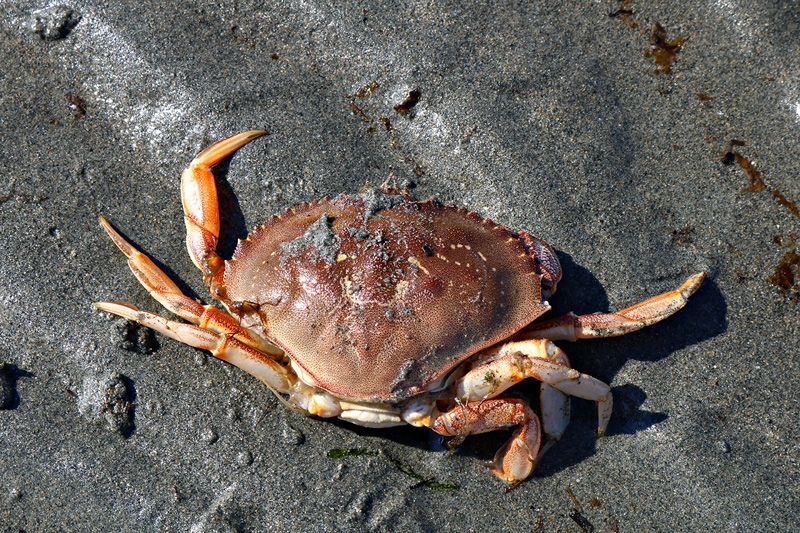
What causes delays in the fishery opening? When will the 2025-26 season start?
Crabbing season opens when crabs are ready, Shanks said, meaning they're fat enough and have low enough levels of domoic acid, a marine biotoxin. Produced by algae that shellfish eat and retain, domoic acid is not harmful to crabs.
But those who consume contaminated crabs, particularly their internal organs, can become sick, with severe cases causing permanent short-term memory loss. If levels are too high, the fishery season can't open.
"Crabs eat everything under the sun," Shanks said. "They'll eat detritus that's fallen to the bottom, worms and clams. So they can end up with a buildup of domoic acid in them."
Although Oregon's crabs have passed both meat-fill and biotoxin tests, this year's fishery is closed until at least Dec. 16 to sync with the delayed openings of California and Washington.
Image captions
 Image 1
The inside of a crab trap (Photo by Sarah Frimtzis, courtesy of Dan Morrison)
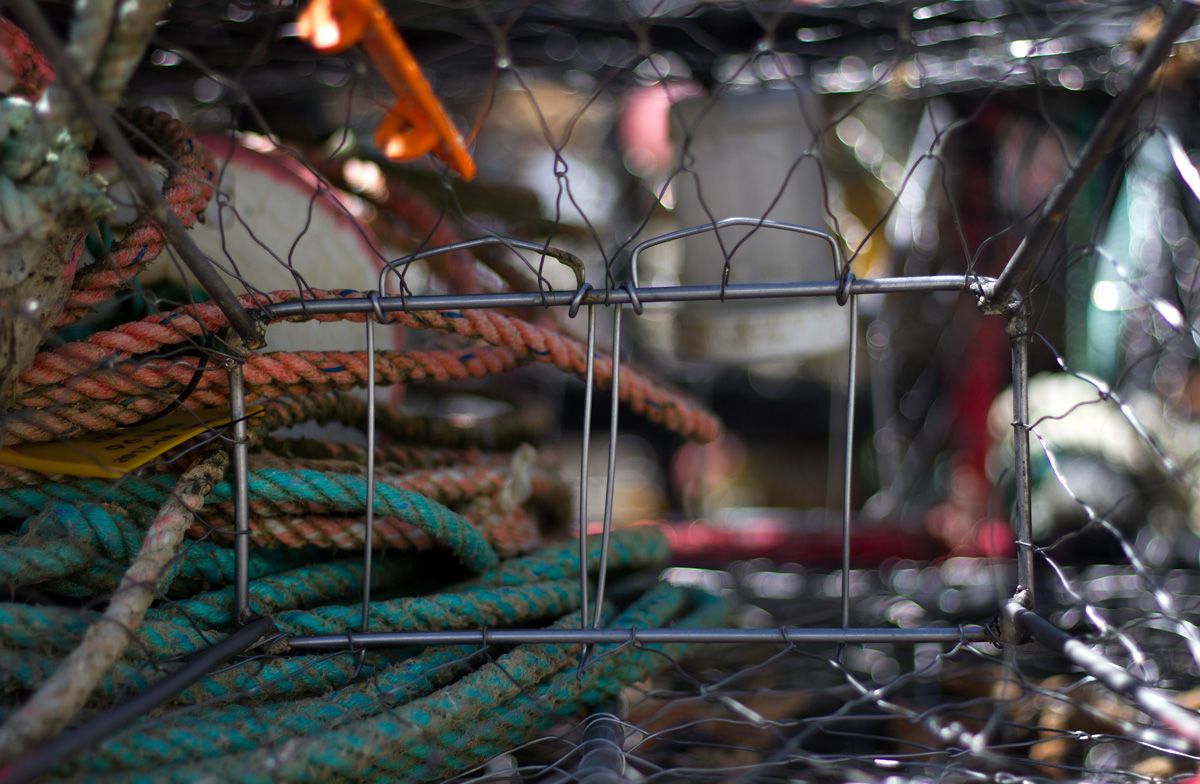
The inside of a crab trap (Photo by Sarah Frimtzis, courtesy of Dan Morrison)
The inside of a crab trap (Photo by Sarah Frimtzis, courtesy of Dan Morrison)
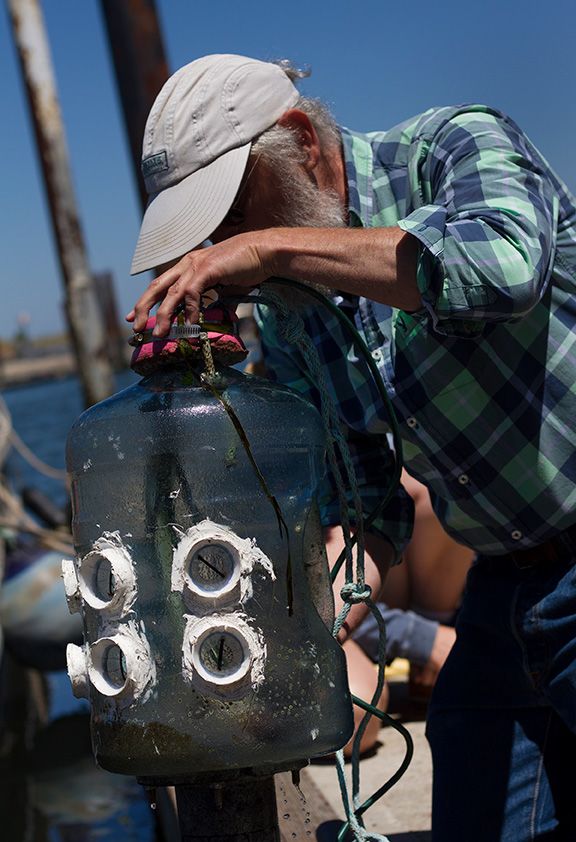
Alan Shanks developed a light trap to attract and collect megalopae. (Photo by Sarah Frimtzis, courtesy of Dan Morrison)
How can the industry predict when a year will be a good or bad crabbing season?
In the winter, Dungeness crabs hatch near the shore as larvae no bigger than fleas. Because of their limited swimming abilities, they're swept by currents through much of their early development.
They're first pulled north towards Canada and then pushed back southward in the spring, returning as megalopae, the last larval stage. The crabs then spend the next four years near shore until they grow into the full-sized adults the fishery catches.
So, the number of baby crabs each year is a rough predictor of the number of harvestable adult crabs four years later.
Alan Shanks developed a light trap to attract and collect megalopae. (Photo by Sarah Frimtzis, courtesy of Dan Morrison)
Shanks counts the number of baby crab that return to a port in Coos Bay. Every day from April through September his team collects them using a light trap, a five-gallon plastic water bottle with an LED inside.
"I have no idea why they're attracted to light, but they're suckers for it," Shanks said.
Shanks' predictions, based on larval counts, typically fall within 12 percent of the actual commercial catch. His team also found that the number of baby crab in Oregon is correlated with the commercial catch in California - but not Washington, due to their differing oceanography.
What causes the variations in the harvest year-to-year?
Some years, Shanks' team catches thousands of larva; in others, they collect millions. Three main factors contribute to the huge year-to-year variation, Shanks said: El Ninos, Pacific decadal oscillations and the timing of the spring transition.
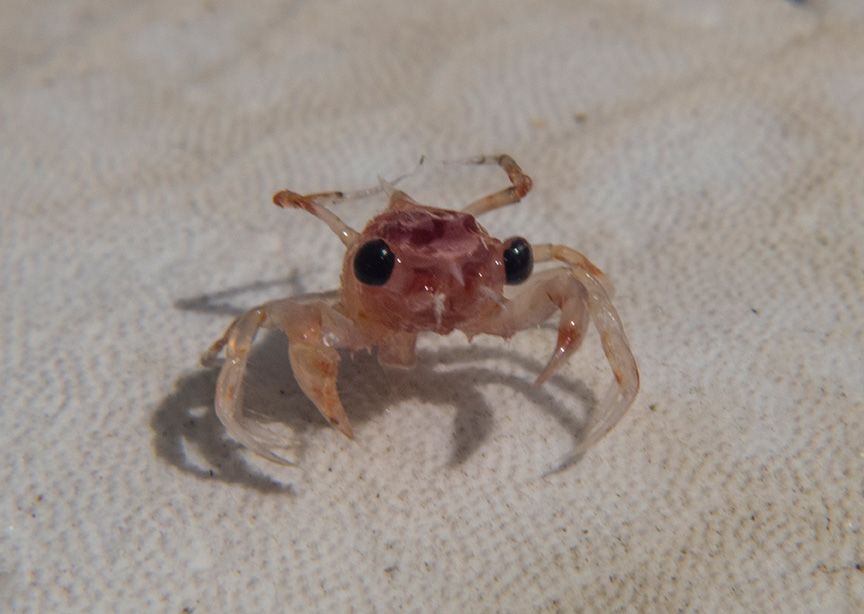
Although smaller than a dime, Dungeness megalopae are bigger than other baby crab species, which is one way researchers tell them apart. (Photo by Sarah Frimtzis, courtesy of Dan Morrison)
El Ninos strengthen northward currents, sometimes sweeping the California crabs as far as Alaska, lowering the commercial landings along the Oregon coast. Negative Pacific decadal oscillations and early spring transitions do the opposite, creating stronger southward currents that bring crabs back.
But Shanks notes that more larvae don't always translate to more adult crabs. When baby crabs arrive at Coos Bay in the thousands, Shanks can anticipate the state-wide commercial harvest to be thousands of times larger. But if baby crabs arrive in hundreds of thousands or millions, the scale falls into tens or even single digits.
That drop-off is perhaps due to limited food resources, causing competition among the crabs, Shanks said.
"So what's the major thing they could eat? Each other," he said. "They're nasty little cannibals. So when the number of megalopae returning is very low, like during a strong El Niño, they have better chances of growing up and becoming a crab."
Although smaller than a dime, Dungeness megalopae are bigger than other baby crab species, which is one way researchers tell them apart. (Photo by Sarah Frimtzis, courtesy of Dan Morrison)
How is climate change affecting things?
The increasing prevalence of marine heat waves is throwing crab season - and Shanks' predictions - out of balance.
"When it's a normal year, my predictions are amazingly good," Shanks said. "When there's a marine heat wave, my predictions are way low."
Shanks estimated the 2024-25 season to be 11 million pounds, but it resulted in 15 million pounds. The catch was higher than predicted because the baby crabs returned during a marine heat wave, which aided their survival.
"That's very common in cold-blooded creatures: warmer temperatures mean faster growth," Shanks said. "Faster growth means they grow rapidly out of their tiny sizes, which are most vulnerable to predation and cannibalism, leading to more successful adult recruitment."
Based on Shanks' data, the 2025-26 season is predicted to produce 30 million pounds, roughly 1.5 times the average. But the marine heat wave four years prior may underestimate that.
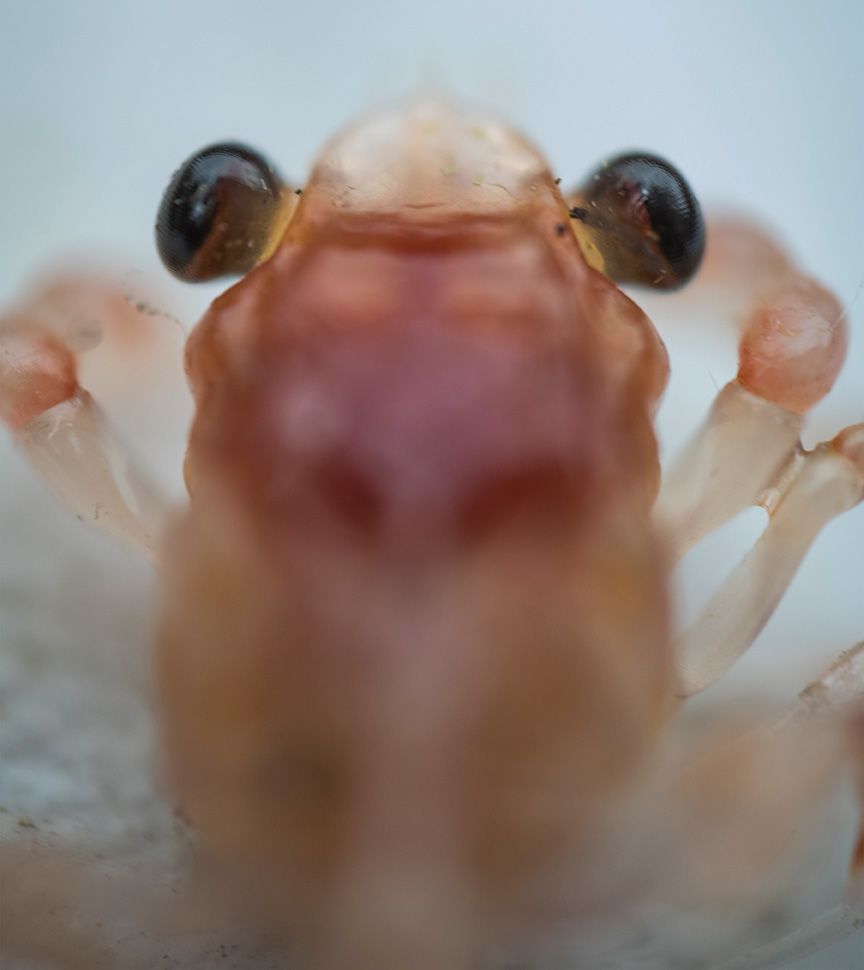
To a commercial crabber, more crabs sounds lucrative. But to an ecologist like Shanks, he worries it could lead to the crash of the Dungeness crab, especially as extreme temperatures become recurrent.
"We've been having marine heat wave after marine heat wave, so the number of adult crabs could easily be going up and up and up," he said. "I look at that and think, 'Are those extra crabs going to find enough to eat?' At what point do we have too many, and they start starving to death?"
The circumstances reflect the crash of the snow crab fishery in Alaska, which scientists suspect was caused by warmer waters.
"Could this be the beginning of a crash for the Dungeness crab? The answer: Who knows?" Shanks said. "We don't know because there are some big scientific gaps in our understanding of these crabs. We're flying blind."
Shanks is quick to note, however, that the fishery is remarkably sustainable due to the regulations in place. But without research on how warm water affects the crabs, he said it's unclear if their fate matches the snow crab.
Image captions
 Image 1
A young male crab (Photo by Sarah Frimtzis, courtesy of Dan Morrison)
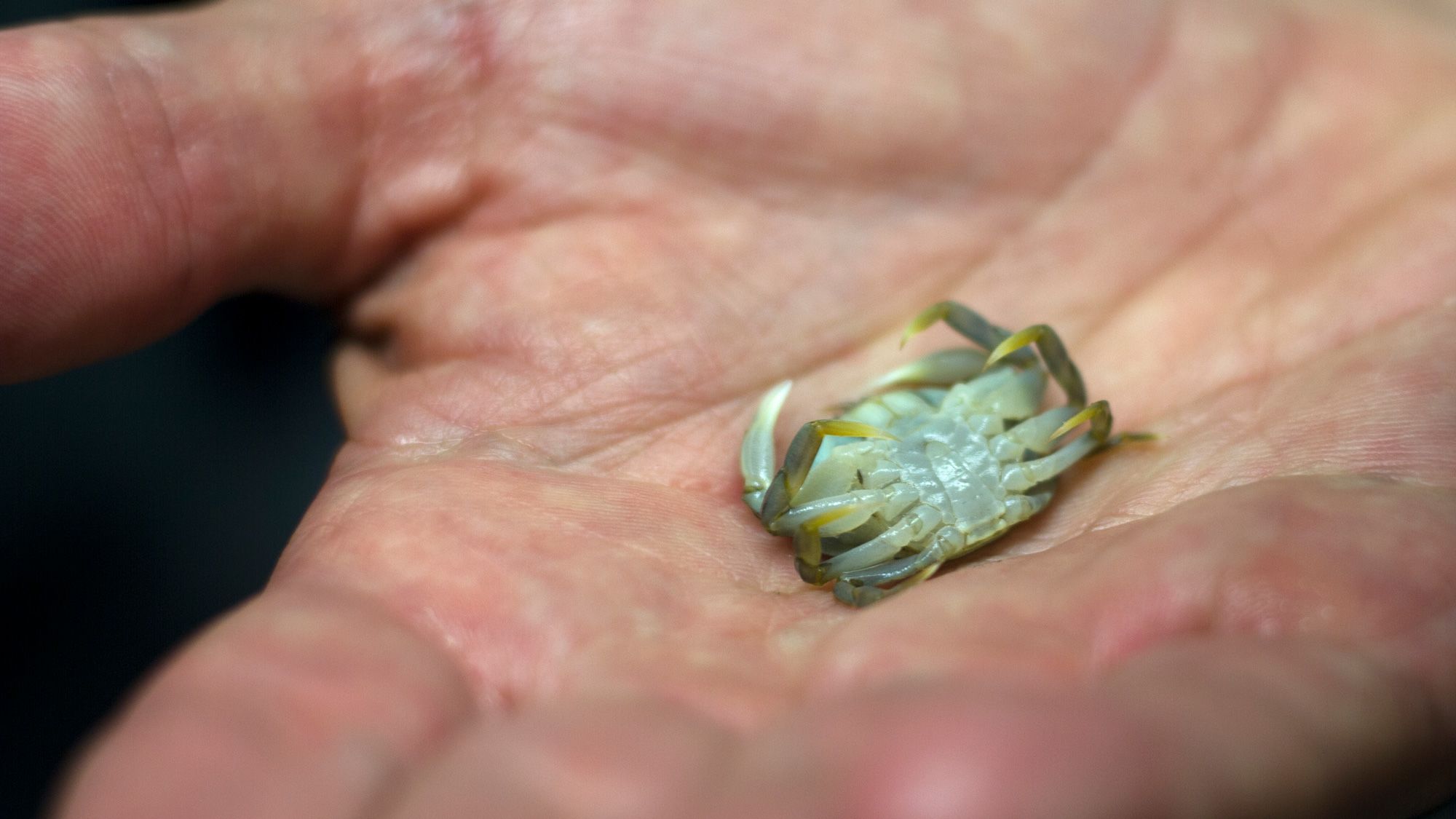
A young male crab (Photo by Sarah Frimtzis, courtesy of Dan Morrison)
A young male crab (Photo by Sarah Frimtzis, courtesy of Dan Morrison)

With Alan Shanks retired, Maya Watts, education program coordinator, front center, is now running the long-term Dungeness dataset. (Photo by Nic Walcott, University Communications)
Maya Watts, standing, will recruit new UO students to help collect and count megalopae. (Photo by Nic Walcott, University Communications)
What's the future of the tracking project?
Shanks has retired, so he's collaborating with Maya Watts, education program coordinator at the Oregon Institute of Marine Biology, to continue the long-running dataset and recruit students. Watts also will be working with Leif Rasmuson, a former doctoral student of Shanks', from the Oregon Department of Fish and Wildlife.
"It's been really nice collaborating with ODFW, as well as the U.S. Fish and Wildlife Service, because this is an important fishery not only in Oregon but up and down the West Coast," Watts said. "Being able to help fisheries prepare for these booms and busts is a valuable economic service."
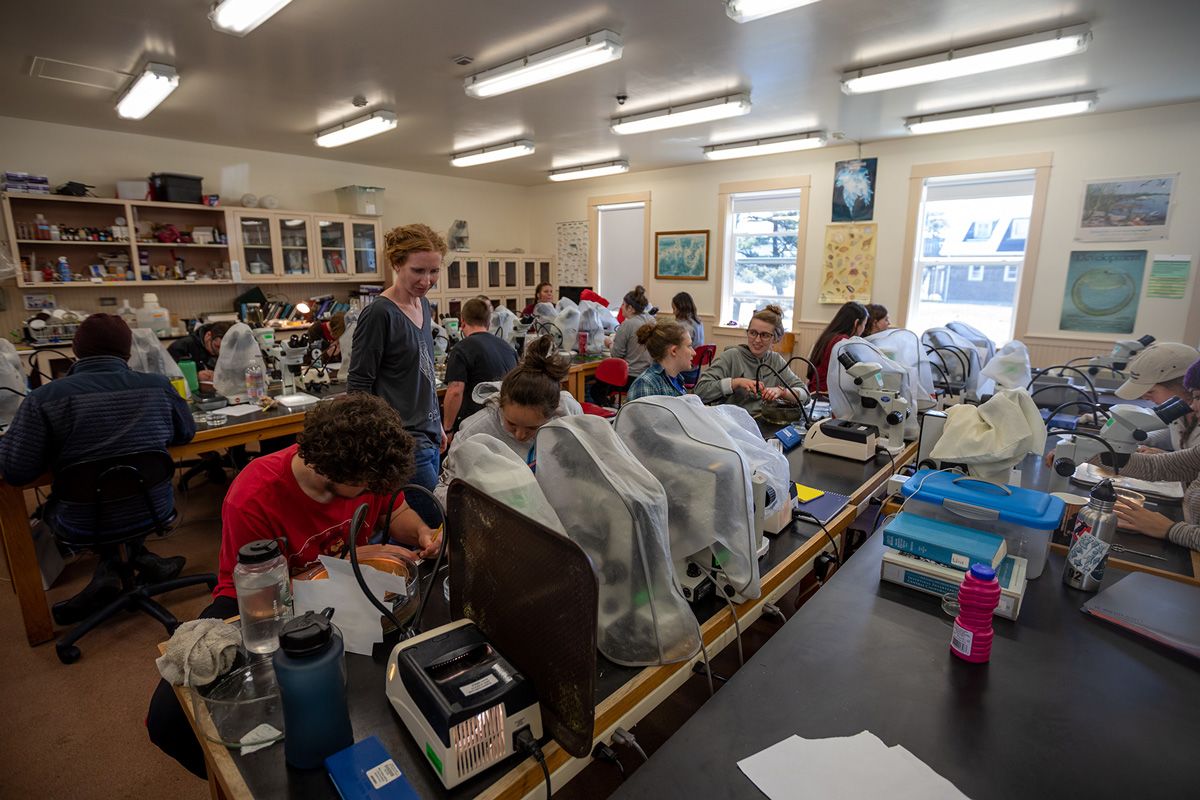
That service wouldn't be possible without the more than 150 UO students who picked up a bucket, walked from UO's coastal campus to the local pier, and counted each baby crab collected by light trap, which they've done daily from April to September for the last 25 years.
"It's valuable for the students in a way that's accessible to them too," Watts said. "It's something they can work on for just two hours a day and be contributing to something larger."
It's also a testament to the Oregon Institute of Marine Biology's dedication to experiential learning.
"We're working with students who are so interested in marine biology that they've gone through the hassle of leaving Eugene - their housing, friends, everything - and coming to the coast for a year," Shanks said. "So I've had the luxury of dealing with enthusiastic students throughout my entire career. I'm totally spoiled."
The larval monitoring project is supported by the Oregon Crab Commission, the Oregon Department of Fish and Wildlife, and the U.S. Fish and Wildlife Service.
Discover the coast with the Oregon Institute of Marine Biology
waves
The first marine biology program in Oregon celebrates its 100th anniversary
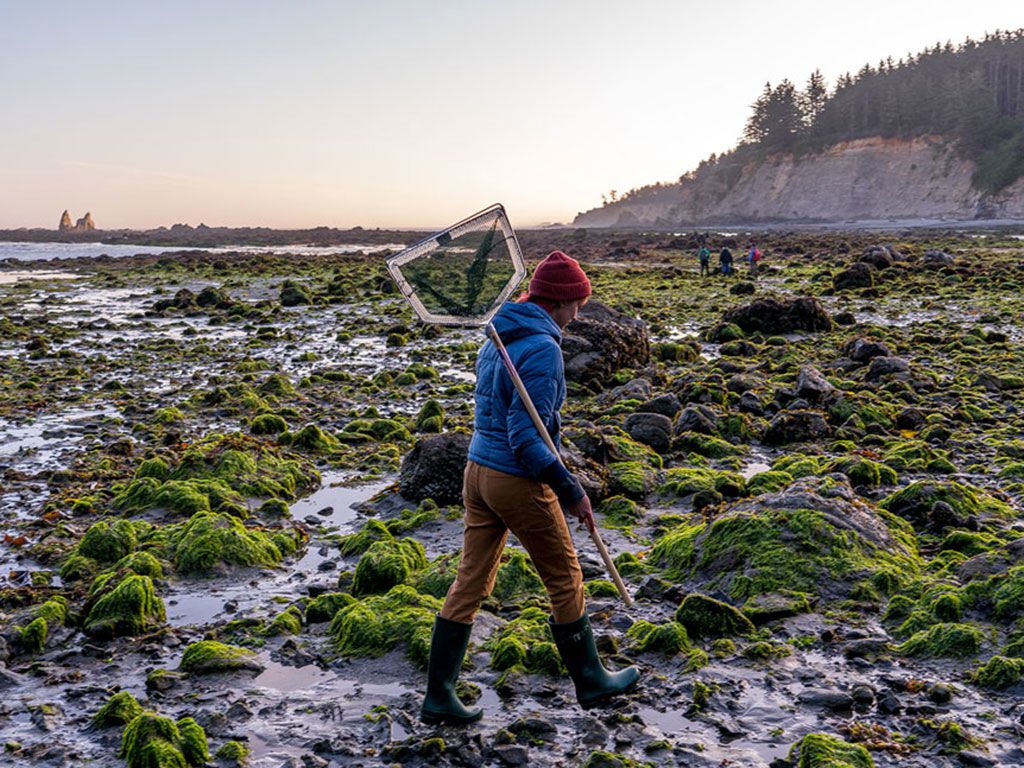
Marine biology students get their feet wet at OIMB
UO's coastal campus is dedicated to hands-on learning.
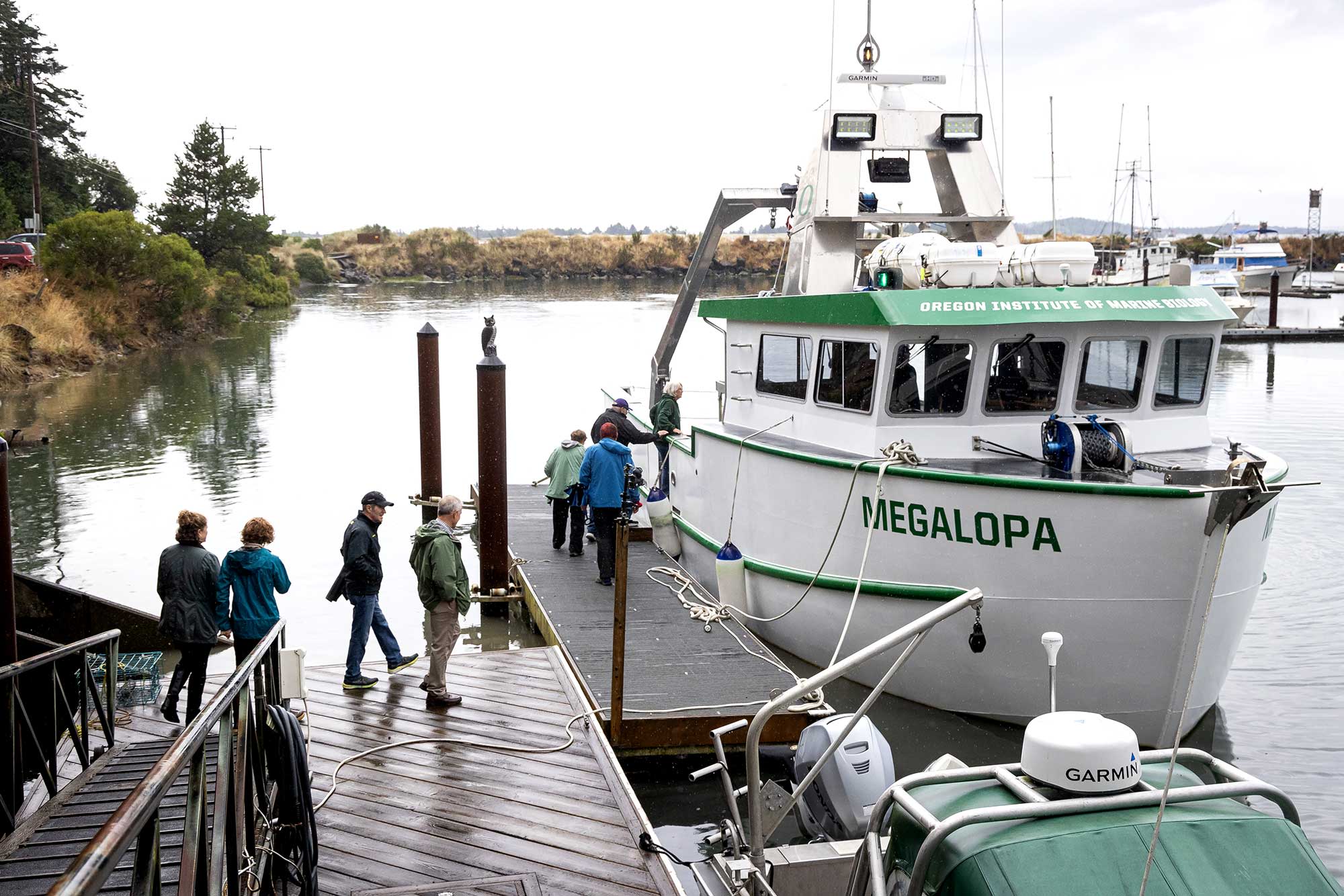
Students from all majors explore interdisciplinary research on the coast


