
A research team from the Nanjing Institute of Geology and Palaeontology of the Chinese Academy of Sciences (NIGPAS), in collaboration with international partners, has completed a high-resolution biomarker analysis of the Zal section in northwest Iran. This study uncovers new insights into ecological disruption and microbial community shifts across the Permian-Triassic (P-T) transition in the region.
The findings, published recently in Palaeogeography, Palaeoclimatology, Palaeoecology, address a critical gap in global P-T research: while the transition marks the most severe biotic crisis of the Phanerozoic Eon, microbial dynamics during this interval remain poorly documented in key areas of the Paleotethys Ocean.
Iran's western Paleotethys outcrops offer well-preserved, continuous marine sediment records-making them a vital archive for studying the crisis. Comparative analyses between western (Iran) and eastern (South China) Paleotethys sites are critical to understanding global environmental and biological trends, yet Iran's specific environmental and microbial histories have long remained unclear.
The study identifies three overlapping environmental crises that unfolded simultaneously during the transition:
Biomarker data reveal a major shift in primary producers-from eukaryotic green and red algae to bacteria-with cyanobacteria becoming dominant at the extinction boundary.
Sediment records document recurring bottom-water anoxia, strong water-column stratification, and prolonged intervals of euxinia (oxygen-depleted, sulfide-rich conditions).
Sharp increases in terrestrial organic matter, linked to intensified wildfire activity and soil erosion, suggest land-derived nutrients may have exacerbated marine eutrophication.
Notably, these biomarker patterns align with negative δ13C isotopic shifts and match trends previously observed in South China, indicating that ecological decline occurred synchronously across the Paleotethys. Collectively, the results point to volcanism-driven terrestrial environmental collapse and widespread marine anoxia as key amplifiers of the end-Permian mass extinction.
This work was supported by China's National Key Research and Development Program and the Jiangsu Innovation Support Plan for International Science and Technology Cooperation.
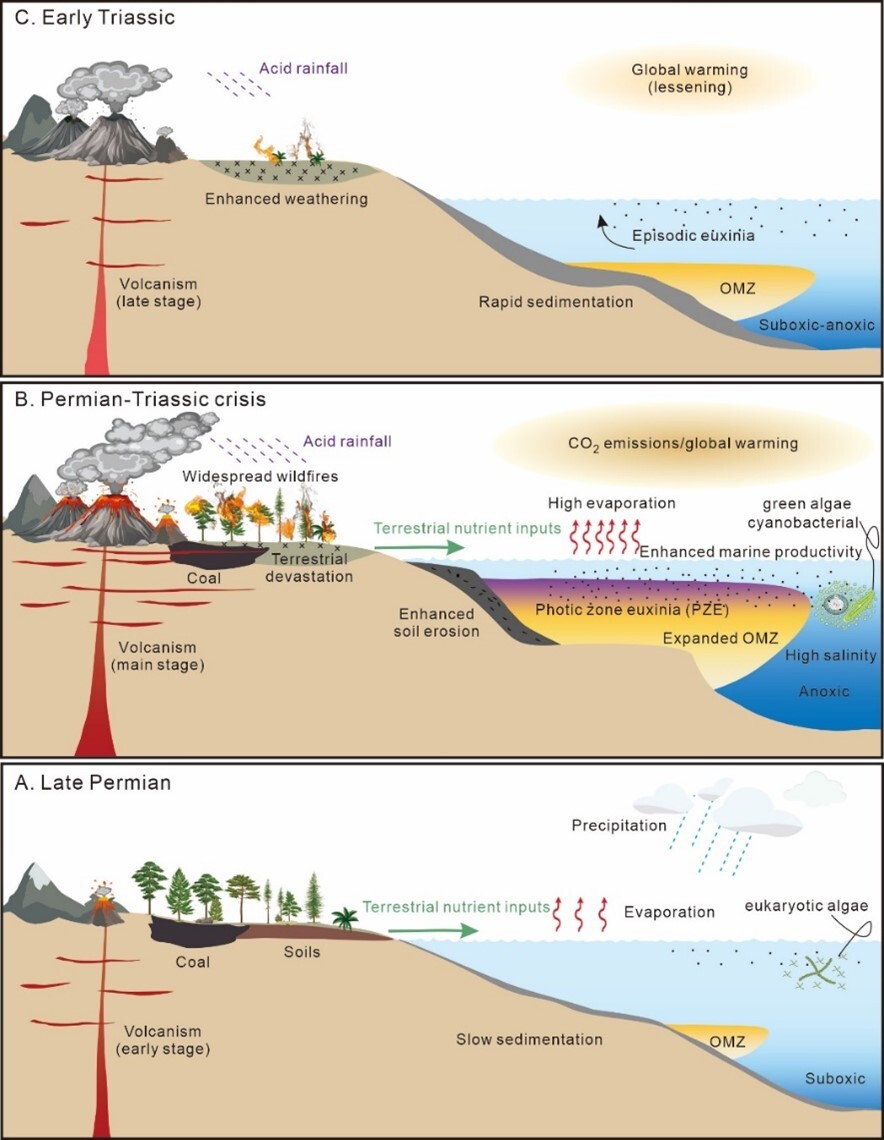
Conceptual models of oceanic anoxia and ecological disturbance in terrestrial-marine systems from the late Permian to Early Triassic. (Image by NIGPAS)


