
A team from CIRTTA-UAB and IMB-CNM-CSIC has succeeded in reducing the water content of skim milk using electric fields. The study explores an alternative strategy for drying high-value liquid foods that better preserves their nutrients and does not involve the application of heat through electrospray.
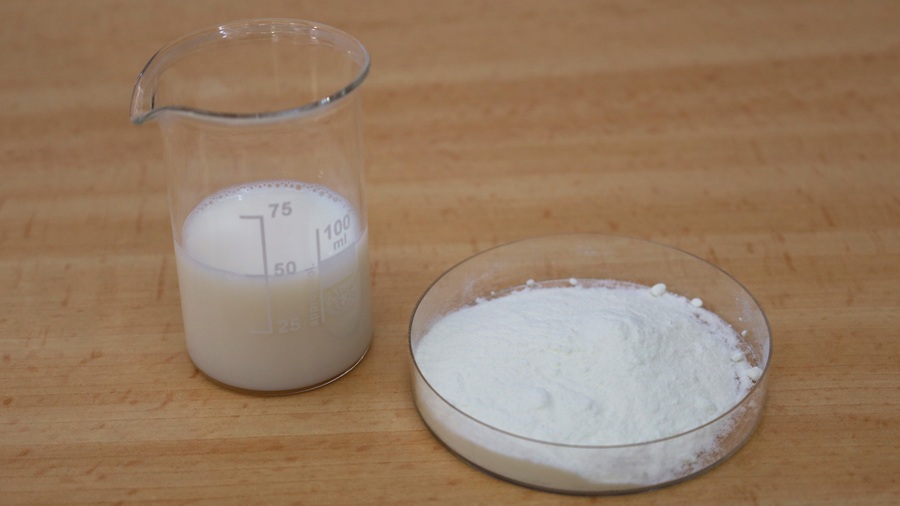
Dehydrating milk to turn it into powder is, today, an energy-intensive process that subjects the product to high temperatures. Powdered milk is widely used by the food industry and allows the product to be stored and transported in a stable condition for long periods of time without the need for refrigeration. While industrial methods are effective, they have high energy costs and can alter heat-sensitive components, such as whey proteins, enzymes, or vitamins. A team from the Institute of Microelectronics of Barcelona (IMB-CNM-CSIC) and the Center for Innovation, Research, and Technology Transfer in Food at the Autonomous University of Barcelona (CIRTTA-UAB) has, for the first time, explored a non-thermal alternative to this process: electrospray, a technique that uses an electric field, rather than heat, to remove water from liquid foods, such as milk at room temperature (20 °C).
The team, consisting of Bernat Perez Playà, Anna Zamora, Manuel Castillo, and Llibertat Abad, presented the technology in a study recently published in the journal Innovative Food Science and Emerging Technologies. Using this method, which is currently being patented, the researchers were able to concentrate the milk by removing a significant amount of water without altering the structure of its proteins.
The results are promising, as the water content of the milk has been reduced by nearly half, although the process needs to be optimized to produce completely dehydrated milk.
An electric field instead of heat
In milk, as in any liquid, droplets tend to stick together due to surface tension. To turn it into powder, industrial processes use heat to evaporate the water it contains and concentrate its components. Electrospray takes a different approach: by applying a strong electric field, it overcomes surface tension and breaks the liquid into millions of microdroplets. It's as if the electricity were shattering the milk droplets, causing a single drop to break down into increasingly smaller droplets, where the water can evaporate more effectively at room temperature.
The electrospray technique is already used in fields such as tissue engineering, nutraceuticals (nutrition and pharmacology), and sensor manufacturing, but its application in food processing had barely been explored and had never been studied for dehydrating milk.
Researcher Bernat Perez, who developed this line of research in his doctoral thesis at CIRTTA-UAB and IMB-CNM and is the study's first author, explains that, since this is a novel technique in the food sector, "tests with skim milk have made it possible to determine the influence of critical process variables, such as injection flow rate, the distance between the tip and the collector, and the milk's fat content."
How the technique was tested
The study was conducted in the Micro and Nanofabrication Clean Room at the IMB-CNM-CSIC, using an electrospray system (Fluidnatek LE-10) adapted to inject reconstituted skim milk at various concentrations and flow rates, applying a voltage of 29 kV and maintaining a distance of 10 cm between the tip and the collector.
The injection flow rate proved to be a determining factor in water removal. At a high flow rate (0.2 mL/min), the milk's solids content barely changed after the process. In contrast, at a low flow rate (0.01 mL/min), the milk became significantly more concentrated: in the case of reconstituted milk with 12% total solids, its solids content increased from 12.3% to 36.8%. According to the researchers, this is because, at low flow rates, each drop receives a greater electrical charge relative to its volume, which promotes its fragmentation and greater water evaporation.
The researchers also analyzed the size of the deposited droplets, the amount of water removed, and, using gel electrophoresis, whether the process altered the structure of the main milk proteins, such as caseins and whey proteins. Manuel Castillo, a professor in the Department of Animal and Food Science at the UAB and a researcher at CIRTTA-UAB, explains that the results "suggest that electrospray drying, unlike conventional thermal methods, does not alter these key components of milk."
A first step toward heat-free food drying
The authors emphasize that this is a first step toward validating the technology: under the tested conditions, a completely dry milk powder was not obtained, and aspects such as processing capacity, energy efficiency, and the scalability of the technique still need to be demonstrated. In addition, the method for dehydrating liquid products is in the process of being patented.
Llibertat Abad, a researcher at IMB-CNM-CSIC, notes that "the next steps in this work will focus on optimizing parameters such as liquid flow rate, applied voltage, and the distance the droplets travel during the process; as well as exploring configurations with multiple emission points that allow for scaling up production, evaluating energy consumption, and assessing the microbiological stability of the final product."
All in all, the study opens up a new line of research for the dehydration of high-value liquid foods, such as milk, juices, or other heat-sensitive products. Although it is still far from industrial application, this non-thermal technology points toward a new way to transform liquids into stable, easy-to-store products while better preserving their original characteristics.
Reference article: Perez-Playà, B., Zamora, A., Abad, L., & Castillo, M. (2026). Proof of concept of electrospraying skimmed milk. Innovative Food Science and Emerging Technologies, 113, 104757. https://doi.org/10.1016/j.ifset.2026.104757


