
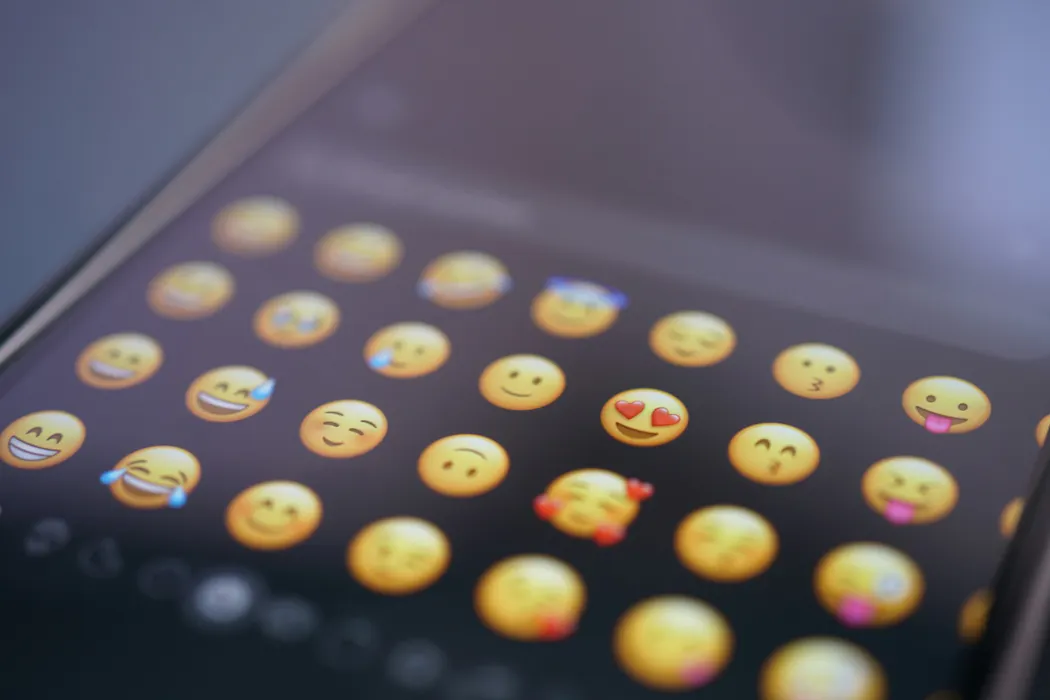
You've typed it, deleted it and typed it again. You need to let your colleague know there's a problem with a project at work. Should you use a grinning face - 😄 - in that Slack message to soften the blow, or an angry face - 😠 - to show your distress?
If you've experienced this type of internal debate, you're not alone. Instant messaging now dominates workplace communication, with 91 per cent of businesses using two or more chat platforms . But when we instant message, we can't see our colleagues' facial expressions. We try to compensate with emojis, using them as stand-ins for non-verbal cues .
But do emojis actually help, or can they backfire?
My recent study, conducted with colleagues at the University of Ottawa and published in Collabra: Psychology , reveals that emoji choice matters. The emoji you pick, and whether it matches the tone of your message, may impact both how competent your co-workers think you are, and how appropriate your message is for the workplace.
The research project
We asked 243 research participants to read short workplace instant messages from a hypothetical co-worker.
The messages varied on three dimensions: the emotional tone (positive, negative or neutral), the emoji attached (a grinning face 😀, an angry face 😠 or none) and whether the sender was described as a woman or a man.
Participants rated how competent they thought the message sender was. They also rated how appropriate the message felt for a professional setting.

No emoji is often the safest bet
Overall, messages with no emoji received the highest ratings for competence and appropriateness. A neutral "Can I have Tuesday off?" read as perfectly professional. So did a more positive: "Just attended another super-effective presentation."
When the sender added a 😀 to either message, the ratings held steady. This is likely a reassuring finding if you're someone who likes using emojis to sprinkle warmth into your messages.
On the other hand, when the sender added a 😠, competence and appropriateness ratings dropped.
This finding was remarkably consistent: across positive, neutral and negative sentence content, the no-emoji version was either the top-rated option or statistically tied for first place.
Match emoji and message tone
But the real story is that emojis need to match the tone of your message. A grinning face 😀 attached to "Someone broke the printer again" came across as less competent and less appropriate than either a negative emoji or no emoji at all.
Here, the mismatch may have created the impression that the message was passive-aggressive or insincere.
Notably, an angry face 😠 paired with a negative message fared better than one tacked onto a positive or neutral one. However, sending that same negative message with no emoji still outperformed the congruent but angry version.
For negative messages, emojis that fit the emotional tone of the text don't really help. Those that clash actively hurt.

Women rated women more strictly
We also tested whether the sender and participant gender changed any of this. For competence, they didn't - which is notable given evidence that women are judged more harshly for expressing negative emotion in face-to-face workplace settings .
One possibility is that text-based communication mutes the impact of gender enough to blunt that bias. When gender cues are reduced to a name or profile picture at the top of a chat window, rather than continuously signalled through appearance or voice, recipients may simply process them less.
For appropriateness, we found a small but significant effect: women rated negative emojis from women senders as less appropriate than men did. It's a modest finding, but it aligns with research suggesting that women sometimes hold other women to stricter professional standards - an interesting thread worth pulling on in future work.
Small choices carry weight
The key takeaway for emojis at work is this: match, don't mask. A positive emoji appended to a positive or neutral message is fine, but using one to sugarcoat bad news may detract from perceptions of competence.
Negative emojis are generally riskier than their positive counterparts, but if you're going to use one, at least make sure the message underneath is genuinely negative. And when in doubt, the plainest option - no emoji - almost never hurts.
We're still collectively figuring out the norms of digital professional communication. Of course, a controlled study with undergraduates reading hypothetical messages can only tell us so much about your workplace messaging thread. Workplaces will all have their own norms to navigate, and most of us run private experiments every day in our chat apps.
Studies like this one suggest that the small choices - a grinning face here, or an angry face there - may carry more weight than we think. The good news is that the underlying principle is pretty intuitive: say what you mean, and let the emoji agree with you.

The current study was supported in part by funding from the Social Sciences and Humanities Research Council of Canada.


