
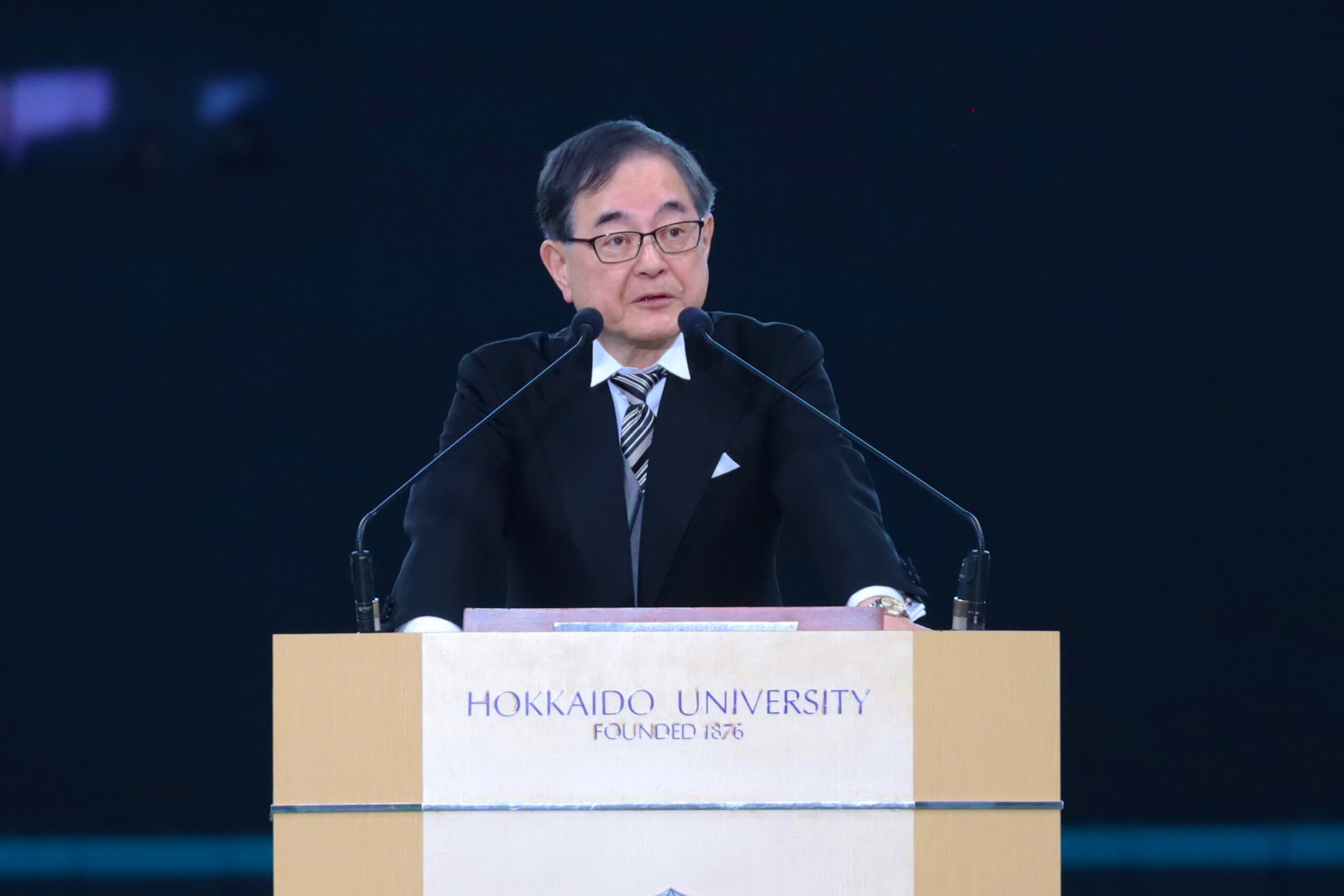
On behalf of Hokkaido University, allow me to extend my sincere welcome and heartfelt congratulations to all 2588 new undergraduate students embarking on a new journey at our esteemed institution. I'm sure there are many family members in the crowd today who are just as excited for the new students to take these next steps. Congratulations to you, too, for guiding and supporting these students to this milestone. Well done!
After my brief address, there will be congratulatory video messages displayed on the large screen with contributions from many people. I am sure they will speak of their high expectations for you as you join this prestigious institution at this historic moment, as we celebrate its 150-year history. I encourage you not to be intimidated, but to look forward to the new challenges that lie ahead.
There are several people in attendance today representing our esteemed partners in government and business, as well as many generous donors. I would like to extend my deepest gratitude to you for taking time out of your busy schedules to join us. I would, especially, like to extend my appreciation to Principal Officer Yuki Kondo-Shah of the U.S. Consulate General in Sapporo and Consul General Wang Genhua of the Chinese Consulate General in Sapporo. You honor us with your attendance at this momentous occasion.
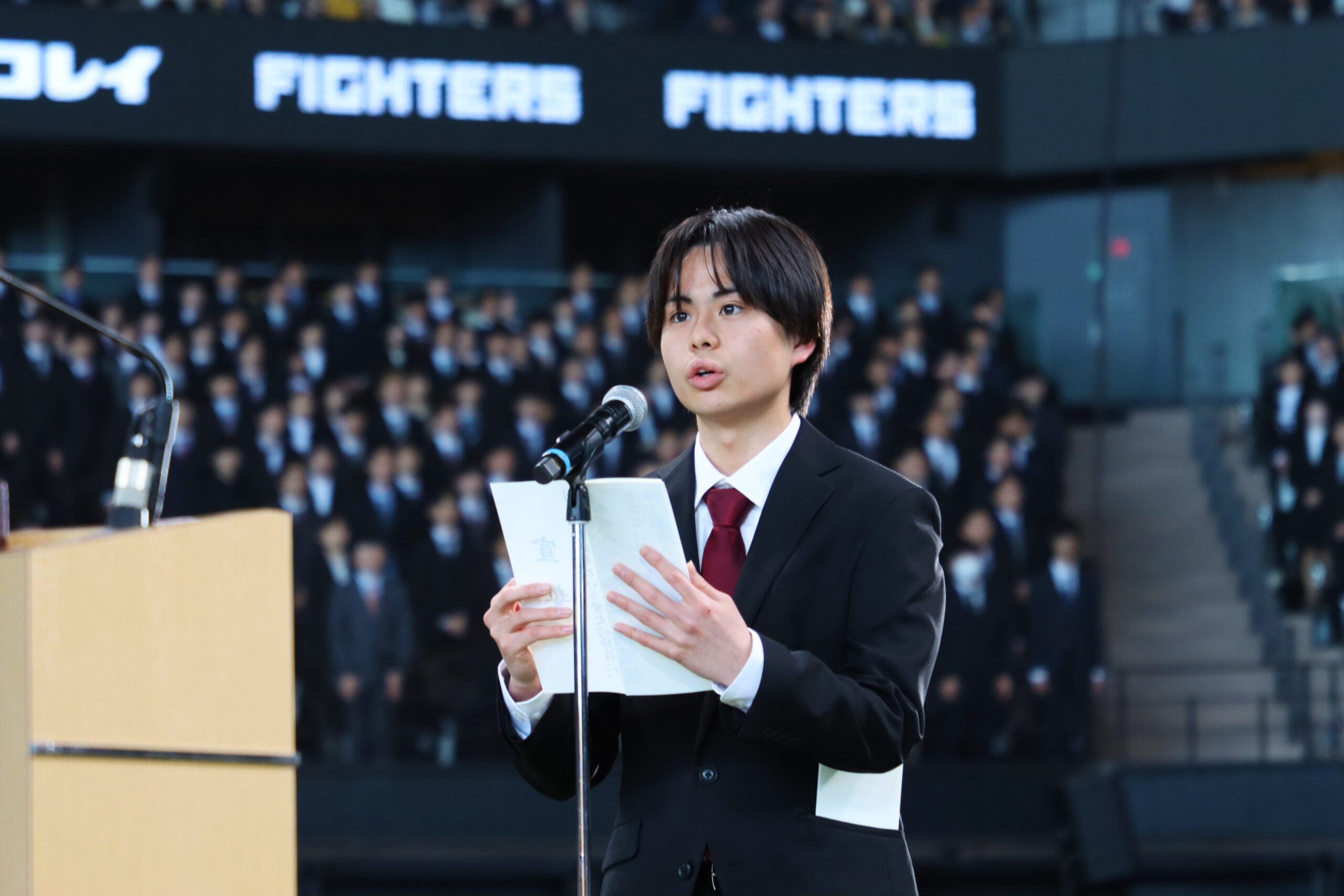
And while extending thanks is clearly up to bat, I would like to thank the Fighters Sports & Entertainment Co., Ltd. for allowing us to hold our entrance ceremony here during this incredibly busy season. Go Fighters!

Today marks the first time in our long history that we have held an entrance ceremony at Es Con Field in Kitahiroshima. The official Pacific League professional baseball games were held in this field until yesterday. Holding our entrance ceremony here, just one day later, is a challenge in itself, and we hope you will enjoy this unique experience with us today.
Now, I believe it would be meaningful to take a moment to explain why we decided to have our ceremony here in Kitahiroshima, at Es Con Field, and how it connects to Hokkaido University's history
Back in 1876, 150 years ago, in the 9th year of the Meiji Era, the Meiji government established Sapporo Agricultural College in its efforts to bring higher education up to standards on par with those of the institutions of the day in Europe and America. This college was one of Japan's first establishments of higher education and is the predecessor of what we now call Hokkaido University.
Sapporo Agricultural College based its teaching on the American-style liberal arts education model. Liberal Arts in this context simply refers to general education across a breadth of subjects. From the very beginning, the fundamental curriculum at Sapporo Agricultural College included not only the expected agricultural sciences, but also math, chemistry, biology, and even history and economics. Furthermore, a great number of these courses were taught entirely in English, which is genuinely impressive. Considering our current efforts to internationalize education at Hokkaido University, it's fascinating to think that the groundwork had already been laid 150 years ago by Sapporo Agricultural College - an institution clearly ahead of its time.
Since its founding, Hokkaido University has continued its liberal arts educational framework and, as a result, has come to hold tightly to 4 basic philosophies. These philosophies are: "frontier spirit," to explore new academic fields; "global perspectives," to respect diversity and become worthy global citizens; "all-round education," to lay the foundation for personal growth; and "practical learning," to return the outcomes to society.
With these philosophies ever present in the background of Hokkaido University life, we are also blessed to have a beautiful and diverse campus on which to continue fostering them. The beauty of the four seasons reflected throughout our campus truly brings to the forefront its exceptional natural diversity. Furthermore, with our campus in Hakodate, a number of regional research sites, and the largest research forest in Japan, our university is quite literally a major presence in Japan. It is perhaps through these environments that our philosophy of valuing diversity and sustainability has been shaped.
I would also like our incoming students to remember that, before the campus of Sapporo Agricultural College was built, this land was home to the indigenous Ainu people. Surrounded by the beauty of nature, our campus was a part of their everyday lives. We would do well to hold onto their memories as we move forward, remembering that our unique position in history allows Hokkaido University to champion the global goals of diversity and multiculturalism anew, so long as we remain aware of what lies behind us.
A sign was installed in March of this year near the main gate of the campus to express our deep respect for the indigenous Ainu people and their long history and culture, as well as our determination to pass our historical connection on to future generations. I encourage you all, when you have a chance, to go and take a look at it.
As one would naturally expect with the 150th anniversary of our founding as a university, this year we have several celebratory events planned at Hokkaido University. In fact, I believe it is fitting to include this entrance ceremony, held at Es Con Field, among those celebratory events. I'm sure I am not alone in looking forward to the many more events to come. Your attendance, too, at these events would be a great honor.
It will have been nearly 150 years, in April, since the first vice-president of Sapporo Agricultural College, William S. Clark, returned to America in 1877, leaving behind the parting words "be ambitious" to inspire future generations of Hokkaido University students. In fact, those parting words were uttered right here, in Kitahiroshima, as he was departing on his horseback while being seen off by the first cohort of students to grace our institution's halls. Indeed, this is a fitting place to welcome you, the new students of Hokkaido University in its 150th year.
Today, we are also passing out a booklet about the 150 years of Hokkaido University and its students. It succinctly outlines how our unique history as a university intertwines with contemporary history at large. We hope that as you read it, you will learn more about and come to appreciate this university.
At present, our world is on the cusp of change. With the advent of artificial intelligence, the speed of that change has been brought to the forefront of our everyday lives on a global scale, and there is no denying that the impact has been significant on our society at large. One might even say our world has seen more change in a short time than we could have ever anticipated.
Our human brains are recognized for their capabilities in three major areas: intelligence, emotional and aesthetic sensitivity, and philosophical and moral reasoning. Which begs the question, to what extent is AI capable of emulating these?
First, in relation to intelligence. Large Language Models have proven to be adept in production of human language, with all its inherent ambiguity, through various forms of writing. When used in tools to enhance education and study, AI developments have been rapid, and some even appear to have surpassed human intelligence in this regard.
What, then, does AI make of emotional and aesthetic sensitivity? Not long after their advent, some new Large Language Models emerged that displayed facility in rendering diverse data sets that one might consider to be productions of art, music, and video. Now the arts, long accepted as uniquely human pursuits, feel as if they have been invaded by AI.
And expanding towards the sciences, we see in recent years that generative AI known as Genomic Language Models, have emerged with the capability of reading DNA and RNA sequences, enabling them to analyze humans and biology itself.
In this way, it seems as if AI is fast encroaching on the powers of the human brain, especially in the domains of intelligence, in addition to emotional and aesthetic sensibility. In fact, in recent years, we have seen the development of autonomous AI agents and social media platforms made specifically for them, such as Moltbook, where these agents engage in discussions with each other.
Some people are even saying that it is only a matter of time until we have an AI with intelligence truly comparable to our human intelligence, known as AGI or Artificial General Intelligence. It would seem as if AI is closing the gap between itself and humans, even in things that require emotions or creativity.
With that in mind, all of us-including you, as well as our faculty and staff across all academic fields-need to fundamentally rethink how we cultivate our intellect, sensibility, and reason in order to thrive in this age of AI.
In this new age of AI, learning to properly own our human intelligence, emotional and aesthetic sensitivity, and philosophical and moral reasoning, and balance it against AI, will take deliberate cultivation regardless of the field in which you choose to specialize.
Whether you plan to go into humanities, finance, education, law, or one of the many other fields offered at Hokkaido University, your futures will be intertwined with politics, finances, education, and yes, even discerning how and when AI is used in your field. Likewise, for those of you pursuing engineering, science, agriculture, and aquaculture, AI will not simply be something other people have to worry about. Even now, in Silicon Valley, people with science and engineering backgrounds were among the first of those reported to have lost their jobs since the emergence of generative AI. Medicine, pharmacy, veterinary sciences, dentistry, and other biological and health science-related fields have also seen an uptick in the use of AI in diagnosis, treatments, and formulating medications. In this way, it appears that humans are being relied on less and less and AI more and more.
On top of this, an age in which AI can formulate and conduct experiments and then obtain and evaluate results isn't something in the far-off future; it may very well be now. Laboratories that don't rely on human researchers, known as "light-free laboratories" or Dark Labs, are emerging across fields of research, and some are even already in operation.
Perhaps I have breached a subject unsuitable for the hope that entrance ceremonies are generally defined by, but I ask you to bear with me, because I believe there is still hope. We humans, are still shown to have the upper hand when it comes to philosophical and moral reasoning. Despite the sudden changes we are seeing in society today, or the changes we may see in the next era, if we determine what we are capable of making with our own hands, I believe we can be confident in the future, however unknown it may feel. The job of the university will also be to take this unknown future head-on and revolutionize what we already do.
You are all positioned uniquely as forerunners in the era of AI and its use. It will be up to you to recognize where the potential in AI lies and to translate that into solutions to the challenges we face, such as declining birth rates, environmental concerns, or energy crises.
In the coming age, we face the potential for exciting new developments in human history, like long-term stays on the moon, and one day, perhaps, even on Mars. The widespread use of sustainable energy sources like nuclear fusion could pave the way for even more advancements, such as those in medicine, like new DNA therapies. Furthermore, in taking care of environmental issues, the establishment of systems to bring about stability in food supply doesn't seem all that far-fetched and could even usher in an era of world peace. Then there is us, at the center of it all in Hokkaido, working with the abundant natural resources the land provides to establish new industries. With all the growth and development we nurture, we are very much positioned to be a driving force in Japan, and in turn a shining example to demonstrate to the rest of the world what sustainable cities look like.
With our 12 undergraduate schools and 21 graduate schools, Hokkaido University is the largest comprehensive university in Japan. This positions us to provide the perfect environment for our students to be trained and equipped for the challenges the future may hold.
For those of you who are just beginning your studies with us, I hope that you will take advantage of the wealth of opportunities afforded to you at this institution. Through practical learning that embraces diversity, international perspectives, and the pursuit of truth, I believe that our students will be able to solve the problems facing our society.
Dr. Clark set out in the cold climate of Hokkaido to help establish advanced agricultural practices here. This was his ambitious challenge, and one set forth by the Meiji Government at the time.
Since then, 150 years have passed, and the challenge to develop advanced agricultural practices has evolved into the ongoing challenge to find sustainable food production techniques.
Now, with the emergence of the necessity for renewable energy and initiatives like that of Hokkaido Digital Park, which is aiming to launch new industries centered on semiconductors, Hokkaido University is in a unique position to take on a second Ambitious Challenge.
In this way, Hokkaido University continues to be a truly ambitious university where bold challenges are taken on to achieve innovations. Today's entrance ceremony is truly an Ambitious Challenge. If we-as a university, including the president, faculty, and staff members-do not challenge ourselves, we cannot expect our students to be ambitious.
At Hokkaido University, the "be ambitious" spirit has remained an unbroken thread weaving its way throughout our 150-year-long history. It is our hope that in four, six, and even ten years and beyond that, we will continue to rise up and equip students to shine brightly into the futures that are set before them. I sincerely wish you all the best of luck for your future. Once again, congratulations to all, and I wish you a fantastic new beginning at Hokkaido University.
Click the link below to read the transcription of the original Japanese address:
https://www.hokudai.ac.jp/president/greeting/25.html


