
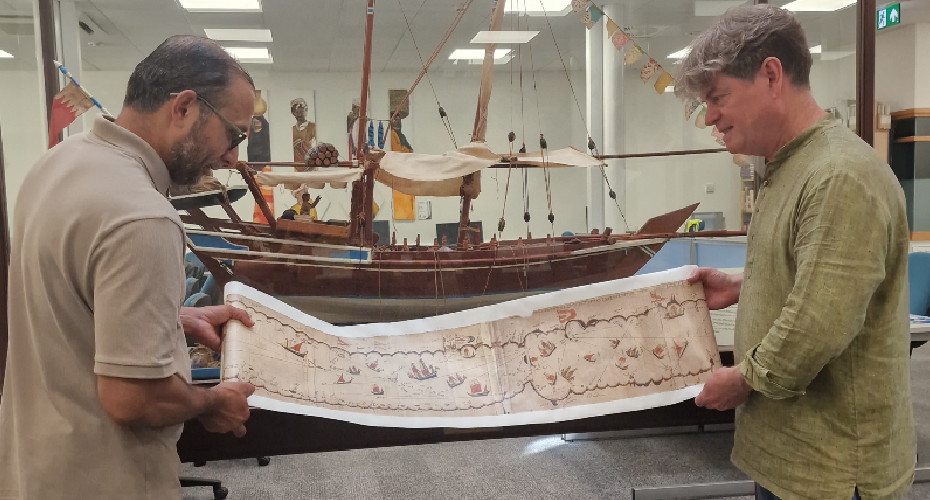
Experts have unlocked secrets hidden for two hundred years in a beautiful navigational chart made for 18th century seafarers negotiating the Red Sea and Gulf of Aden.
The paper scroll is evidence seafaring communities in the region used their own effective system of navigation that enabled trade and exchange between India, Arabia and the Horn of Africa in the age of sail, before the uptake of a more abstract, instrument-based navigation.
The Indian, Kachchhi/Gujarati, document has been part of the Royal Geographical Society's collection for 189 years and is one of the most detailed surviving indigenous navigational charts produced in the Indian Ocean tradition.
New research shows it was an effective aide memoire, capturing and reflecting the intimate knowledge of sailors from modern Gujarat in India. It is a window onto the indigenous navigational practices of people across the western Indian Ocean.
Researchers have been able to identify and interpret place-names and astronomical data inscribed on the chart for the first time, establishing latitude and providing sailing directions and showing intimate local knowledge: the chart was not simply designed to facilitate long-distance transit to first-order Red Sea ports.
The chart, which is adorned with beautiful images of ships and religious buildings, dates from the late 18th or early 19th centuries. It was acquired by Alexander Burnesin 1835 from an un-named sea captain in Kachch. He donated it to the Royal Geographical Society. However, he and subsequent scholars were not able to translate and analyze the map to extent that the current study has.
The 66 or so Devanagari place names on the chart have never been fully transcribed and identified and most European scholars who appraised the chart wrongly claimed that it had no latitude or longitude information. They also thought the fact it did not show the 'real' angle of the Red Sea and Gulf of Aden as a shortcoming when in fact it makes the chart more portable.
Experts have produced a projection of the chart that presents the information it contains spatially in a way familiar from modern maps.
The cartographer who made the document depicts more than 180 islands, plus reefs and other features such as landmarks, religious buildings and flags.
Alexander Burnes, who lived from 1805 to 1841, acquired the chart while lieutenant in the East India Company Service and assistant to the British Resident in Kachchh. Burnes had already won celebrity through his 1832 imperial expedition across Central Asia, which had resulted in a best-selling book,honours from London learned societies including the RGS and an audience with King William IV.
He declared it would "form a specimen of naval surveying … unequalled in any of the cabinets of Europe" and believed it had been a working document used on board ship. But he didn't realise it was a practical navigational chart.
The chart has been interpreted previously in 1947, 1987, 2002,2012 and 2022, but scholars have overlooked the chart's navigational affordances. Around half of the chart's Devanagari toponyms were left unidentified and without locations-with more still lacking precision.
Researchers believe they have now found coordinates for all 66 toponyms and improved transcriptions of the Devanagari script.
They have found that chart's 29 rhumb lines serve three main purposes: establishing the principal trend of a coastline; indicating a direction of travel across open water; and, in possibly two cases, showing safe passage into and out of port.
Professor John Cooper, from the University of Exeter's Institute of Arab and Islamic Studies, who led the research, said: "Today we are used to maps and charts that project space mathematically and to scale, making regions of the world visually familiar and accessible to us in a very particular way. Although this chart doesn't look accurate to our way of thinking, it allowed seafarers with the necessary experience and knowledge of stellar navigation to negotiate some of the harshest and most challenging waters in the world. All the required information was packed into a very portable scroll just 25cm wide.
"This is a rich and effective navigational reference work: its stellar information allowed sailors to know their latitude and set sailing directions; its many place names and topographical information enabled them to locate themselves precisely; its religious buildings suggest the navigator's Muslim faith; and its flags suggesting nodes of political and fiscal action.
"It was designed for those with specific local navigational knowledge. Although rich, the inscribed information would not be enough to enable people uninitiated in regional seafaring traditions to navigate safely. But, for those who knew, it functioned as a handy reference at sea, fulfilling a mnemonic role. Its scroll format allowed it to be opened partially, showing only the relevant section, with the rest rolled away. It stored and handled easily on-board ship."
Dr Katherine Parker, the Royal Geographical Society's Cartographic Collections Manager, said: "Re-examining our Collections is an ongoing process that allows researchers to apply new methods, technologies and perspectives, uncovering the meanings and utility that these remarkable artefacts held for the people who created them centuries ago. We have been delighted to work alongside the team to bring a greater understanding of the navigational, geographical and cultural value of this chart, as well as the cartographic skill and knowledge of its creators, into focus."


